Showing posts with label Stafford Cliff. Show all posts

Thursday, 4 June 2026

The New House Book I

     A day of sunshine and half-hearted showers; a blustery day with the trees just beyond the garden sounding like the sea.  A welcome return to normal weather.

     A return also to the world of Terence Conran, and his second big book of interior design: 'The New House book' of 1985.  My edition of the book is published by Book Club Associates; the original by Conran Octopus.  'English Style', by Stafford Cliff and Suzanne Slesin, was published the previous year and the difference could not be more marked.  Like the original House Book, this is a collaborative effort.  The usual names appear: Stephen Bayley, Gillian Darley, Susan Collier (of Collier Campbell), and the aforementioned Suzanne Slesin, and Stafford Cliff.  Cliff was the Project Consultant, and Hilary Arnold the Project Editor.
     So the mid-eighties, and many of us will have an idea of what that entails, a notion gleaned from journalism and the internet.  The same applies to the proceeding decade, as though 1970s decor comprised solely of garish wallpaper.  I cannot stress enough that since the end of the 18th century we have been in period of eclecticism.  So what do we find here?            Firstly, much that I wrote about the first 'House Book' (Mitchell Beazley, 1974) could equally apply here.  Those six categories of interior which were there as a guide for the perplexed remain, but their presence is by implication.  Secondly, let me say that not all the interiors on display are contemporaneous, some are the creation of the previous decades, centuries.  Realising also, that these images are a selection, an editorialising, so not entirely objective, it is still possible to make some general comments on what, it has to be said, is a very middle class selection.*  On the whole it is 'all done in the best possible taste'.  The outlandishness that was the hallmark of a certain strand of 60s/70s taste is largely absent.   An elegant sobriety rules.  After all, the interview with Conran which fronts the book is entitled 'A Taste for Simplicity'.  Colours are on the whole subdued.  There is a tendency to isolate items, endowing them some sort of signification, which may be the result of the increasing interest in the 'designer' object.  Many of the rooms are very serious, if not intellectual; austere to the point of loosing a sense of domesticity.  They are rooms of parade, not comfort.  As I have written before these sort of rooms begin to take on the quality of public space.  All that said there is much to admire.  The design of the book is excellent (with the exception of the Dust Jacket).  Perhaps those rooms which hint at the Mediterranean are the best.  You may recall that 'Mediterranean' is one of those six categories of the original House Book, and is one that in this book Conran sought to emphasize, it being the only one mentioned in the introductory interview.
     Unlike Habitat, this Conran publication happily takes Post-Modernism in its stride.  One of the reasons, I think, that things went a bit awry at Habitat in the 80s was the inability to come to terms with the change in taste in the late 70s.  Perhaps a bit strange that, as I believe, and I'm sure I've said this before, it is possible to make a case for Habitat being in a state of eclecticism if not Post Modernism since its inception.  It was always a bit of a dressing up box.  This book is no different.


* A book like this is a complex enough thing; at one level it functions as a survey of contemporary taste, but it is also in a quiet, polite sort of way, a polemic, and a manifesto.  And that's before we get to the book as 'Apologia Pro Vita Sua'.

Saturday, 30 November 2024

'English Style'

      This book, 'English Style', is to be found nestling in the bibliography at the back of Ben Pentreath's wonderful first book 'English Decoration'.  Although keeping a lazy eye out for other books on the list, I always felt a certain reticence about buying this book.  I think I may have been put off by the images of the book online, but I must say in the flesh this book is in many ways superb, a real delight.  The photography, by Ken Kirkwood is absolutely spot-on.  There are interiors by likes of David Hicks, Bernard Nevil, Charles Beresford Clarke, and Terence Conran. If I was feeling particularly cynical (which I often am these days) I might say the usual suspects.  Certainly if, like me you have a (small) library of this sort of book, then you can guarantee that certain people, and certain properties, such as The Temple at Stoke-By-Nayland, will reappear with pleasant regularity.  To leaven things there are, however, some new names to conjure with: Priscilla Conran, Piers Gough, Brian Henderson, Lesley Astaire, Tricia Guild, and Susan Collier (of Collier Campbell).  I could go on.  Anyway, in all there are some 58 entries or short chapters - short on text, but rich in photography.  In addition, there is both a Forward by Terence Conran and a Preface by Fiona MacCarthy. Both are good, but the latter steals the prize. Although this is a book essentially about the English house, the net is cast wide enough to include a gypsy caravan and a narrow boat. (They are, it has to be remarked, the only working class interiors.) In addition, there is even, perhaps oddly, one garden.  The result is an eclectic, seemingly encyclopaedic book.  Regardless of any claim to the latter, it is certainly an embarrassment of riches, happily swinging between austerity of Minimalism and over abundant bricolage.  Minimalism apart this is essentially a conservative book, rather like Habitat (for all its vaunted Modernism).  As the Introduction points out the short efflorescence of the Sixties - in its wilder moments - had little lasting influence on English style.  There are no inflatable Italian furniture or Pop Art graphics on view here, and I see nothing necessarily wrong with that.  Not only is there an almost innate conservatism on display but also a certain seriousness, that I suspect could verge on the high minded.  An at times distant echo of 17th century Puritanism, perhaps.
     'English Style', not to be confused with that excellent book of the same name by Mary Gilliatt and Michael Boys*, was first published in the US by Clarkson N Potter Inc of New York, and then in Britain by Thames & Hudson in 1984.  It is the work of Suzanne Slesin and Stafford Cliff, who was also the designer.  The former an American, the latter from Australia.
     Slesin, a grand stepdaughter of Helena Rubinstein, is a prolific writer on matters of style and design: she worked at the New York Times as both writer and editor, and is currently design editor of Conde Nast House and Garden, and Editor-in-chief of Homestyle. Among her books is a biography of Helena Rubinstein: 'Over the Top: Helena Rubinstein: Extraordinary Style, Beauty, Art, Fashion and Design'.
     Cliff, as you may well remember from earlier posts, was the designer of 'The House Book' of 1972 and the Creative Director of the Habitat catalogues in the 1970s.  At time of publication, he was 'Creative Director' of the Conran Group, and 'Project Consultant' of 'Terence Conran's New House Book' of 1985.  Slezin contributed the chapter 'One Room Living', Susan Collier 'A Sure Sense of Style'.  Stafford and Slesin subsequently worked together they worked on a number of books: 'French Style'. 'Greek Style', 'Indian Style', and 'Grimsby Style'.
     So far so good.
     However I have a number of reservations about this book, which in 1984 was subject to a scornful and dismissive review in the December edition of the 'World of Interiors', some less trivial than others.  Firstly the design.  On the whole it is very good.  I particularly like the use of a different textured paper for the 'supporting cast' - the introduction, the 'Catalogue of Sources', and the Index, etc.  There is a logic to it.  However the last two pages of the Introduction are in the same glossy paper as the 'main feature'.  A small point, I know, but some consistency would be preferable.  I suspect a technical explanation, which is fair enough.
     My main reservation however lies with the text of the Introduction and its ambition - and, indeed, the ambition of the whole book.  I realise that all books of this sort are subjective in their choices - the omitted (alas, no Angus McBean) are perhaps as telling as the included - but the authors go further than usual by attempting to cement Habitat and the whole Conran phenomenon in the mainstream of British art and design, as inheritors of the 'great tradition'. There are two problems with this; firstly, the writers are too close (being part of the Conran cohort) to be completely objective; and secondly, and I think, shamefully, there is an attempt to do this by denigrating the opposition i.e. Laura Ashley.  A tame academic from the RCA is even brought in at this point like a hired assassin to wield the knife.  And that, to me at least, all seems a bit unnecessary.  
     Truth is, I suspect, that 'English Style' is in all but name a Conran production - at least a half a dozen of the interiors catalogued here are owned by people closely connected to TC, including the home, 'Old House, Informal Mix', of one of the photographers who worked on the 1985 Habitat catalogue - same furniture in the same positions in both publications etc.  
      The result then is not what you might call objective however it is a thing of beauty, and utility.  A very useful visual and historical reference to an eclectic, and interesting, period in British interior design.


* Little in the way of inflatable furniture etc. there either.


Monday, 16 September 2024

The Habitat Catalogue V: 1981/2

     So here I am with yet another vintage Habitat catalogue.  This time from 1981.  A rather jaunty cover, mainly blue and yellow, busier than before with just a smidge of vulgarity.  The aesthetic has changed - more sharper and hard-edged, less homely.  That change detected in the 1978 edition continues to grow.  It could be said however that the covers are at variance with catalogue interior, which tells a slightly different story, in that it is more evenly balanced between the new hard style and the old 'humanism'.  In fact, some of the images, say of the 'Arbour' bedroom range, look like they've been used in earlier editions, however the presence of a new wallpaper range 'Kandi' on the wall shows that the image was taken specifically for the 1981/2 edition. Habitat as evolutionary, and perhaps even conservative.  As for the eclecticism of earlier catalogues, apart from the lighting, Art Deco Revival has disappeared, as have the Liberty prints, but the Laura Ashley inspired 'ditzy' print 'Tangleweed' remains.  Brown is on the way out and there is an increase of bright primary colours and pastels, with mixed results.  The best of the new fabrics is 'Fleur des Champs', but all the other new fabrics are discarded by the time of the 1985 catalogue.  There are no Collier Campbell fabrics in this edition.
     One of the delights of the Habitat catalogue are the little extras in the way of articles.  This edition has four written by members of the Conran stable such as Stephen Bayley* (Bauhaus furniture), and Antonio Carluccio (Italian cooking).  I guess, in a way, it makes Conran seem like Henri Gautier Villars.
     Several of the new style home sets, it has to be said, are really quite awful. The worst is the room created by Stafford Cliff; perhaps not bad in itself, but hardly domestic.  More suitable for a commercial space. Born in Australia, Cliff, I should remind you at this point, had been the Art Director of the Habitat Catalogue for 10 years from 1971; this then could be either his final catalogue, or the first without him.  I know that this is tantamount to heresy, but I'm that not that impressed with the room set designed by Terence Conran either.  It just seems a bit tired.  The work of a man with a busy schedule and little time to spare. But then, I suppose, Habitat seems to have quite the history of bad design**, in the same way it was quite good at simulacra.  Anyway, the good....


The bad....


 And the strange....


*  Described once as 'Robin to Conran's Batman'
** For example, pattern design, which, on what ever surface, was always a bit of a weakness.


Monday, 29 August 2022

The Habitat Catalogue IV: 1976


     Well, I have to admit that I've had this vintage Habitat catalogue for a while now, and only now have I got round to actually posting it. To be honest I found it a little bit of a disappointment when it arrived in the post, it being not quite as stylish as I had hoped. Anyway my collection of vintage Habitat catalogue quietly grows. Still there are some nice images - some of which were photographed at Terence Conran's own country house, Barton Court in Berkshire. I particularly like the Deco-ish sofa that graces the front cover.


Thursday, 16 January 2020

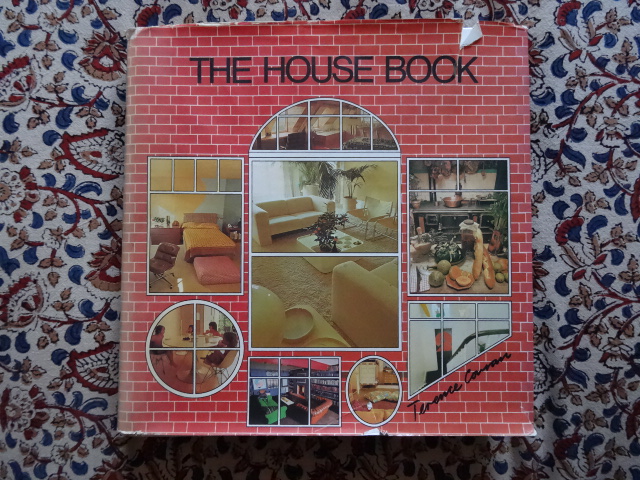
The House Book I

     Well, I've been meaning to write a post about this book for a long time, and by 'a long time' I mean 5 years....since when on our holiday in Norfolk I found 'The House Book' in the secondhand bookshop run by the Bure Valley Railway at their station in Wroxham. It was a book I had been looking for for some time. It is hefty tome, choc full of photographs of then contemporary interiors. A surfeit of images and ideas. And that is one of this book's fascinations; it makes for an excellent record of British middle class taste in interior design in the late Sixties and early seventies. (London centred at that.) And it is heady stuff, bold and intense. Confident. A startling contrast too to the prevailing sense of failure and dissolution that began to swamp Britain at the time. I find it a perennial inspiration, and have given copies of it as gifts to those I know who are setting up home.

     But I'm getting ahead of myself here.

     This encyclopaedic, heavyweight tome was published by Mitchell Beazley in 1974, and it bears the imprimatur of Terence Conran, though how much of the text is actually by him is open to question - there is a long list of contributors at the beginning. Perhaps it is best seen as a collaborative effort of a team of writers and designers in the Conran orbit - the design of the book, for instance, was not the work of the publishers but 'in-house' at Conran Associates.  Stafford Cliff, also the Art Director of the Habitat catalogue in the 1970s, was the designer.
     Whatever the truth, 'The House Book' was one of the ways that Conran became known as was one of the major arbiters, and shapers, of Post-War Middle Class taste in Britain. And I think it was a very bourgeois project for all the talk of the democratisation. Conran is rather like the British cookery writer Delia Smith in that they are both interpreters, and indeed re-packagers, of high style to the new (and therefore uncertain) Middle Classes. (What this meant in effect was they took the ideas of, say, the British cookery writer Elizabeth David (1913-1992) and made them accessible.) Both Conran and Smith therefore stand in the tradition of Mrs Beeton the famous nineteenth century cookery writer, that exhaustive guide for the newly bourgeois. 
     Anyway what Conran did in the terms of retail, i.e. Habitat which he founded in 1964, was all very aspirational. All those room sets in 1970s Habitat catalogues craftily contained the element of unattainability - yes, of course one could easily buy the furniture etc, but the rooms invariably contained decorative elements that were not so easily affordable or available. Things, one might argue, that were only available to the metropolitan initiate. It was all very clever - simultaneously to satisfy and feed the desire. To leave the consumer oh so hungry - eternally hungry, eternally insecure - for more. Consumerism as way of achieving group identity.

      Well, The House Book is, thankfully, rather less hard sell than that. One could call it neutral in that respect, though one suspects plenty of Conran design projects on display. It is also deeply practical, as well as frankly beautiful. (I always feel that one of the major influences on Conran is that French art of living - L'Art de Vivre, that is such a joy and fascination in French literature.) There are sections on all sorts of things you need to know to run a house well, but perhaps the most telling section is at the beginning of the book when the uncertain amongst us are taken gently by the hand and given six design templates to follow: 'Farmhouse', 'Townhouse',' Country House', 'Mediterranean', 'International' and 'Eclectic'. Six consumer choices, six items from the dressing up box. Anyway the book is full of images of work by any number of favourites of this blog: Geoffrey Bennison, David Hicks, Mary Gilliatt, David Hockney and his assistant Mo McDermot, and Alvilde Lees Milne. Anyway enough said - here are twelve images for your delectation and delight.  More to follow.