Showing posts with label Vale of Glamorgan. Show all posts

Monday, 11 May 2020

Better late than never: St Cadoc, Llancarfan

     You may remember last year, about this time actually, the bf took me into the Vale of Glamorgan to look at a church, and how I felt I couldn't even bring myself to discuss the church let alone share my photos with you. If you can remember I was snapping away happily in the church - a church, I should remind you has received any amount of Lottery Funding to make it suitable for tourists - only to find an A4 notice pinned to a notice board inside the church stating that anybody wishing to post any image of the church online had to receive permission from the PCC or equivalent thereof. Utterly absurd. And shameful. How for instance were they going to police that? Anyway, emboldened by a recent conversation on twitter, here are the photos I took.

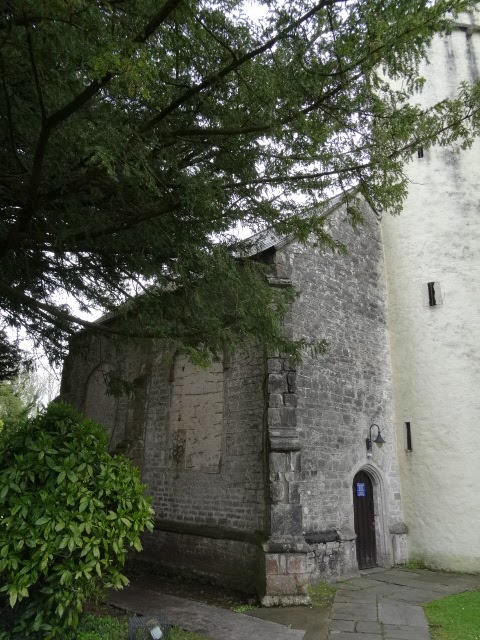
     Village and church nestle in a wooded valley - hard to think that we are not that far from Cardiff. The church, with those characteristics of Medieval Welsh churches - twin naves, no clerestory, austere unbuttressed tower - is very attractive, a bit beyond the ordinary. And that sense of being a bit beyond the ordinary continues within, for St Cadoc holds a couple of treasures, both of which are not quite apparent when you walk in, for Llancarfan church opens up to the visitor like a flower, atmospheric and accretive like all good country churches should be. The architecture is uneven and full of incident. There are old floors, whitewashed walls and at the far end of the s aisle a tall medieval screen all drawing in the visitor so that they can miss the immense late medieval wall painting of St George looming over them in all his pomp and pageantry. That, a recent discovery, is the first treasure. Step through the arcade into the nave and there in the chancel is the second treasure - the remains of a wooden Perp altarpiece. A rare survival. Equally astounding is the vast window in the N chancel wall that lights it.
     In the mid 20c George Pace came this way. He is an architect for whom I have a deep sense of ambiguity. He was capable of great sensitivity particularly when dealing with an ancient building but equally capable of producing the most rebarbative work imaginable. Thankfully his work here errs toward the former rather than the latter as at Spalding in Lincolnshire where the organ case is utterly atrocious. The outer doors of the porch are rather lovely, rather Arts and Crafts and will continue to improve with age. The s chapel furnishings are a mixed bag - the best things are the pews. As to the High Altar I will swiftly pass on.


Friday, 17 May 2019

Vale of Glamorgan

     We've been out on a mystery tour, thanks to the bf.  We headed west along the M4 (while I came up with ever wilder guesses as to our destination - the 'Pobol y Cwm Experience', the 'The Esma Cannon Museum'?) and into the rather posh Vale of Glamorgan. I was in the need of cheering up and the bf knew what would help, and after traversing some ridiculously narrow country lanes (thanks to the sat-nav) we arrived at the village of Llancarfan and the church.
     And here the narrative ends, except to say that there was I happily snapping away inside only to espy a notice stating that to post images of the church, even on social media, one had to seek permission from the PCC, which seems an inordinately and ultimately futile way of controlling images of the church, and one I won't endorse by applying.

     Our second port of call was eminently middle-class community of Cowbridge, a linear community along what was once the main road west out of Cardiff.  It has a not inconsiderable charm. The church, dedicated to The Holy Cross, is a big muscular sort of building, but was actually a chapel-of-ease to Llanbethan.  It forms an interesting grouping with the Grammar School and town gate. The interior highlights the problems of both using and spatially unifying a structure that was built for a standing, not sitting, congregation. It is also an example of what one could call civic Anglicanism - something that tends to leave me cold.  First however let's start with the exterior which is varied and interesting. The brooding, defensive-looking central tower dominates.  The double nave is long and low - in common with many Welsh churches the clerestory is absent - the windows are all Perp.  The E end is complex, even picturesque, with chancel, N chapel (with blocked windows) and deeply projecting vestry.  The inside is more varied still consisting of essentially three disparate spaces: nave, tower and chancel.  The former chancel chapel is screened off and closed off which is a shame as it would add a welcome unexpected element to the interior.  The best things are the mural monuments and the inner door of the porch by George Pace on his best behaviour, and is really quite sensitive. It should look even better with age. Otherwise it is far too dark and there is too much semi-secular clutter.  The fine spaciousness of the nave with its elegant perp arcade deserves better. It would benefit from a wholesale removal of pews and a re-flooring in stone.