Showing posts with label The Barber Institute of Fine Arts. Show all posts

Sunday, 31 December 2023

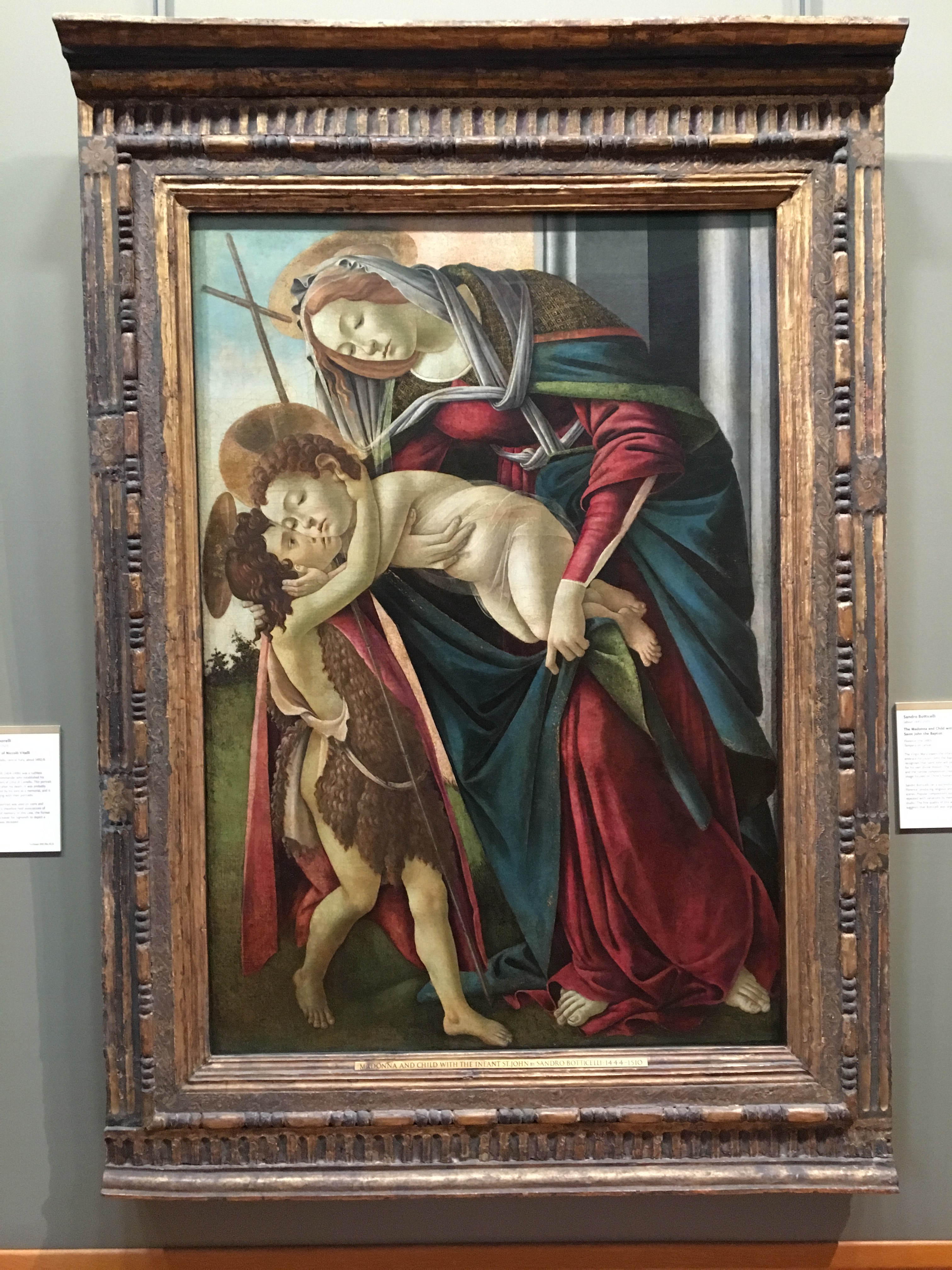
Madonna and Child with the infant St John the Baptist

 St Sylvester, 31st December, 2023


     It is the final day of the Octave of Christmas, what in Orthodoxy is termed the Apodosis - the 'Leave Taking'; and I thought I'd conclude this little sequence of paintings with this arresting image: 'The Madonna & Child with the infant St John the Baptist' attributed to the Renaissance Florentine Master Sandro Botticelli, (14415-1510).  It currently resides in the Barber Institute in Birmingham.  Sadly, the Institute, unlike the Fitzwilliam Museum, does not list provenance online.

    The painting depicts the meeting of the infant Christ with St John the Baptist, a subject that seems to have been continuously popular with artists in the Middle Ages and beyond. It is however an event that is apocryphal but not impossible.  There is a near identical painting that, according to Wiki, is in the Palazzo Pitti collection, though it is not listed in the online gallery collection.  It is the mirror image of the painting in the Barber.  The colour of the Barber painting however seems, to judge by a comparison of photographs on the internet, to be the more sombre.  Both paintings seem a long way from the usual 'sweetness and light' Botticelli style. The extraordinary element lies in the composition which seems to echo depictions of the adult Christ's Deposition from the Cross.  Christ appears as one dead. 

Saturday, 30 December 2023

Madonna and Child with Bird


      Something rather different today.  A sculpture, 139x95cms, undertaken in glazed terracotta in Renaissance Florence.  It is the creation of the workshop of Giovanni della Robbia, (1469-1529), son of the much better known Andrea della Robbia.  Today it is on display in the foyer of the Barber Institute (part of the University of Birmingham), but it was originally made for a monastery (and I have no idea which) located in Castellina near Florence. I took the photograph way back in 2017 when I made my first visit to the Institute.

     The sculpture is in the form of an aedicule (from the Latin meaning 'little house'), essentially a small shrine.  It is an example of those ways in which Classical Antiquity was adopted and adapted to fit a Christian context.  The term 'tabernacle' might be used today.  The aedicule is of the Corinthian order supported by a winged cherub's head flanked by two cornucopia profusely sprouting foliage, fruit and pine cones.  The profusion is repeated in the sunk panels of the Corinthian pilasters and cornucopia replace the volutes, the 'helices', in the capitals. Indeed, the whole 'architecture' of the aedicule is highly decorated, most particularly the frieze of the entablature which echoes the ornamentation of the support with alternating cherub heads and foliage. The cornice is itself is a little simplified, omitting the brackets/modillions (for technical reasons?).

     The visual and devotional heart of the aedicule is a relief sculpture of the Theotokos and the Christ child contained in a thin arch decorated with 'egg and dart'. She placed centrally, Christ to her left. Both are standing - the Virgin Mary is three quarter length, Christ full length.  Both the figures occupy slightly different positions in the 'picture' plain - Christ, who is standing on the 'sill' of the arch is in the foreground, his mother slightly behind, her lower half partially hidden by the architecture. Christ's right hand is raised in blessing, his left hand, which is held above his heart is holding a small bird.

     The work of the della Robbia family has an immediate appeal to the viewer.  I particularly love the tondi, which are used so successfully to decorate the exterior of so many Renaissance buildings in the city and also the dazzling ceiling of the Chapel of the Cardinal of Portugal attached to the north aisle of San Miniato del Monte also in Florence. In the Madonna and Child with Bird, which is so scaled as to suggest a devotional use, I love the freedom with which the Classical language of architecture is handled. 

    Is the bird in the infant Christ's hand, I wonder, a reference to the legend of the infant Jesus making birds from clay and then giving them life?  The story occurs in the Infancy Gospel of Thomas.  The legend later occurs in the Quran and in Medieval Jewish writing.  Although entirely apocryphal it was, like stories from the Proto-Evangelium of James, a very popular subject for Medieval artists.  If it is then it is some sort of comment on the work of della Robbia as a sculptor in clay and by extension to work of all artists.
Saturday, 15 April 2017

Back in Birmingham I

   The bf and I sent part of this week visiting my family in the West Midlands.  On Wednesday we had a full day in Birmingham.  We started with a visit to the university and specifically 'The Barber Institute for the Fine Arts', which was founded in 1932 by Dame Martha Barber after the death of her husband Henry Barber, the Birmingham solicitor and property developer.  The University campus is visually a mess, but at its centre is a great hemicycle of buildings designed by Sir Aston Webb (1849-1930) in an amazingly eclectic style - part Byzantine, part Perpendicular Gothic, part Flemish.  Wholly original.  Wonderfully detailed - like all buildings of that date.  Red brick suitably enough predominates.


     Opened in 1938 the Barber is also a building is hard to nail down stylistically - part Classical, part Art Deco, part Viennese Secession.  The architect was Robert Atkinson (1883-1952).  The best things on the exterior are the strange ventilation towers.  Worth comparing too with the Aston Webb buildings to see the change in taste in little more than a generation.  The interior is full of lovely details, though everything seems curiously flat but very refined; the third dimension is somehow conspicuously lacking.  Anyway at the heart of the building is an auditorium, while wrapped around that central space is, at second floor level, an art gallery with a small(ish) permanent collection that is really very good.