Showing posts with label Art. Show all posts

Wednesday, 15 July 2026

An Artist of the Golden Age: Zurbarán at the National Gallery

     
      Los santos se han de pintar de manera que no quiten la gana de rezar en ellos, antes pongan devocion pues el principal efecto y fin de su pintura ha de ser esta.

     Back to my flying visit to London the other week, and after I had photographed the Comyn Ching Triangle I headed off to The National Gallery in Trafalgar Square and the current exhibition of work by the Spanish artist Francisco de Zurbarán (1598-1664).
    This was my first in depth encounter with his work, and for that matter, with the exception of Picasso, any Spanish Art of any period.  I think I may only have encountered Zurbarán's work in reproduction to be honest.  I can only therefore describe this exhibition as a revelation.  An intense, at times profound, experience, with the visitor immediately plunged into devotional world of the Spanish Counter Reformation.  The world of the Spanish Mystics, of St Theresa of Avila, St John of the Cross, and St Ignatius Loyola.  What you might think of as the unseen engine of this exhibition.
     Confronting the visitor is a monumental depiction of the Crucifixion - the earliest signed work by Zurbarán - Christ is near to death, the darkness has come upon all the earth, blotting out everything. He is naked save for his brilliant white loin cloth, and his is alone.  Alone as forlorn, alone as the sole focus of devotion.  It is said that his contemporaries thought they were viewing a sculpture, not a painting.
      And then, to the right, there is the breath-taking 'Martyrdom of St Serapion' of 1628.  The saint, who came from the Great Britain and was martyred for his ransoming of Christian slaves in North Africa and is depicted, dressed in the habit of the Mercedarian friars, hanging by his wrists, head on one side, heavy with either exhaustion or death. In reality he was crucified and his body hacked to pieces.  To be honest I don't think I've ever seen a painting quiet like it, the composition is so unusual.  Both paintings point to Zurbarán's supreme mastery of fabric.  In the martyrdom it is almost all fabric.

     Francisco de Zurbarán was born in Fuente de Cantos, in Extramadura, at the mid-point of the Golden Age - the Siglo de Oro - a roughly two hundred year period marked at one end by the completion of the Reconquista, and Columbus's first voyage to the New World, and at the other the Terminus ad Quem of the Treaty of the Pyrenees of 1659, and (according to some historians) the Terminus post Quem of the death of the dramatist Pedro Colderon de la Barca in 1681. A period not only of Spanish military and political dominance in Europe and beyond, but a remarkable expansion in the arts and architecture.  Zurbarán's working life was spent mainly in the city of Seville, a place that was both provincial (a long way from the artistic centres of the Italian Peninsular and the Low Countries) and the hub of trans-Atlantic trade between Spain and her empire.  There was, therefore, a lot of money to be spent on art.
     To put him into an artistic, and European, context, Zurbarán was born, lived, and died  during the nascence of the Baroque, when the city of Rome underwent an extraordinary century long transformation. Bernini was his exact contemporary. In Spain, El Greco had died when Zurbarán was sixteen, and Velasquez, Murillo were near contemporaries.  And yet, except for the possible influence of Caravaggio,* Zurbarán seems hardly touched by any of this.  He eschews the writhing ecstasy, the effulgence of sensation.  And, as pointed out by Jaspreet Singh Boparai, writing in The Spectator (25.4.26), he eschews blood.  Zurbarán's art, in contrast, is sober, possessing an austere spiritual intensity that seems to look back not only to the High Renaissance, but the Late Medieval Art of the Low Countries.** His figures have heft.
     All of this is not so far from 'estilo disornamentado' - aka the Arquitectura Herreriana - the architectural style developed by Juan de Herrera during the construction of El Escorial, the vast palace complex commission by Philip II outside Madrid.  Like the painter, the architect before him rejected the excesses of Mannerism, retaining a preference for the High Renaissance, and like the painting the architecture has a lingering sense of the Gothic. What was produced by these men was a sort of distilled creation, shorn of the extraneous.  Zurbarán's use of tenebrism is, perhaps, part of that process of elimination.

     To return now to the paintings.  The second room (there are seven in all) contains the single picture in the exhibition I actively disliked.  (There always had to be one.)  'The Virgin of the Rosary with the Carthusians', 1648-9.  It hangs between two other paintings, 'The Circumcision' and 'The Adoration of the Magi', which together formed a single tier from what must have been a colossal altarpiece, commissioned by the Carthusians of Jerez de la Frontera.  'The Adoration' I particularly liked.  A fine composition, rather Netherlandish.
     The third room contains of what you might term religious portraits - virgin martyrs in beautifully rendered contemporaneous costume and two depictions of St Francis of Assisi.  One, of St Francis standing, is often used to exemplify Zurbaran's work.  Justifiably so.
     Movingly, in the fourth room, a group of three immense crucifixions, and on the wall opposite two Assumptions of the Virgin Mary. In the fifth, some rare secular work, particularly three (?) paintings from a series of seven of the Labours of Hercules.  Opposite two of larger series of the sons of Jacob, on loan from the Bishop's Palace at Bishop Auckland in County Durham, where they grace the Prince Bishop's State Dining Room.  I think they were the first of Zurbaban's paintings to arrive in Britain.  They are quite different in tone from the Labours of Hercules, and from a lot of work in the exhibition, what with their exuberant costumes and colouring.  And then there is the Giant Head - an enormous painting of a man's head that has relatively recently been accredited to Zurbarán, placed as to visible from the other end of the enfilade in room 3  It's rather compelling.  If not strange.
     In contrast, the exhibition concludes with two rooms given over to small works; still-lives & devotional works. As the popular reworking of a saying of St Theresa of Avila has it: 'Dios anda entre los pucheros.'***  These still-lives illustrate, for me, a recuring element in Zurbarán's work, a sense of distance, if not unreality, which occurs also sometimes, say, in the work of David Hockney.  A sort of disengagement, that seems particularly strong in the pictures of fruit (invariably lemons) in baskets.  Though obviously painted from life there is an air of detachment about them that could be due to the strange use of light and colour. A juxtaposition of hyperreality of the lemons and the almost schematic treatment of the basket.  In general there is a recurrent strangeness, an awkwardness if you will, about Zurbarán's work that sets it apart, and sometimes disturbs the viewer.

      We are also introduced to the work of his son Juan de Zurbarán, particularly his mesmerizing still-life 'Plate of Grapes', of 1639, painted when he was a mere 19 years old.  Masterly.
 
*       Zurbarán has been called the 'Spanish Caravaggio' from his masterly use of chiaroscuro.  However, it seems unlikely that he had any contact with the art of Caravaggio.  It has been suggested that 
**    King Philip II was avid collector not only of Venetian Art, the art of the Low Countries.
*** 'God moves between the pots and pans.'

Friday, 12 June 2026

David Hockney (1937-2026)

     I am writing this an hour or so since the announcement of the death of the British artist David Hockney, and I must that admit that in that time I have been feeling a bit emotional.  Oh, nothing that heavy - no tears, no wailing nor gnashing of teeth, just a sense of loss and the sense of a door closing upon a world.
     His was a very full life beyond the capabilities of most of us.  Not only an artist, in quite a range of media, but a printmaker, a designer for the stage, photographer and occasionally a writer. He leaves behind a large corpus of work for the art historians to mull over in the future; the embodiment of the Protestant Work Ethic.  He was after raised in a Methodist family.  Some of this work is perhaps not as good as other work; there was sometimes a risk of banality.  And I find a lot of the work done in the 80s harsh and rebarbative. And I'd rather pass over the stained glass window he designed for Westminster Abbey.  And yet, with such a voluminous body of work over so many years it could not be otherwise.
     For me his greatest periods (there were two) were, firstly the Late 60s and early 70s when he first discovered California, and his art took off in a new figurative direction, and then brought back to London, not only his then boyfriend & muse Peter Schlesinger, but what he had learned under that bright West Coast Sun and applied it to a slightly shabby, down-at-heel, but culturally dynamic London.  It was the time of Jack Hazan's film 'A Bigger Splash', and Schlesinger's book 'A Checkered Past'.  Of mixing with the Beau Monde.  A time of large canvases -  'Portrait of An Artist' and 'Mr & Mrs Clark and Percy', and at the other end of the scale of a series of ravishing pencil-crayon portraits of friends and lovers that are quite masterly.
    The second is marked, after a long sojourn in California, by his return to England in the 1990s, to the landscape of the East Riding and particularly the Yorkshire Wolds. It sparked a period of creativity that had lasted until his death; one that saw the most exceptional creativity and growth in him as an artist.  The creation of huge monumental artworks both painting and new media, as well as the most intimate, using an i-pod.  His ability to work on both scales was something, perhaps exceptional, as was his ability to find a subject matter everywhere and in everything, which suggest an almost inexhaustible curiosity.  He was also, I suspect, what one might call, an intellectual artist.  I suppose in this post I might have depicted him as an almost Romantic artist in his response to his environment; he was an artist who was always deeply aware of the history of art and the craft of art.
    A few minutes ago I was sitting drafting this post long-hand, sitting at the kitchen table, on which stands a most Hockney-ish object - a vase of tulips.

Tuesday, 21 April 2026

The Queen Elizabeth II Memorial, part 2: The Triumph of Mediocrity


   Yes, just when you thought it was safe to go in the water....


    Today marks what would have been the Queen Elizabeth II's hundredth birthday.  So, with a rather muted fanfare the final designs for the Queen Elizabeth II Memorial in St James's Park have been placed before the public.  Well, I think I might be rather muted if this is the best that we can do.  The images are from the Cabinet Office, and they cannot even manage to spell 'Commonwealth'.  I really shouldn't complain about this because, as any reader of this blog will have seen, my spelling is, at times, atrocious.
     Anyway, this morning X, nee Twitter, is mildly a-flutter with posts about this, and the tweeters, including myself, are not happy.  There is a sense that the design, which promises to be 'more than a landmark'. does the Late Queen a disservice.  People have been voicing their disappointment that there will be no equestrian statue of her Late Majesty, as illustrated in Foster + Partners submission.  Sadly, it was never that likely, I think - the five designs that went out to public consultation were merely in the way of an 'Early Proposed Design Concept'.  As Foster + Partners later(?) admitted the equestrian statue was merely there for 'scale'.  As I wrote in my previous post on this project, consultation was a P0temkin exercise.  Not only that, it was highly misleading. People supported the Foster scheme on the assumption that a) it was a serious concrete proposal and b) they were going to get an equestrian statue.
     So, what are we likely to get? Well, thanks to Foster + Partners and Lord Janvrin and his committee* we shall have the following: On the Mall we have a bronze statue of the Queen, by Martin Jennings, standing atop a stone pier, and (beyond the gates designed by Sir Aston Webb) an area with a bronze bust of the Queen on a stone plinth, by Karen Newman; followed by another area with a 'Commonwealth Compass' designed by Sir Norman Foster himself. At some point there will also be a bronze statue of the Late Duke of Edinburgh by Martin Jennings, a new bridge over the lake with a balustrade of cut glass inspired by Queen Mary's Tiara, which the Queen wore on her wedding day.  And then there is the sculpture by Yinka Shonibare, 'The Commonwealth Wind Sculpture'.  Apparently, there will be themed gardens with places for relaxation and reflection.   
     The words, reflection reflect and contemplation, re-occur throughout the material provided by the Cabinet Office; the Prime Minister is quoted thus on the Government website: "As our longest‑serving monarch, Queen Elizabeth II devoted her life to public service. The nation will commemorate her extraordinary reign with a memorial that offers a place of reflection for generations to come."  Nice to know everybody is on message.**
     Lord Foster says, "With a serene and contemplative atmosphere, there will be opportunities to rediscover – or perhaps for some to discover – the legacy of Her Majesty."  What does that even mean?
     We told that the design attempts to reflect (that word again) the Queen, as the Chairman of the Committee has written, "Our task has been to recommend a memorial capturing her role, her personality and what she meant to so many of us - whilst being of public benefit which was so important to her."  But how is that possible when so much of her private values, such as her Christian faith is omitted?  The official memorial website, run by Kanda Consulting, does talk about her 'private faith', but does not mention any concrete expression of that.  I remain sceptical.
     The result of all of this seems to be a design teetering on the incoherent.  We are given a bit of this and a bit of that.  Some of it, such as the new bridge - the 'Bridge of Unity' - strikes me as tawdry.  As for the sculptures by Foster and Shonibare, the latter looking rather like the ghost in Jonathan Miller's 1968 tv adaptation of 'Oh, Whistle and I'll Come to You, My Lad', are, a profound level, quite meaningless.  It is the triumph of mediocrity.

     I honestly believe that an equestrian statute would have been enough.


* Valerie Amos, Amelia Fawcett, Joe Garner, Alex Holmes, Keay, Sandy Nairne, and William Shawcross.  Nice work if you can get it.
** The Queen Elizabeth II Memorial website is no different.  It just bristles with insincerity.  As I said above the website is run/managed by Kanda Consulting, the Competition Website by Malcolm Reading Consultants.


Sunday, 4 January 2026

The National Gallery: Siena and the rise of Painting 1300-1350 Part Two


     Well, here, finally, after an very long wait, is the 2nd part of my review of  'Siena and the Rise of Painting 1300-1350' at the National Gallery.  I'm not that sure it makes much sense.  Make of it what you will.


    And I John saw the holy city, new Jerusalem, coming down from God out of heaven, prepared as a bride adorned for her husband.  And I heard a great voice out of heaven saying, Behold, the tabernacle of God is with men, and he will dwell with them, and they shall be his people, and God himself shall be with them, and be their God.

      Now to the actual exhibition, and as is so often the case with exhibitions of this type, it is haunted by absence. In many ways the viewer is presented with a mystery.  In this particular case there is the unknowable, yet palpable, presence of the Medieval city, which sometimes saw itself as the New Jerusalem.

    During the near half century covered by this exhibition Siena was at the height of her wealth and power.  A city where, like the meeting of two great ocean currents, the Gothic north and the Byzantine east came into fruitful contact.  As this exhibition shows it produced an interesting, scintillating synthesis; as to whether in doing so, as the curators argue, it kickstarts Western Art I have my doubts.  Much is made of the position of the city on the Via Francigena, the Pilgrim route between Canterbury and Rome, with the suggestion that objects - luxury objects - such as illuminated breviaries and ivory triptychs were brought to the city by pilgrims.  They would have to be pretty grand pilgrims, it must be said.  Only it isn't said. It is suggested also that pilgrims ordered items from Sienese painters to be picked up later on the return journey.  There is no evidence for this, as far as I can see, and again they would have to be at the wealthier end of pilgrim traffic; the items in this exhibition are 'high status'.  But then nature abhors a vacuum, and something, i.e. supposition, must take its place.
     Nothing is made, as far as I can remember, of what must have been the presence of contemporaneous Byzantine art in the city.  Its presence, like that of Gothic art from the North must be inferred because its influence, like that of the Gothic, is there in Sienese art, particularly in the work of Duccio.
    At this time Siena was ruled by a mercantile oligarchy - hardly the 'most representative', or 'inclusive' (yes, that is on one of the information panels at the start of the exhibition).  Out of this oligarchy, the 'Noveschi', a nine men council, the 'Nove', was elected to govern the Commune of the city for periods of two months at a time. This provided, in a city state that was notoriously unstable, a sustained period of relative political stability.  I say 'relative', because for all her power and wealth during that those five decades Siena was still subject to regular bouts of communal violence.  Be that as it may, that half century saw a remarkable flowering of art and architecture in the city, as the authorities sought to re-order the city politically and spiritually. In 1348, however, came the fearful arrival of the Black Death, the population of the city was decimated and in the ensuing years there was the repeated threat of famine.  In 1355, after 68 years, the rule of the 'Nine' was overthrown. 

       And then there is the absence of two immensely large, and immensely important, paintings, both works by Duccio: 'The Rucellai Madonna' and 'The Maesta'.  Presences that may have had the ability to change the 'narrative' of the exhibition. I have talked about the former before, here.  Panels from the predella of the latter form the centre piece of the exhibition, occupying the central octagonal room. Along with the panels in the preceding room they clearly show the master's profound debt to Byzantine art.  For some they are evidence that Duccio may have been trained by a Byzantine master, but tempting though that is we are back to supposition.  The Maesta was designed as a free-standing altarpiece for the cathedral in Siena.  The front is essentially a massive icon of the Panakranta type with the Virgin and the Christ child sitting enthroned and surrounded by all the company of heaven. The reverse however is a collection of scenes - a collection of icons - of a devotional scale.  How much any this was clearly visible to the congregation, i.e. the laity, is another matter.
    In Duccio's work the Theotokos continues to wear the blue Maphorion; other later artists, as this exhibition illustrates, are not so humble in regard to the tradition.   
   Of the works exhibited I find Duccio's the most sympatico; I certainly felt less warm to some of the work of the Lorenzetti brothers.  I however, particularly warm to a panel painting - religious in theme, I cannot remember if the artist was named - that hung in the tax office of the Palazzo Pubblico.  And why not?
     The strange thing is that while the exhibition began with icons it ended with an icon: Simone Martini's 'Christ Discovered in the Temple'.  The Virgin Mary still wears her dark blue Maphorion. Is the exhibition actually saying nothing has changed? A narrative could be created thus.

* On June 9th, 1311, the newly complete altarpiece, the embodiment of the cultural, political, economic, and spiritual power and aspiration of the city was brought in procession from Duccio's workshop to the cathedral.  Like the Ark of Covenant, in 1 Samuel 6 and 1 Chronicles 13 it rode upon a cart drawn by oxen to its resting place. The Theotokos being the ark of the New Covenant, and the tabernacle in the passage quoted at the head of this post which is from the Book of Revelations. This extremely large double-sided altarpiece was placed behind the High Altar until it fell victim to fashion and was eventually riven asunder, with parts of the predella ending up in the National Gallery.


Thursday, 25 December 2025

Season's Greetings

Wishing you all

a

very

Merry Christmas

and

Happy New Year


Tuesday, 9 December 2025

Bath in November II


     Tuesday and our final day in the city.  The morning was spent mainly shopping; the afternoon, however, was spent visiting the city's art collections.

     Our first stop was the Victoria Art Gallery, the municipal gallery and collection.  It is housed in a splendid turn-of-the-century building by the Scots architect J M Brydon (1840-1901).  Eclectic and lavish - the detailing is very fine.  On a corner site with a circular, rather French vestibule linking (like a hinge) the staircase etc. with the first floor gallery.  The latter is a single, long top lit space with a coved ceiling and walls coloured blue, which makes a welcome and splendid foil to the pictures.  (Such a contrast to the dreary grey and white colour scheme at the Glynn Vivian Gallery, here in the infernal city.  Both art and architecture deserve better.) 
    Pictures are displayed 'skied', as they would have been in the past, and anti-clockwise around the room chronologically (?).  The overall effect is very confident.  Highlights are work by the local artists Rosemary & Clifford Ellis, and the portrait of the furniture maker Charles Baker by George Frederick Swaish (no, I haven't heard of him either).

     Later, as the light began to fade we walked up Great Pulteney St. to the Holburne Museum.  I've talked about the building briefly before. The collection, as we soon found out, is a marvel, of national standard.  It is the work of Sir Thomas William Holburne, 5th Baronet Menstrie (1793-1874).  Sir Thomas lived in Cavendish Crescent with his three sisters.  At the time of his death his collection numbered some 4,000 objects.  In 1882 his sister, Mary, bequeathed the collection to the city.
    The second home of the collection was the splendid former Bath Savings Bank in Charlotte St. (George Alexander, 1841).   In 1911, however, the collection trustees bought the former Sydney Hotel at the far end of Great Pulteney St., and employed Sir Reginald Blomfield to convert the building into a gallery.  The result, unsurprisingly, is rather and unnecessarily Frenchified - he was, after all, the author of the two volume 'A History of French Architecture'.  The museum opened to the public in 1916, in the midst of WWI.
    The collection, which now numbers some 13,000 objects, is, as I have said, quite spectacular.  There are objets d'art, ceramics, textiles, furniture and paintings.  Artists include Guardi, Zoffany, Brangwyn, and Gainsborough.  In particular there is a room dedicated to the Northern Renaissance, and it is utterly splendid.  A real Schatzkammer.  Some stunning panel paintings.  I was particularly impressed by a portrait 'Unknown Man' attributed to Jan Cornelis Vermeyen.


Sunday, 12 October 2025

Turner in Cardiff

      A return trip to Cardiff on Friday to see the Turners on display at the National Museum of Wales.  A small exhibition of deeply evocative oils and watercolours from the permanent collection to celebrate the 250th anniversary of Turner's birth in 1775.  If I remember rightly the oils are all of the Kent coast, and the watercolours are of Wales.  It was quite something to be able stand so close to these remarkable paintings - works both delicate in the oily washes of paint and forceful in gestural impasto. Quite an emotional experience if truth be told.  Paintings that are rich in texture and colour and glow with vitality.  Yet, oddly enough, I was put in mind of the atmosphere created by the work of Caspar David Friedrich - both men exploring the place of humanity in the vastness of nature.

     The permanent collection at the National Museum is rather fine and it was very instructive to be able compare what I had just seen with the Canaletto - 'The Baccino di San Marco looking north' -  in the adjacent gallery.  Turner's technique, surprising perhaps, was not so far removed from that of the Venetian Vedutista - the same application of numerous thin washes of transparent colour, the smear of impenetrable impasto for such elements as a sail; the same impressionistic rendering of detail eg figures, and yet the results could not be more different.  From serenity and reasonableness to sturm und drang, of nature 'prowling round like a roaring lion looking for someone to devour'.


Wednesday, 13 August 2025

The National Gallery: Siena: The Rise of Painting 1300 -1350 Part One

Apologies for the tardiness of this post.  We are still in the midst of family illness.


Introduction

   I feel I should have done some research before going to this exhibition, which is a collaboration between the Metropolitan Museum in New York and The National Gallery in London.  It would certainly have helped, for although filled with beautiful and lustrous images, this is a hard exhibition to take in.  As I said to a friend later that day over lunch, there is a limit to the number of panel paintings one can take in at one sitting, and I write as somebody who usually loves this sort of thing, but something, for me at least, was not quite right.


'The Art that shaped the Future': Art History in the Age of Stupid?

     For the ignorant, and I think I may include myself in that category, Sienese art of the Middle Ages being a bit esoteric, both galleries have produced introductory videos to the exhibition.
    The Met video features the James Pope-Hennessy Curator in Charge of European Painting, Stephan Wolohojian and Caroline Campbell, then Curator of Italian Art at the National Gallery.  At one point Wolohijan said: '[....] in the last years of the 1340s Europe is infested by the Black Death, this great plague that was especially present in Italy, so by the end of our story none of these artists survive."  The implication being they had all died of the plague. This is nonsense.  Simply not borne out by the facts. Of the four artists that this exhibition focuses upon, Ambrogio Lorenzetti and his brother Pietro may indeed have died of plague, but Duccio died c1318 and Simone Martini died in Avignon in 1344 at the age of 60.  Towards the end of the video Wolohojian stands in front of the beautiful 'Christ Discovered in the Temple' by Simone Martini with its delicate cusped & subcusped Gothic arch and lilting Gothic folds in the clothing of the three figures and says: "No gable, no Gothic form, a truly kind of framed painting, the way you could see made today...." Why do people make such statements like that, when, in this particular context, the exhibition is filled from beginning to end with panel paintings in square frames without 'no gable, or Gothic form'?
     The National Gallery video, grandiloquently subtitled 'The Art that shaped the Future', features, amongst others, a local Sienese artist Chiara Perinetti Casoni, who has it appears a real downer on Byzantine art. (I hate how in order to re-enforce an argument it is done at the expense of something else.)  She seems to speaking from a place of ignorance and one perhaps tainted by a certain anti-clericalism. In common with the other talking heads she presents a view of Byzantine art that is crude and almost unrecognisable.   She implied, for instance, that Byzantine icons were produced solely by religious ie monks.  However, icons were created both in a monastic and secular milieu.  There were professional secular artists in the Empire creating icons in a workshop system that couldn't have been that different from the one operating in Siena. Too much Vasari, and too much Romanticism.  Certainly, this whole exhibition is indebted to Georgio Vasari and his book 'The Lives of the Most Excellent Artists, Sculptors, and Architects' .
     A claim is made in both videos that the icon tradition is 'rigid', 'rote and stale' and yet icons developed over time just like any other pictorial art, for example the introduction of Chrysography or 'striations'.  Contrary to the impression given, the depiction of the Virgin & Child in Orthodox iconography is not tied to the 'Hodegetria' type, which, according to legend, was established by St Luke the Evangelist.  There are other ways depicting the Theotokos and Child eg. 'Panakranta', 'Pelagonitissa' and most importantly in this context the 'Eleusa'.  According to Wiki it is sometimes referred to the in the West as the 'Virgin of Tenderness'.  Perhaps the most famous example of this type is the Vladimirskaya which dates from c 1130.  So claims that the it was the artists of Siena - 'true artists', mind you - those men, 'whose blood boiled' and 'felt strong emotions' who introduced tenderness & emotion into the dead language of Byzantium have to be taken with a pinch of salt.  Italian artists before Duccio were producing art with emotion; for example there is the work of the Florentine artist Meliore di Jacopo (fl 1255-85).  Two of his paintings spring to mind: The Madonna and Child with Two Angels, c 1270-75, and The Enthroned Madonna and Child of the same period.
     But then, sadly, although this exhibition opens movingly with a room of icons from the city, it underplays the role of those images in the religious and civic life of the contemporaneous Italian city: there were, for example, processions of icons in Rome and in the cities of Lazio to the south, and in Siena itself, where in addition the cathedral and San Niccolo al Carmine possessed miracle-working icons of the Virgin Mary.  In researching for this post I soon realised that I knew very little about the cultural spread of Byzantine art in Northern Italy.  The presence of Byzantine culture in Venice I understood, and in southern Italy and Sicily too where there were then still Greek speaking communities worshipping according the Byzantine rite. 
      What, however, was worse about these productions is that virtually no speaker in either video could bring themselves to say 'Byzantine', 'Gothic' or 'International Gothic'.  And these are the categories, the concepts, after all, that exhibition is dealing with. 

     You know, looking at these videos I felt just that bit cheated - I mean, all this people educated - lengthily, expensively, exclusively - talking with all the inanity of a fashion journalist.  PR rules.


Saturday, 21 June 2025

London

       To a sultry London on Sunday for a few days and hefty dose of culture, and (it could be argued) you can't get more cultural or arcane than an exhibition of Medieval Sienese religious art at the National Gallery.  That was Monday morning.  I intended to post everything in order over the next few weeks or so, but I still need time to form a response to the art on display, so I will have to return to this topic at a later date when my thoughts are clearer.  (You may, perhaps, want to read this 'reluctance' on my part as a tacit admission that I wasn't that impressed, but I couldn't possibly comment.)  The two photos below were taken in Covent Garden on the way to the National Gallery.  The first is a contemporary reconstruction of an entrance arch by Inigo Jones - one of pair flanking his church of St Paul.  Jones as Mannerist.  The second is Russell House, attributed to the English Baroque architect Thomas Archer.


     It's funny how on these little trips of mine themes sort of emerge from the serendipitous.  On this particular visit three themes emerged.  The first was Post-Modernism.  After the exhibition, and a visit to the remarkable Maison Berteaux on Greek St., I headed into Covent Garden via Seven Dials to buy a new shirt. I couldn't resist, however, popping into the Ching Court.  A triangular public space formed out of a chaos of backyards and sheds in the centre of the urban block created by Monmouth, Mercer and Shelton Streets - the so-called Comyn Ching Triangle. The result is a beautiful, serene piece of urbanism.  It is an early work (1978-86) by the architect Terry Farrell, combining, in a Geddesian manner, the old (Georgian terrace houses) and the new (three new architectural interventions - one at each corner).  How one felt the optimism of those heady days when it seemed that Modernism was finished!  I particularly like the detailing of the three wooden porches on the w side of the court.


     Afterwards lunch with a friend who now works for another friend Ben Pentreath, at his rather glamorous studio in Lambs Conduit St. We ate at 'La Fromagerie' over the street from Ben's office.  Quite the best gnocchi I have eaten in a long time.  A rushed supper at 'Hare and Tortoise' in Bloomsbury interrupted by extraordinary behaviour of a diner when her child misbehaved and that left the other diners open mouthed in disbelief.  From there to the Art Workers Guild where RIBA TAG was having a symposium and summer party.  I managed to arrive very late, all the chairs were taken, the speeches dull, and the heating on. I lasted half an hour before leaving.


Further Reading

'Terry Farrell' (Architectural Monographs No9), Terry Farrell & Frank Russell, Academy Editions, 1985

Wednesday, 7 May 2025

'The Queen Elizabeth II Memorial, part 1: 'Conversation Pieces of Memorable Quality'


     So late this afternoon my timeline on Twitter has been mildly a-flutter with images of the five final 'concept designs' in the competition to design a fitting memorial for the Late Queen.  It is now time for a public consultation.  I'm not quite sure how this is to work out: we are given a limited number of visuals from which to make our choice and we are also told the 'winning' design may be altered/refined in the next stage of the design process - they are merely 'Early Proposed Design Concepts' remember, so it's all a bit vague.*  There is a real possibility then that the public will not get what it 'voted' for.  It's all a bit of swizz really.  A Potemkin exercise.
     'The memorial,' we are told, 'is envisioned to be a new national landmark of outstanding quality...'  That remains to be seen.  The proposals range from the flat-out bizarre to the mediocre.  So far, at least, what seems to have attracted people's favourable attention is an image from the Foster + Partners submission showing their proposal for the equestrian statue of the Queen.  A remarkably classical design for Foster, hitherto the epitome of sleek anonymous Modernism, that would stand on the s side of the Mall opposite Marlborough Gate. 
     The five finalists (each receiving an honorarium of £50,000) are (as presented on the Malcolm Reading Consultants** website - they are handling the public consultation): Foster + Partners, Heatherwick Studio, J&L Gibbons, Tom Stuart Smith, and finally WilkinsonEyre.  And while I have some sympathy for anyone who entered this competition as the 'brief' is exhausting, contradictory and in parts mutually exclusive, I have to say I find none of the five very inspiring.  Perhaps they have been set up to fail.  Some, however, are more bathetic than others i.e. Heatherwick Studio and Tom Stuart-Smith. That said the Heatherwick proposal is, at least, visually cohesive; the other proposals tend to visually incoherent with a little bit of this here and a little bit of that there - there is, for instance, that ridiculous flame sculpture in the Foster proposal.  I am reminded of the scatter gun aesthetics of the coronation. Is this really to be the aesthetic identity of the new reign? Is this really the best we can do?
     Reading the blurb, I am struck with just how complex and bureaucratic the whole design process is.***  Each design team has to have a whole phalanx of consultants. I can't help but see this as a projection of a lack of cultural confidence.  All that is needed really is an excellent piece of sculpture of the Late Queen, preferably equestrian, on a suitable plinth.  It isn't rocket science. The rest including, all the bridges**** and the landscaping, the places of reflection, and the cod symbolism is essentially superfluous.  And judging by the response on Twitter/X this afternoon I am not alone in thinking this. 
   'Envisioned', I ask you.

     (07.06.25  Reread Stephen Bayley's essay for 'The Critic' this afternoon.  He rightly says that the 'compulsory' platitudes viz inclusion etc. should be dropped.  Cassandra like, he also evokes the spectre of an earlier royal memorial, and to be honest one I had forgotten about, the truly dreadful Queen Elizabeth Gate, in London's Hyde Park.  Didn't that have the the Prince of Wales' imprimatur? Let it be a warning to us all.)

     (24.01.16  Turns out that the equestrian statue of the Queen will not be made.  It was never going to be.  It was only in the 'Early Proposed Design Concept' for scale. I am not surprised. Disappointed but not surprised.)


*  For instance, what will happen two those twin gates to St James's Park that stand on The Mall opposite to Marlborough Gate?  They are very French and were likely designed by Sir Aston Webb (and made by the Bromsgrove Guild) as part of his redesign of the Mall as part of the Victoria Memorial.)

**  I wonder how much they will be paid for their 
 efforts.

***  This isn't an isolated example.  Watching the BBC coverage of the RHS Chelsea Flower Show I was surprised at how prescriptive and bureaucratic the process has become for those designing one of the main show gardens.  The risk in all of this is that designers will eventually walk away.  Which of course they should.

****  Two of the proposed bridges actually have names: from Foster 'The Bridge of Unity' and from Heatherwick 'The Togetherness Bridge'.  Not sure which is the more ghastly. 

Thursday, 18 January 2024

Back in London: The National Gallery

      From the York Water-gate, I made my way to the National Gallery in Trafalgar Square, via St Martin-in-the-Fields, which is an admirable building but worldly.  Deserving, though, of a post to itself.   In preparation for this post, I was trying to remember when I was last at the National Gallery.  The last time I blogged about a visit was, I discovered, in 2016.  I simply can't believe that that last visit was so long ago.  I must have been there between times, surely?  One difference between then and now was immediately apparent, the massively increased security.  Similar measures were present, also, on last year's visit to the British Museum.
     Not sure what the following selection says about me, apart from I like Bronzino and I'm not so keen on tenebrism.


     From that National Gallery I waked to St James, to do a bit of shopping, and then walked back to the hotel, stopping in Maison Bertaux for cake. For lunch I tried Gails in Bloomsbury - busy and a bit chaotic, food good - before walking south to Grey's Inn. Dinner in Hare & Tortoise, previous night dinner in the wonderfully 'Old Skool' Caio Bella in Lambs Conduit St.  Sinner that I am I had veal.

Sunday, 31 December 2023

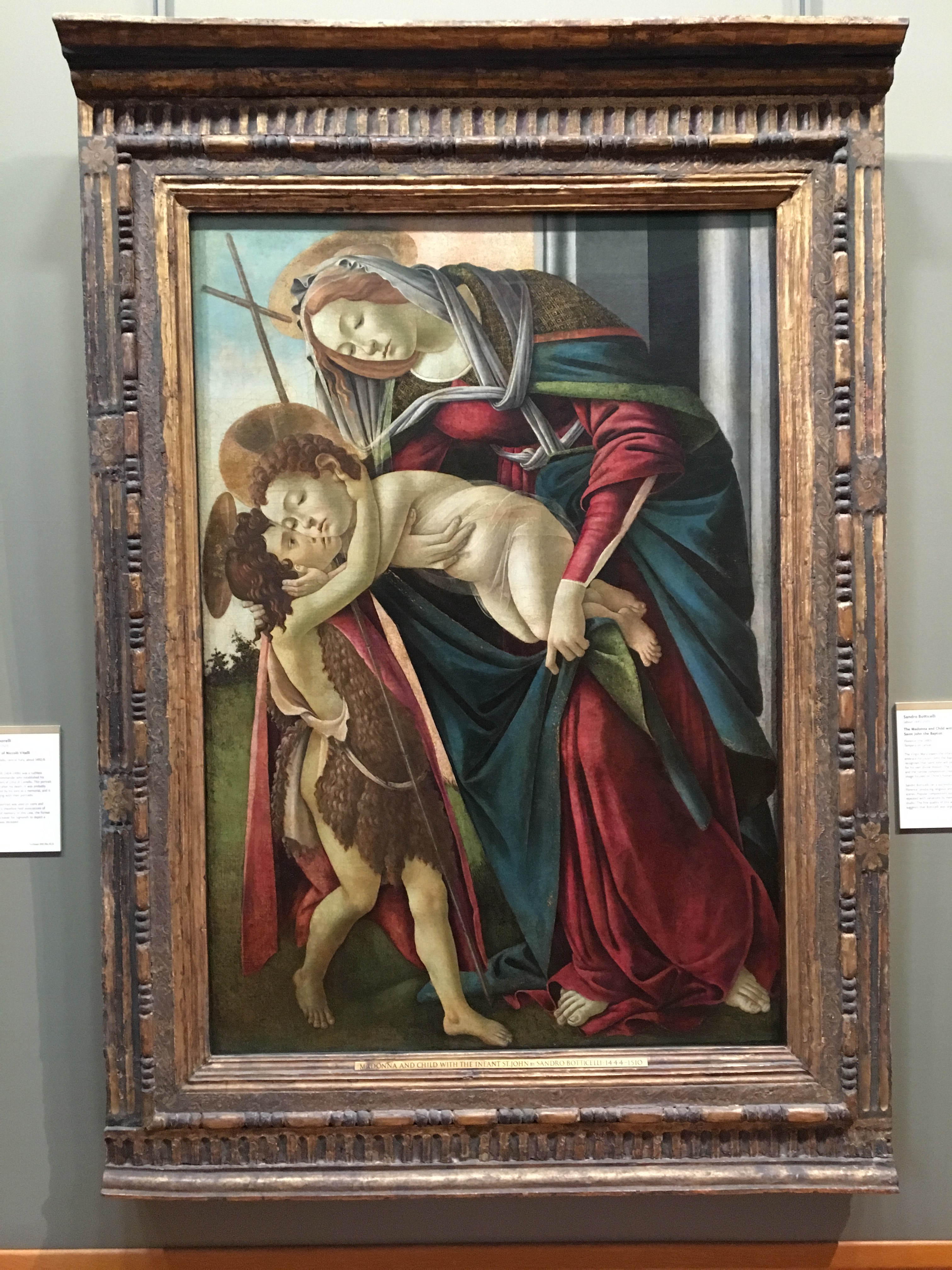
Madonna and Child with the infant St John the Baptist

 St Sylvester, 31st December, 2023


     It is the final day of the Octave of Christmas, what in Orthodoxy is termed the Apodosis - the 'Leave Taking'; and I thought I'd conclude this little sequence of paintings with this arresting image: 'The Madonna & Child with the infant St John the Baptist' attributed to the Renaissance Florentine Master Sandro Botticelli, (14415-1510).  It currently resides in the Barber Institute in Birmingham.  Sadly, the Institute, unlike the Fitzwilliam Museum, does not list provenance online.

    The painting depicts the meeting of the infant Christ with St John the Baptist, a subject that seems to have been continuously popular with artists in the Middle Ages and beyond. It is however an event that is apocryphal but not impossible.  There is a near identical painting that, according to Wiki, is in the Palazzo Pitti collection, though it is not listed in the online gallery collection.  It is the mirror image of the painting in the Barber.  The colour of the Barber painting however seems, to judge by a comparison of photographs on the internet, to be the more sombre.  Both paintings seem a long way from the usual 'sweetness and light' Botticelli style. The extraordinary element lies in the composition which seems to echo depictions of the adult Christ's Deposition from the Cross.  Christ appears as one dead. 

Saturday, 30 December 2023

Madonna and Child with Bird


      Something rather different today.  A sculpture, 139x95cms, undertaken in glazed terracotta in Renaissance Florence.  It is the creation of the workshop of Giovanni della Robbia, (1469-1529), son of the much better known Andrea della Robbia.  Today it is on display in the foyer of the Barber Institute (part of the University of Birmingham), but it was originally made for a monastery (and I have no idea which) located in Castellina near Florence. I took the photograph way back in 2017 when I made my first visit to the Institute.

     The sculpture is in the form of an aedicule (from the Latin meaning 'little house'), essentially a small shrine.  It is an example of those ways in which Classical Antiquity was adopted and adapted to fit a Christian context.  The term 'tabernacle' might be used today.  The aedicule is of the Corinthian order supported by a winged cherub's head flanked by two cornucopia profusely sprouting foliage, fruit and pine cones.  The profusion is repeated in the sunk panels of the Corinthian pilasters and cornucopia replace the volutes, the 'helices', in the capitals. Indeed, the whole 'architecture' of the aedicule is highly decorated, most particularly the frieze of the entablature which echoes the ornamentation of the support with alternating cherub heads and foliage. The cornice is itself is a little simplified, omitting the brackets/modillions (for technical reasons?).

     The visual and devotional heart of the aedicule is a relief sculpture of the Theotokos and the Christ child contained in a thin arch decorated with 'egg and dart'. She placed centrally, Christ to her left. Both are standing - the Virgin Mary is three quarter length, Christ full length.  Both the figures occupy slightly different positions in the 'picture' plain - Christ, who is standing on the 'sill' of the arch is in the foreground, his mother slightly behind, her lower half partially hidden by the architecture. Christ's right hand is raised in blessing, his left hand, which is held above his heart is holding a small bird.

     The work of the della Robbia family has an immediate appeal to the viewer.  I particularly love the tondi, which are used so successfully to decorate the exterior of so many Renaissance buildings in the city and also the dazzling ceiling of the Chapel of the Cardinal of Portugal attached to the north aisle of San Miniato del Monte also in Florence. In the Madonna and Child with Bird, which is so scaled as to suggest a devotional use, I love the freedom with which the Classical language of architecture is handled. 

    Is the bird in the infant Christ's hand, I wonder, a reference to the legend of the infant Jesus making birds from clay and then giving them life?  The story occurs in the Infancy Gospel of Thomas.  The legend later occurs in the Quran and in Medieval Jewish writing.  Although entirely apocryphal it was, like stories from the Proto-Evangelium of James, a very popular subject for Medieval artists.  If it is then it is some sort of comment on the work of della Robbia as a sculptor in clay and by extension to work of all artists.

Friday, 29 December 2023

The Virgin of Humility


     Today something far removed from yesterday's towering painting. We are back to the Fitzwilliam collection and back in the pre-modern and the Gothic.  That slightly strange, to Northern eyes at least, Gothic of the Italian peninsular, where the Gothic north blends with strong and persistent Classical, Romanesque and, most important in the discussion of this painting, Byzantine traditions.
     What we are looking at here is essentially an icon set within a tabernacle - everything we see is constructed of gesso-ed, painted and gilded wood.  According to the Fitzwilliam museum it dates from after 1440; the work of Paolo Schiavo.  It is Florentine, but at some point the tabernacle turned up in Pisa.  By 1883 it is known to have been in the collection of the Pisan Giuseppe Tuscanelli.  The tabernacle is a devotional object, but not for personal, private use, but for the use of a lay devotional community - in this case a group of flagellants. In one sense it is a variant of the 'Madonna enthroned' I talked about on Wednesday; the Theotokos and the Christ child are still surrounded by a heavenly court - there are angels in the soffit of the arch, and saints on the piers 'supporting' the arch, four in all. The variation is simply that the Theotokos is seated on the ground; hence the title 'The Virgin of Humility'.  A fitting subject for such a confraternity, which is depicted in the panel below the main panel performing the funeral rite of one of its members. 

     Finally, I suppose I ought to say something about these flagellants.  All we need to know is that in the Middle Ages confraternities were very popular, loci of popular lay devotion.  Some very famous Medieval paintings, such as the Rucellai Madonna1 by the Sienese master Duccio Di Buoninsegna, were commissioned by such confraternities.  The flagellants were simply a more 'extreme' example of such devotional life. They seem to have been a product of the later, post Black Death, Middle Ages.


1 The Rucellai Madonna was commission by the Laudesi confraternity.  They met within the 's' transept of Dominican church of Santa Maria Novella, where they had a chapel.  It has often been said that the painting - tempera on wood - was an altarpiece. I don't think that that is accepted these days. The image - which is extremely large and is essentially, like 'The Virgin of Humility' an icon, though of the 'Panakranta' type - may either have stood in the confraternity's chapel or outside in the transept. After the completion of the nave it may have been moved there, to stand either against one of the piers or upon the rood beam, what in the Italian peninsular was then referred to as the 'Iconostasis' (see: 'The Art and Science of the Church Screen in Medieval Europe', Eds: Spike Bucklow, Richard Marks, & Lucy Wrapson).  The Iconostasis in the Upper Church at Assisi not only supported (centrally) a Crucifix, but icons of St Michael and the Virgin Mary & Christ child of the 'Panakranta' type - the beam is depicted in Giotto's fresco 'The Verification of the Stigmata', also in the Upper Church. 
     When Vasari ruthlessly remodelled the interior of Santa Maria Novella during the Counter-Reformation (the amount of destruction was quite the equal to that done by Protestants in N Europe) the image was placed in the Rucellai chapel off the 's' transept. Hence its current name.  It was moved out of the church in 1937 and on to display in Uffizi in 1948 (wiki says it was moved to the Uffizi in the 19th century) and denuded of its power thereby. (Image from wiki Commons)


Thursday, 28 December 2023

Adoration of the Shepherds

 The Holy Innocents, 28th December, 2023


     Just over a hundred years separates today's image - 'The Adoration of the Shepherds', by Philippe de Champaigne (1602-74) in London's Wallace Collection - from yesterday's; and, although perhaps not a fair comparison for they are not of the same genre, the contrast in style and technique could not be greater: lucidity to mystery, hieratic to fluid drama, from an even light to the theatrical disposition of light and darkness. It is, paradoxically, both a maximalist and minimalist work - by minimalist I mean the ruthless expunging of extraneous detail. As in all Baroque art, all is subsumed into a whole that is designed to elicit, to excite, an emotional response in the viewer. While in yesterday's painting the subjects were either deep in contemplation or addressing the viewer, here the figures are completely oblivious to the observer being entirely caught up in the communal moment when the shepherds are brought into the divine presence.

     According to The Wallace Collection website The Adoration was painted c1645. It is a large work, some 260x160cms, commissioned, perhaps, for Abbey of Notre Dame de Quincy, where it is tempting to think it formed part of an altarpiece.

     Altarpiece, or not, the whole thing, I think, can be read as an allegory of the Eucharist, or rather the Eucharist as it was understood in the Western catholic church in the early years of the seventeenth century.  The shepherds, who can be thought of as the Faithful, have brought a lamb, a bound lamb pointing to Christ's passion and death, as an offering to the infant Christ. It lies upon the floor of the cave.  Christ is the Lamb of God. The Virgin Mary stands as a 'type' of the church presenting to the faithful the incarnate God for adoration, just as the church, in the person of the priest, in the elevation of the consecrated species, presents the faithful the risen body & blood for adoration.  It was at that moment of adoration that the altarpiece and the liturgical action below it became one and time was collapsed.