Showing posts with label restaurants. Show all posts

Saturday, 21 June 2025

London

       To a sultry London on Sunday for a few days and hefty dose of culture, and (it could be argued) you can't get more cultural or arcane than an exhibition of Medieval Sienese religious art at the National Gallery.  That was Monday morning.  I intended to post everything in order over the next few weeks or so, but I still need time to form a response to the art on display, so I will have to return to this topic at a later date when my thoughts are clearer.  (You may, perhaps, want to read this 'reluctance' on my part as a tacit admission that I wasn't that impressed, but I couldn't possibly comment.)  The two photos below were taken in Covent Garden on the way to the National Gallery.  The first is a contemporary reconstruction of an entrance arch by Inigo Jones - one of pair flanking his church of St Paul.  Jones as Mannerist.  The second is Russell House, attributed to the English Baroque architect Thomas Archer.


     It's funny how on these little trips of mine themes sort of emerge from the serendipitous.  On this particular visit three themes emerged.  The first was Post-Modernism.  After the exhibition, and a visit to the remarkable Maison Berteaux on Greek St., I headed into Covent Garden via Seven Dials to buy a new shirt. I couldn't resist, however, popping into the Ching Court.  A triangular public space formed out of a chaos of backyards and sheds in the centre of the urban block created by Monmouth, Mercer and Shelton Streets - the so-called Comyn Ching Triangle. The result is a beautiful, serene piece of urbanism.  It is an early work (1978-86) by the architect Terry Farrell, combining, in a Geddesian manner, the old (Georgian terrace houses) and the new (three new architectural interventions - one at each corner).  How one felt the optimism of those heady days when it seemed that Modernism was finished!  I particularly like the detailing of the three wooden porches on the w side of the court.


     Afterwards lunch with a friend who now works for another friend Ben Pentreath, at his rather glamorous studio in Lambs Conduit St. We ate at 'La Fromagerie' over the street from Ben's office.  Quite the best gnocchi I have eaten in a long time.  A rushed supper at 'Hare and Tortoise' in Bloomsbury interrupted by extraordinary behaviour of a diner when her child misbehaved and that left the other diners open mouthed in disbelief.  From there to the Art Workers Guild where RIBA TAG was having a symposium and summer party.  I managed to arrive very late, all the chairs were taken, the speeches dull, and the heating on. I lasted half an hour before leaving.


Further Reading

'Terry Farrell' (Architectural Monographs No9), Terry Farrell & Frank Russell, Academy Editions, 1985

Friday, 24 May 2024

Tenby

     Yesterday a respite from the Infernal City and a welcome return visit to Tenby.  Tenby is a small marvel, and one of our better seaside resorts. A 'must visit' sort of a place; with some fine urbanism and architecture.  It is built on a dramatic promontory jutting out into the Bristol Channel, and retains its medieval walls, the result is a tightly packed, and visually satisfying urban environment with all sorts of alleyways leading off the main streets, and the tower and spire of St Mary's church sailing over all, for all the world like an escapee from Ireland or Scotland.  As always, although loving the various colours of the buildings, I'm struck by the use of slate hanging.  There is something rather satisfying in its use.*
     In the original iteration of this post I erroneously stated that Tenby was the birthplace of Myfanwy Piper (nee Evans), critic and librettist (she collaborated with Benjamin Britten, Alan Hoddinott, and Malcolm Williamson), 2nd wife of the artist John Piper and muse to Sir John Betjeman.  She was actually born in London in 1911.  Her paternal grandfather was a minster in Tenby, and she spent summers in the town as a child.  (She had a connection to my own county, Lincolnshire, in her maternal grandfather, Charles Playll, a minister in Louth.)  She really deserves a blogpost of her own.

     Lunch was taken at the atmospheric Plantagenet House Restaurant on Quay Hill.  Delicious food, attentive staff.  In all, very good.


* 6.5.25 A lot of the old town is a fascinating, and piquant, combination of Medieval urbanism and smartest Neo-classicism.

Wednesday, 27 October 2021

Bradford on Avon

     On the second full day of our trip to Bath we headed off to the station and caught the next train to Bradford on Avon. A mere fifteen minutes away. Trains are every half hour and it is a journey I would recommend if you're holidaying in Bath. (I'd also recommend 'Pablo's Tapas' where we had lunch!)

     In the late seventies and early eighties the English architectural historian Alec Clifton Taylor presented three series (each of six episodes) on the architecture of English towns for the BBC. A different town in each episode. They were excellent. Just the sort of thing that the BBC was then very good at. Alas, I don't think the same can be said today. These half-hour documentaries can be occasionally found on YouTube, but usually disappear again; I think for copyright reasons. I suspect the BBC is very assiduous in that. However these programmes are really worth looking out for. Anyway Bradford on Avon appeared in the second series which was broadcast in the Autumn of 1981. And I suppose it was seeing that particular episode on YouTube a year or so ago that put the idea in head when we decided to visit Bath.

     Bradford is not large, (pop 9,000+); the centre in particular is very small - a tight knot of narrow streets that suffers a lot from through traffic. An important river crossing that was once over looked by a hill-fort, high on the hill to the N above the town. In Late Saxon times Bradford was the site of a monastery. So a place of some considerable history. There isn't much town on the southern bank of the Avon but on the north it creeps up that steep hillside to the Budbury plateau in a series of long parallel lines of old stone houses that once housed weavers. This was once a manufacturing town, and down on the valley floor were a series of great woollen mills. The architecture in all is very like what I was used to living in south Lincolnshire - ooltic limestone, ranging from pale grey to warm ochre, and stone slate roofs. Both Kesteven and Bradford are at either end of the Limestone Belt that weaves its way through England roughly SW to NE. What interested me in Bradford were the remarkable group of Baroque houses, somewhat similar to the ones on Bath, and the two medieval churches. One of which, St Lawrence, really is something special, of national importance.

     You know, as I upload these pictures I feel I haven't really done Bradford on Avon justice. Alas we didn't see Bradford Hall, which is the second building in the town of national importance, or the the tithe barn. Or the long terraces of of weavers houses that climb the hillside and that bear such evocative names as 'Top Rank Tory'. In places the narrowness of the streets and lack of pavement meant it was next to impossible, on a normal week day, to take photographs. Perhaps another time.


        English Baroque of the local type at Westbury House 


        The Old Church House, now Wallington Hall. Late Medieval church hall. 


     Houses in Church St. Particularly admire the combination of stone walls and yew hedging


Friday, 15 October 2021

Bath I: Baroque in the City

      Just back from a few days in Bath - a treat to celebrate the bf's significant birthday. We couldn't have had nicer weather, for what was our second visit. Our first visit is chronicled is here. Our two days away were spent mainly spent ambling around the city, immersed in a mixture of shopping and architecture. However our peregrinations did take in deliberate visits to The Museum of East Asian Art (which we enjoyed) and two favourite bookshops of ours: Persephone Books and Bath Old Books, without which a visit to the city would be incomplete. We also went on a jaunt to Bradford-on-Avon yesterday, but more about that in future posts.
      As you can imagine I took a fair number of photographs, but I'd like to start with those I took of the baroque buildings of the city - an attempt to catalogue the Baroque architecture of the city, a style not readily associated with Bath where the overwhelming  majority of historic buildings labour under the undue influence of English Neo-Palladianism. With the buildings that will appear in the next blog about our little jaunt down the line to Bradford-on-Avon it is possible to discern a local Baroque style. Firstly the majority of buildings have a resault, or risalto, of a single bay emphasized by a stack of aedicules - each essentially of a single storey in height. Perhaps they can be related to Vanbrugh House in Oxford, where the resault consists of a single giant order aedicule. Secondly the influence of French architecture. One way of understanding the rise of Neo-Palladianism is to see it as a self-conscious attempt to break the French influence in British art.


     We ate so well in Bath, it has to be said, there were two particular highlights. There  was dinner on our first night in the city at 'Sally Lunn's', North Parade Passage; I had a Pork and Walnut terrine, followed by a beautiful looking, and tasting, beef pie. Beef pie was also on the menu at the vibrant 'Corkage', Chapel Row, where we ate last night. The food was mightily inventive, and it being the bf's actually birthday we did rather indulge; pigeon, sardine, pie and marrow, lemon posset. We then headed off to the Canary Gin Bar in Queen St. Finally I'd like to mention the wonderful breakfasts at our hotel, The Kennard on Henrietta St.

Monday, 2 August 2021

Gower

      We've been away for a couple of nights, staying at Port Eynon on Gower. It's been just the ticket. We've done a lot of walking, exploring the coast line between Port Eynon and Oxwich. Beautiful, remote and empty. The sort of landscape that sometimes leaves me a little uneasy. I really do need some humanity, and that is one of the reasons why I found lockdown so hard to bear. Gower is, in Diane Williams words, 'a land set apart'. Somewhere quite special. A poetic, 'thin' place.

      Wednesday afternoon took us to within sight of The Sands at Lower Slade. Yesterday we went further walking over to Oxwich via Oxwich Green. Horton and Oxwich Green are both delightful, but quite different. The last time I was in Oxwich was Boxing Day 2015 in very different weather; overcast and wild. The beach the haunt of fearless surfers. Yesterday it was full of holiday makers.

     Lunchtime was an extraordinary treat: we had lunch at The Beach House, Hywel Griffith's Michelin starred restaurant at Oxwich. The whole thing was purely serendipitous - the bf having, unbeknownst to me, emailed the restaurant in case of a cancellation - only for them to contact us when we were in Oxwich Green. It was needless to say marvellous. I had 'Flowering Courgette', 'Carmarthenshire Pork Belly' and 'Bara Brith Soufflé'. I'm still thinking about that soufflé. It was just exquisite. And the sherry, a Fernando De Castilla Cream Sherry, that was pretty damn good too. The return walk to Port Eynon was a sluggish affair.


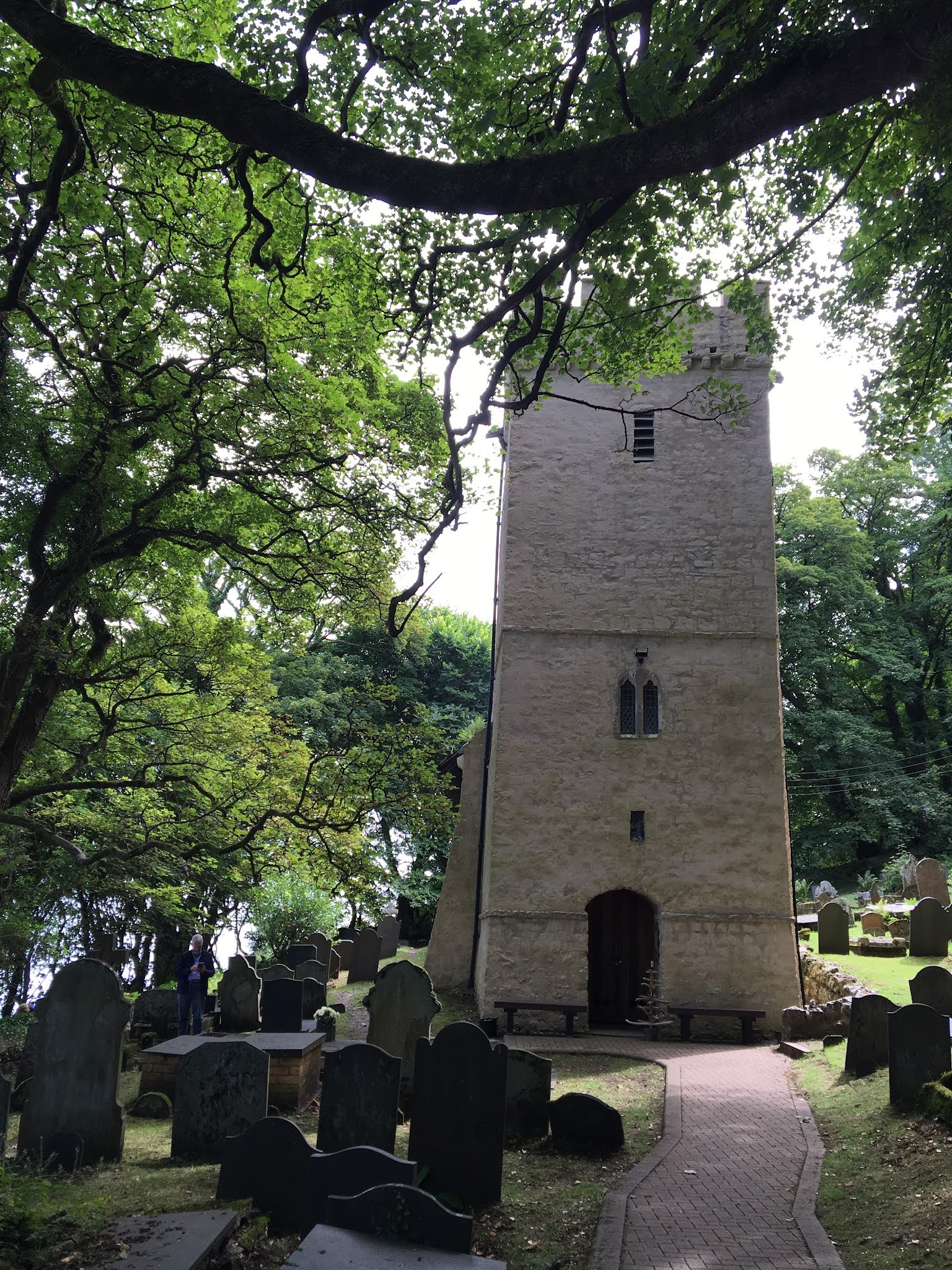
     And then Friday morning a brief stop on the return journey in Penmaen to draw and photograph the church. Mostly Victorian, 1854-5 by R K Penson. Best 'Cambridge Camden Society' approved Middle Pointed. Lovely position on triangular village green.