Showing posts with label Gower. Show all posts

Wednesday, 19 July 2023

Weobley Castle

      A jaunt onto Gower this morning and a visit to Weobley Castle, romantically set high above the salt marshes on the north coast of the peninsula with wide views across the Loughor estuary and far to the Brecon Beacons. On the landward side the castle stands beside a working farm. As castles go not at all large, but a comfortable fortified manor house, the best remaining example of its type in Glamorgan according to the Buildings of Wales volume on the county. Some nice architectural details too.  In places the ruins seem to merge with the natural outcropping rocks. 


   From there to quite my favourite village on Gower, Llanmadog, wth sheep grazing in the village street and ancient stone walls and even older parish church. A place to treasure. We took a brief walk along the coastal path towards the pine woods of Whiteford Burrows and Cwm Ivy Torr, a place of utter silence and solitude. Le Pays de Galles Profonde. A truly remarkable place, very atmospheric if not faintly disturbing in its emptiness. I can quite understand its folkloric associations. From there back to civilisation and the lovely Cwm Ivy cafe for tea and cake.


Wednesday, 11 August 2021

Back to Gower

     I must down to the seas again, to the lonely sea and the sky.


     A two bus trip Monday to Pobbles Bay and Pennard on peninsular Gower. A blustery, cool day at that and plenty of walking done. But, if I have to be totally honest, not enough sketching. Still it was wonderful to see the sea again. The tide was out when I arrived leaving acres of smooth pristine sand at Pobbles Bay. I hope these photographs capture the dramatic nature of the coastline.


Monday, 2 August 2021

Gower

      We've been away for a couple of nights, staying at Port Eynon on Gower. It's been just the ticket. We've done a lot of walking, exploring the coast line between Port Eynon and Oxwich. Beautiful, remote and empty. The sort of landscape that sometimes leaves me a little uneasy. I really do need some humanity, and that is one of the reasons why I found lockdown so hard to bear. Gower is, in Diane Williams words, 'a land set apart'. Somewhere quite special. A poetic, 'thin' place.

      Wednesday afternoon took us to within sight of The Sands at Lower Slade. Yesterday we went further walking over to Oxwich via Oxwich Green. Horton and Oxwich Green are both delightful, but quite different. The last time I was in Oxwich was Boxing Day 2015 in very different weather; overcast and wild. The beach the haunt of fearless surfers. Yesterday it was full of holiday makers.

     Lunchtime was an extraordinary treat: we had lunch at The Beach House, Hywel Griffith's Michelin starred restaurant at Oxwich. The whole thing was purely serendipitous - the bf having, unbeknownst to me, emailed the restaurant in case of a cancellation - only for them to contact us when we were in Oxwich Green. It was needless to say marvellous. I had 'Flowering Courgette', 'Carmarthenshire Pork Belly' and 'Bara Brith SoufflĂ©'. I'm still thinking about that soufflĂ©. It was just exquisite. And the sherry, a Fernando De Castilla Cream Sherry, that was pretty damn good too. The return walk to Port Eynon was a sluggish affair.


     And then Friday morning a brief stop on the return journey in Penmaen to draw and photograph the church. Mostly Victorian, 1854-5 by R K Penson. Best 'Cambridge Camden Society' approved Middle Pointed. Lovely position on triangular village green.  


Wednesday, 22 July 2020

Arthur's Stone

     Our first proper outing since the start of Lockdown was to the crown of the great sandstone ridge of Cefn Bryn on peninsular Gower, taking the Red Road over the common from Llanrhidian. It was our first visit and we were properly rewarded with panoramic views in all directions. It certainly feels like the very centre of the peninsular - whether that's entirely accurate is a different matter.
     On the north flank of the hill, and with panoramic views over the Loughor estuary to the Brecon Beacons is Arthur's Stone. (I mention that because it could have significance as to the placing of this monument.) Its Welsh name is Maen Ceti. The stone is a glacial erratic, now split into two, that forms the capstone of a two chambered burial cairn - time and the hand of man removing its covering of stones. I'm not sure if anybody knows for certain whether the stone was moved to this location, or that the burial chamber was excavated from underneath the pre-existing stone. Either way it's a hell of a thing to achieve. As its English name suggests it has connections to the legend of King Arthur, but to St David also. Both men are credited with cleaving the stone in twain. Arthur used Excalibur and David his pastoral staff. A little further off to the west is a second cairn.


Friday, 15 November 2019

Own work: 'Rocks and Cave, Pennard'

     Latest painting, after a short-ish hiatus: 'Rocks and Cave, Pennard'. Mixed media on 300gsm watercolour 30x26cms. What more can I say?


Wednesday, 2 October 2019

Own work: 'Rocks and Scree; Pennard'

     I had started this last month before me exhibition completing it during the first full day there.  It is based on a drawing I made of the cliffs at Pennard, Gower.  Mixed media on 300gsm watercolour paper, again making use of butter for the stopping out. I hope you like it.


Wednesday, 4 September 2019

Own work: Cliffs at Pobbles Bay

      A new work to share with you: Cliffs at Pobbles Bay.  Mixed media on 300gsm watercolour paper.  Pobbles bay, which at low tide is connected by smooth pale sand to Three Cliffs Bay, is one of those hauntingly beautiful places that peninsular Gower is so rich in. The sky and the rocks were created by applying a wash over butter!  It, the butter, was then removed with a hot iron.


Friday, 21 June 2019

A morning on Gower: St Cenydd, Llangennith

      Our final port-of-call was Llangennith, the largest of the three communities we visited and the most (but discreetly) 'touristy'.  Attractive none the less, with a crowd of houses facing across the sloping green to the church.

      St Cenydd's was built as a priory under the authority of the abbey of St Taurin, Evreux, but the site has a longer history still - see the slab of interlace now standing in a niche beside the chancel arch but long associated with the traditional burial place of the patron saint in the chancel. St Cenydd was a hermit from the 'Age of the Saints' living on the nearby island of Burry Holms. There imitating the Dessert Fathers he became a 'Miles Christi' - a soldier of Christ contending against 'the world, the flesh and the devil'. As I wrote of St Guthlac, 'Making Catharsis on the path to Theosis.' Both saints remind me of Bede's description of St Cuthbert as a 'beata Christi athleta', referring in part to St Paul's description of fasting etc as 'askesis' or athletic training. 'Miles Christi' was one of a whole number of descriptions of ascetics and their striving for union with God in Late Antiquity and the Early Middle Ages: militum Christi/spiritualis, agon, certamen, conluctatio.  Words denoting conflict, warfare. (Not, when one thinks of it, words that denote passivity, but activity.) Athanasius, the Egyptian bishop who during his exile in the Western Roman Empire introduced monasticism to the West (he, not Benedict, is the Father of Western Monasticism), described monasticism as a sort of prolonged martyrdom. On the village green is a small holy well dedicated to Cenydd. A minor place of pilgrimage then.
   Always small, the priory was suppressed in 1414 along with all the other alien monastic houses in England and Wales.

      The church consists of a long, aisle-less nave and chancel with a austere tower attached to the north of the nave.  The parts make a very picturesque whole, but the interior, it has to be said, is a disappointment.  The light blue colour does not help neither the drastic restoration by J B Fowler which raised the floor level by 4ft.


Sunday, 16 June 2019

A morning on Gower: St Madog, Llanmadog

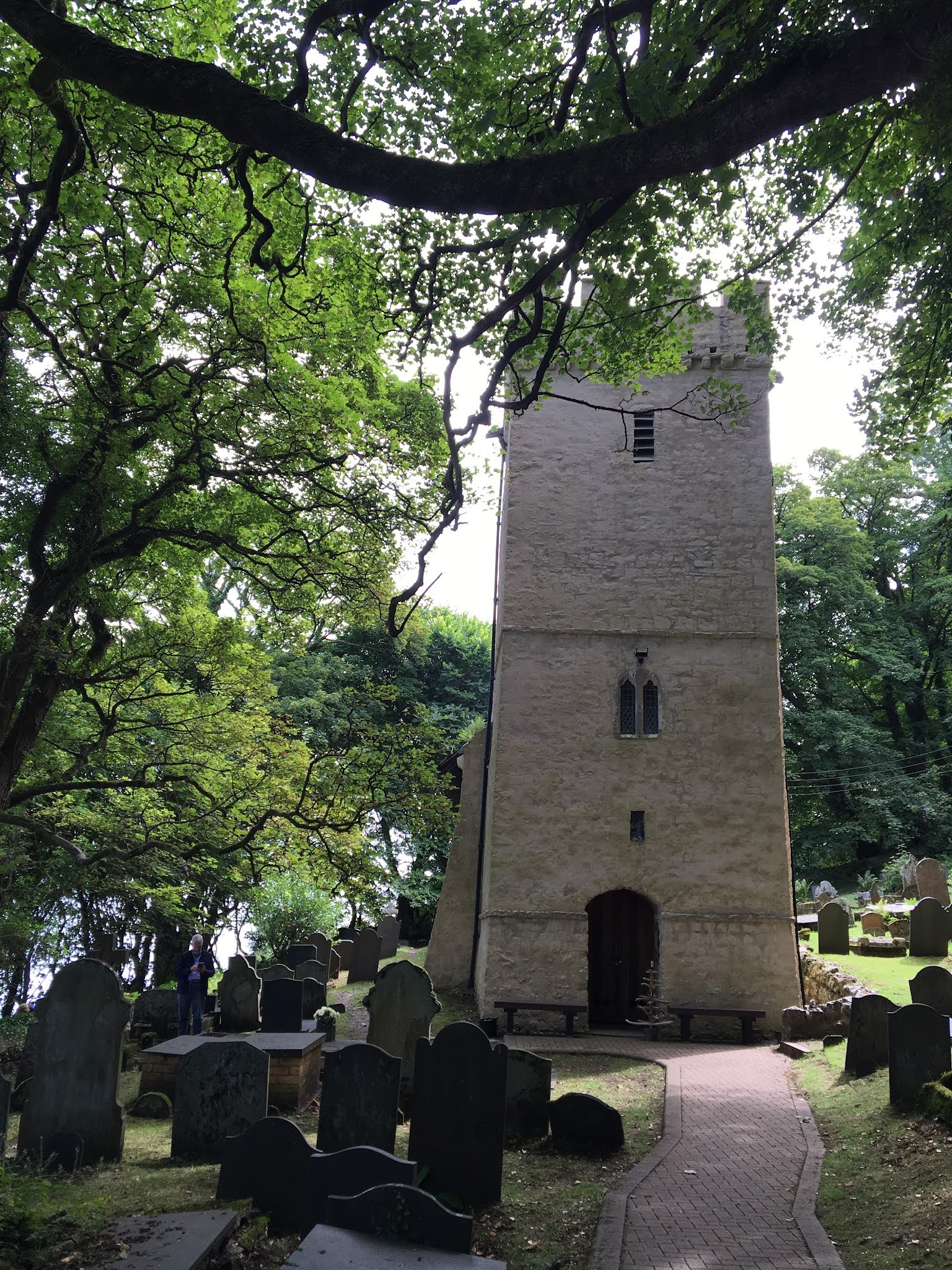
     The next village west of Cheriton - at the very north west of the Gower - is Llanmadog.  The sacred enclosure of St Madoc.  Early gravestones found in the churchyard and now inside the church indicate that this was an important site for the early church in this part of Wales. One of the stones dates from the late 5th century and reads: ADVECTI FILIUS GVAN HIC IACIT.
     The founders of the church could not have chosen a more lovely site - there are beautiful views across the estuary of the Loughor, and along the northern shore of the Bristol Channel west toward Tenby.  A serene place. A place to treasure. The church is tiny, just a two celled structure with bristly, dumpy west tower; the interior is atmospheric, redolent of Ecclesiological Society correctness. Again there is a sense of the ancient although the church was enthusiastically restored in the 19th century by John Prichard for Rev J D Davies who, as at Cheriton, made some of the fittings himself. In the porch swallows or martins nest above the church door.


Sunday, 9 June 2019

A Morning on Gower: St Cattwg, Cheriton

      Thursday morning and a trip to the far north-west of the Gower peninsular.  A wonderful morning it was, travelling around such a remarkable and beautiful landscape.

      Our first stop was Cheriton, a tiny village nestling deep in the valley of the Burry Pill.  Atmospheric and remote. The church is small but rather monumental thanks to its clear design and heft. It consists of nave, sturdy tower and chancel - three simple volumes.  There are no aisles, but there is a south porch and a Victorian (N) vestry disguised as a N Transept. The church dates from the 13th century, but one could believe it is earlier still - the walls are thick, windows are rare, small and simple in design.  There is a simplicity and primitive quality to this structure that is entirely satisfying.
     The only decorative elements are the really fine s door and the corbels that help support the arches under the tower. Indeed they are the only real carving inside the church for the the interior is just as simple as the exterior which, alas was rather dark when we visited, but then it was pouring with rain outside - a passing shower really but very heavy.  The interior, however, was very moving; a holy place one felt. I was particularly taken with the relative narrowness of the two crossing arches (how 'Anglo-Saxon' this arrangement seemed) and felt the e wall of the nave was crying out for two cathedral-scale icons; Pantocrator on the right (S) and Theotokos on the left (N).  But then, forgive the wild conjecture, that was perhaps how a wall like was actually used at one point, covered in images. St Benedict Biscop decorated his monastic churches with icons he obtained in Rome, and later Anglo-Saxon clerics on pilgrimage to Rome bought among other things silks manufactured in the East Roman Empire and the Caliphate with which to make vestments and altar hangings.  But I digress, but we forget that Rome in the Early Middle Ages was one of the centres of Byzantine civilisation, the walls of its churches sheathed in mosaic and its altars and priests dressed in Byzantine silks. Hard sometimes to believe that the Roman Rite was actually conducted in a space such as Santa Maria Antiqua, it hardly seems to 'fit'. But that really, really is another post.
     No fittings of note except that the Victorian vicar here, the remarkable, scholarly J D Davies, not only had the roofs coloured (quite successfully), but made a number of the fittings himself - slightly clumsy, to be honest, but fun.