Showing posts with label Ben Pentreath. Show all posts

Wednesday, 14 June 2023

Own work: Doric Gate after Batty Langley

     Finally another piece to share with. It's been like drawing teeth! This is 'Doric Gate after Batty Langley' - mixed media on 300gsm watercolour paper. Who, I hear you cry, was Batty Langley? A character in the evergreen British sitcom 'Last of the Summer Wine? Alas, no. Mr Langley was a Georgian master mason/architect and architectural theorist. He is remembered now for his writing, and has been an influence of subsequent generations of British architects such as, beloved of this blog, Edwin Lutyens and Ben Pentreath.


Tuesday, 24 May 2022

God Save the Queen! Platinum Jubilee pt1

     Just had to have this! Perhaps one of the best designed the new commemorative items issued for this remarkable Jubilee - yes, I know I am biased! And it is a snip too. God Save the Queen!


Wednesday, 7 July 2021

Exhibition

     I'm very pleased, excited and not a little daunted (not to mentioned honoured!) to be finally exhibiting this year at my friend Ben Pentreath's shop 'Pentreath and Hall' in Rugby St., which he runs with Bridie Hall. 

     As you may be aware we have all been labouring under a little local difficulty and this exhibition had originally been planned for last year. 'The best laid schemes o' mice an' men/ Gang aft a-gley.' Anyway this will be my first solo exhibition in London and will run from 6th September until the 17th - so just under two months away. Do please pop-in to say 'hello' if you're passing!


Wednesday, 5 October 2016

London and Walsingham


     It's been an eventful week.  A week ago today I took the train into town and a wonderful party at the Art Workers Guild in London's Bloomsbury.  Think architecture meets interior design, meets journalism, meets academia, meets literary London.  The host was my friend Ben Pentreath; the occasion was the launch of his stylish new book 'English Houses'.  With beautiful photography by Jan Baldwin its a lavish, seductive book.  The hall of the Guild (by F W Troup 1914) was decorated in the best Pentreathian manner with armfuls of dahlias that Charlie, Ben's husband, had brought up from their house in Dorset. I'm sure the waiters had been chosen as much for their looks as their hospitality skills. In the long years of caring it was the sort of invitation that came along rarely, and one that would be invariably declined.  The logistics of it would have been just too much hassle. Initial nerves were overcome, and I had a lovely evening meeting new people and catching up with old friends. I briefly met Ben's business partner Bridie Hall (it was her birthday) and Max, her dog and a total charmer.  Ben and Gabby Deeming, the Decoration Director of House & Garden magazine, both made speeches.  And I left with my copy of 'English Houses' autographed.  'Result', as they say.


       The other event of the week was of a totally different nature. And one I'm reticent to speak of, partly because at times I am such a low-grade Christian, but that was in its quiet way such a profound experience that I feel compelled to share.  On Saturday I joined a local pilgrimage party and headed east across the great, flat extent of the Fens and into Norfolk and to Walsingham. Here is my post from last year.  The morning's weather was superb again. Walsingham has this amazing air of serenity that, I think, is quite unique. The sun was warm and the apple trees were heavy with fruit in the garden of St Seraphim's church, like a painting by Samuel Palmer. The afternoon was, however, unfortunately wet.  After attending two indifferent services in the Anglican shrine (Pilgrim Mass and Sprinkling - both meagre food for pilgrims) I found myself attending Orthodox vespers upstairs at the Anglican Shrine.  The chapel was minute - hardly really more than a landing.  So narrow a space that the iconstasis had room only for two doors instead of the usual three.  An elderly priest lead the service, supported by a choir of one - I think it was his wife. From such meagre resources was created something incredibly moving, incredibly spiritual and powerful. Numinous. Transcendent.  The congregation varied between two and seven, but that didn't matter.  It had a deep integrity that somehow what was going on downstairs in the Anglican bit simply did not possess.
     I've been attracted to Orthodoxy for a long time, but rarely attended a service.  The opportunity has rarely arisen.  To attend therefore something that is so freighted with expectation is to risk disappointment.  I needn't have worried, the experience exceeded expectation.  I need to return.

Monday, 8 August 2016

London: Bridie Hall & Dr John Dee

     Nearly a fortnight ago now I popped up to town for a few short hours to catch Bridie Hall's pop-up shop and the Dr Dee exhibition.  An odd mix, and one I can't readily or cleverly link.

     Firstly then to Rugby St and 'Pentreath and Hall' which Bridie co-owns with her business partner my friend Ben Pentreath.  As visitors to Pentreath and Hall will know the premises consists of two small linked shops - they share a common entrance.  The right hand shop is available as a pop-up shop and it is that that Bridie has transformed into something very stylish for two months over the summer.
Bridie Hall is a designer and maker heavily influenced by the idea of 'The Grand Tour' - the trip to the Italian states undertaken by young British aristocrats in the 18th & early 19th centuries ostensibly to study Roman Antiquity.  And this influence is very much evident in the goodies on display: 'Pediment Mirrors' and 'Roman Emperor Intaglio Cases'.  The decor too reflects that interest with one wall papered with a copy of the 'Rocque Map of London' and beneath a fabulous dado designed by Bridie in bold, strong colours - oranges, black and pink. The rest of the space was painted a lovely sage-ish green, the woodwork highlighted in white; an homage perhaps to the 1960s & 70s and to the interior designer David Hicks in particular.  The other items, the End of Day Confetti Lamps for instance, too strike that more modern note.  A contrast that Ben also explores in his interiors.  What gives a unity to it all however is the that bold, confident use of colour; the combinations often striking and original.  In fact it has been noticeable in the work of both Bridie and Ben how their use of colour has become much brighter and stronger, sharper even, of late. You have now until the end of the month to visit.  The Roque Plan and Bride's range of perfumed candles and decoupage (I particularly love the brushpots) are available in Pentreath and Hall next door.  Do go.


     Then to Regent's Park and the Royal College of Physicians - a Modernist building by Sir Denis Lasdun, opened in 1964, set amongst creamy stucco and verdant greenery - and the exhibition:  'Scholar, courtier, magician:  The Lost Library of John Dee'.  The good doctor (1527-1608/9,) 'that excellent Physitian, Doctor John Dee', is an almost mythic figure in British culture - not only a courtier and scholar but physician, navigator, mathematician and spy.  A true renaissance man, an 'uomo universale'. The man who coined the term 'British Empire', whose cipher it is claimed is the origin of James Bond's number 007.  A clerk in Holy Orders who was also alchemist and magician, who claimed to have spoken to the angels.  Damon Albarn has even written an opera about him.  And it is that last - the magician steeped in the Neo-Platonic and Hermetical traditions - that interests me. Dee the 'conjurer of wicked and damned sprites'.  A man who stands simultaneously in both the Pre-Modern and early Modern worlds.
     Dee was a great collector of books.  Even by today's standards his library was large with 3,000 volumes and it is a selection from the hundred or so books that have come in to the Royal College's library from Dee that form the nucleus of this exhibition.  A popular exhibition too when I was there. Quite crowded in fact.  Though that may be explained by the staging of the exhibition on what was effectively a landing. A little disappointing that it was quite so repetitive, and that the books weren't that visually exciting - no illuminated pages, for instance.  But they are minor points; the books were full of Dr Dee's annotations and little, charming sketches.  Marginalia I believe the term is.  My favourite object was what had been claimed to be his scrying glass or mirror - 'Dr Dee's black stone' (on loan from the British Museum).  In origin an Aztec mirror fashioned from a sheet of obsidian, that may have had its ritual use in the New World.  Writing this post I was suddenly struck by the similarity between Dr Dee's black stone and the palantirs found in the Tolkien's 'Lord of the Rings', and subsequently realized that Galadriel herself used a scrying mirror (in the form of a basin of water). I have suspected for a while now that Tolkien's work is more influenced by the occult that is at first apparent. At one time Dr Dee's mirror had been in the collection, suitably no doubt, of that artificer of the Gothic imagination Horace Walpole.  I can't think of a better place to keep such a strange and potent object as Strawberry Hill.

     Perhaps we ought not to be so surprised at Dee's mix of the devout christian faith and his interest in the occult.  There is a long history of it 'all the way from Pico della Mirandola to Arthur Machen to Charles Williams' - the 'Third Inkling' and friend of Tolkein, Anglo-catholic and Rosicrucian.

Wednesday, 8 April 2015

London: the British Museum and Wilton's Music Hall

     The bf and I went up to London yesterday.  It was a beautiful spring day when we arrived in the capital and we strolled down from King's Cross station to Lamb's Conduit St, which has a great selection of independent retailers and places to eat.  After lunch we popped into my friend Ben Pentreath's shop 'Pentreath and Hall' which he runs, (alongside an architectural and interior design practice) with his business partner Bridie Hall.  It's always a visual treat and a good place for ideas.
     From there we went to the British Museum and the exhibition:  'Defining Beauty: the Body in Ancient Greek Art'.  The museum was impossibly crowded, but the exhibition calm.  In fact there was an almost religious air such is the place, the reverence indeed, that these sculptures have in the Western Canon.  They are foundational.  And I have to admit the experience was quite moving at times; these statues seemed to exist simultaneously in two planes: the physical and, well, the spiritual.  It was as though they were caught up in their own thoughts, (the contemplation of their own existence), and their presence in our three dimensions was merely incidental.  A lot has been said about the 'humanism of the Greeks' but there was definitely something religious about much of this art.  It mustn't be forgotten that this art was produced in a pre-modern civilization and hence drenched in the religious.  This other-worldly, even transcendent, quality, may however be the consequence of the loss of the original colour, but I'd like to think that this was not the case.  It would be a mistake to believe that this representative art is merely a copy of life: it is not there is something definitely 'artistic', something transformative, in the work.
     And before you think that this exhibition was solely about monumental depiction of the divine there was a lot of other work: some of it funny and grotesque, some of it domestic.  I will point you in the direction of the small and exquisite bronzes that dot the exhibition, easily missed in the midst of all that monumental white marble.  What unites them all is the amazing quality of the work.  There was example after example of the most sublime technical virtuosity.  I find it almost incomprehensible that Greek cities were just filled with this stuff; incomprehensible too the cultural explosion that produced this work.  Work that is almost out of time - and hence 'Classical'.
     The final room of the exhibition was a slightly strange affair.  All too diffuse.  In one corner a map (the same map as the beginning of the exhibition) showing the extent of Greek civilisation and cultural influence.  This was by no means detailed enough.  By it were two sculptures; a beautiful head of Alexander the Great and a Buddha from Gandhara.  Neither was quite enough, but the culture of the Greeks in Central Asia and the Indian Subcontinent is perhaps another, and exciting, exhibition.  The centre of the space was however, occupied with a dialogue between two great Antique sculptures the 'Belvedere Torso' (on loan from the Vatican) and one of the reclining Gods from one of the two pediments of the Parthenon. Both statues have suffered from the effects of time and that is what I took with me.

     We went to 'Polpo at Bird and Ape' for an early dinner.  As a loyal reader of this blog may now realise Polpo is a bit of a favourite of mine.  It was the bf's first visit.  We started with Chopped Chicken Liver crostini, and then shared a Fritto Misto, Pork and fennel polpetti, and really delicious salad of Zucchini, Parmesan and Basil.  We going to have a go tonight in re-creating the latter.

     Our evening was spent at Wilton's Music Hall in the East End.  I have wanted to visit the place for some time, and it really, really did not disappoint.  A small Victorian building tucked away in a side street, it has been restored in a particularly atmospheric manner. The hall itself is magnificent, rather as you might imagine Vanbrugh or Hawksmoor having a go at designing and not, thankfully, over restored.  In fact it seems, again thankfully, they have done merely that which is necessary to protect the structure - the walls, for example, have been stripped to the original surface but not repainted.  The lighting is perfect: trails of tiny lights hanging from the central ceiling rose like a bell tent.  Quite breathtaking.  The reason for our visit was an evening of early silent comedies bought to us by the Lucky Dog Picture House, the people 'dedicated to recreating the original cinema experience'.  It was a fantastic evening. A brilliant job they did of it: five musicians playing witty, clever original music. There were six films in all; 'Undressing Extraordinary' (1901), 'Mary Jane's Mishap' (1903), 'The (?) Motorist' 1904, 'A Dog's Life' (1918) and after the interval: 'The Lucky Dog' (1921), and 'Liberty' (1921).  The last was the funniest: Laurel and Hardy in a broad, physical farce that culminated in a literally breath taking scene on the top of a skyscraper.  I have to confess that thanks to watching Laurel and Hardy films as a child on television I have not had a great liking for this sort of stuff, but it is a completely different experience seeing these films with live music and an audience.  As I have said on this blog before, do not hesitate, if you have the chance, to watch these films in the manner in which they meant to see.  It is wonderful thing to do.

Wednesday, 30 July 2014

Wales II: Coed Darcy, Swansea, and Llandeilo Fawr

     Another packed day. It doesn't seem a week ago to the day. In the morning we went to the new planned town to the east of Swansea: Coed Darcy.  The masterplan is by Alan Baxter Associates, and sits on the site of a former oil refinery.  A lot of time and money has been spent cleaning it up.
    Unfortunately we were unable to gain access to the 'Demonstration Village' designed by my friend Ben Pentreath.  (You will have to make do with Ben's blog, here.  Where you will also get to know more about the re-development.)  Safe to say that it is an example of the 'New Urbanism' rather like Poundbury in Dorset, and has the involvement of The Prince's Foundation'. Instead of the 'Demonstration Village' we had a wander around the part of the development being built by Persimmon. (22.07.25.  I must say that the developers St Modwen were most unhelpful when I sought permission to visit the 'Demonstration Village'.)


     From there we drove back into Swansea, past the new University buildings that, unfortunately, put me in the mind of Mussolini's EUR 42 in Rome.  Except that quite possibly the EUR buildings were a better build quality....

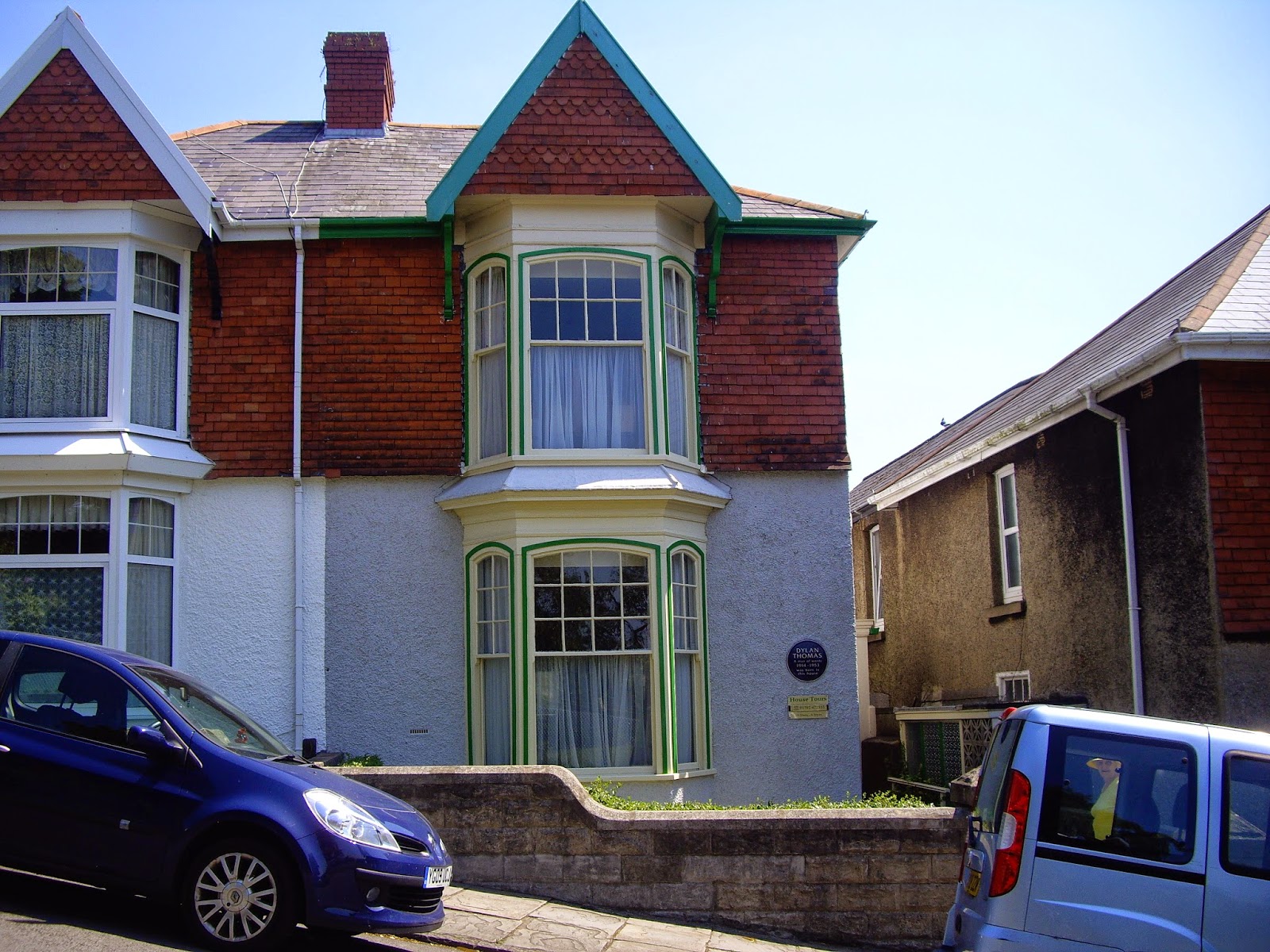
     Swansea seems to undergoing huge re-development, most of which looks regrettable.  We paid a flying visit to the slightly underwhelming Dylan Thomas Centre housed in a splendid old building - the former Guildhall - near the docks.  The exhibition was interesting, if a little too noisy when all the audio clips were playing at once.  From there to the Promenade, and reminiscences of the Mumbles Train, and then swiftly on to 5 Cwmdonkin Drive, in the Uplands area of the city and the childhood home of Dylan Thomas.


     Back down the hill to the The Guildhall, 1934, by Sir Percy Thomas.  A huge brooding bulk of white Portland stone.  A fortress of a building.  A classical building where all the entablatures have been omitted giving each façade the look of a cliff  The entrances are like the mouths of caves punched in the massive masonry.  The windows almost seem incidental at times to the elemental feel.  Each entrance is filled with a Bronze grille and door as though they had stepped out of ancient Rome.  The whole thing is powerful confection of Imperial Rome, French Neo-classicism (Ledoux and Boulle) and Art Deco.


     As you can see ornament is used sparingly - the Guildhall uses mass rather than ornament for effect - though there are a number of Art Deco-ish sculptures.  Sir Robert Lorrimer developed a similar language of bare monumental wall contrasting with carefully placed ornament.  Perhaps it would have benefited from the use of another stone, one with more personality than the even-grained Portland.

     Inside there are civilized spaces and long corridors.  The detailing is superb: bronze handrails end in the prows of Viking Long Boats commemorating the founders of the city.  At the centre of this great hulk of a building nestles the Brangwyn Hall.  This enormous concert Hall contains a series of great mural paintings by Sir Frank Brangwyn, each painted to resemble a tapestry.  Known either as the 'Brangywn Panels' or the 'Empire Panels', they were painted by Brangwyn (1867-1956) as a celebration of the riches, both cultural and material, of the British Empire. 


     After lunch we headed north to Llandeilo Fawr and Dinefwr.  Plas Dinefwr, also known as Newton House, is a property that has been rescued by the National Trust from near dereliction.  The estate marks the political centre of the old Welsh Principality of Deheubarth.  The current house was originally erected during the Restoration, and was surrounded by a Baroque garden and landscape. Unhappily these were swept away, and a landscape Park laid out by Capability Brown. The exterior of the house was eventually recast in Victorian High Gothic by Richard Kyrke Penson, whilst retaining the classical proportions of the original design.


     The porte-cochere and the rather French tops to the corner towers are part of Penson's work.  The interior was a bit of a disappointment. Firstly the interior had been wrecked by squatters, and secondly the Trust had decided to re-instate the interior as it would have been in the Edwardian Age.  I think this was a mistake; I would have preferred the Trust had used an interior designer, someone say of the calibre of the late John Fowler, to create new interiors in a traditional taste. 

     At the rear of the house Penson added this remarkable porch and conservatory which certainly help break up the barrack like bulk of the house. (Walking around the outside I did think the whole thing a little institutional, as though it had once been an asylum.)


     In the park I found these remarkable oak trees with their writhing, twisting roots.


  Finally (!) we stopped briefly in Llandeilo Fawr and I took these.  I need to return and explore some more.


Thursday, 29 May 2014

Mary Gilliatt: 'A House in the Country' II

   Here is part two of my selection of images from Mary Gilliat's 'A House in the Country' - a slightly different selection from the which my friend Ben Pentreath posted earlier this week.


   I love this photograph.


   I suspect that this cottage, in Suffolk, also belonged to Mary Gilliatt.  The furniture in the dining room including the dresser, and the items on that dresser, are identical to those in the image of her dining room and kitchen I posted at the end of last week.  I wonder what the explanation is?


   Seriously, what's not to like?


   The hall is stunning.


   The home of film director John Schlesinger and his partner Geoffrey Sharpe.  The work of David Hicks.  The outside, a former oasthouse in the Weald is suffering from a thorough going over in Suburban style.  The inside however is more more interesting.  The best room is the dining room.  Stairs in the style of Eliel Saarinen, derived in turn from Voysey.


   A wonderful evocative image, those stairs.


   With the possible exception of the lighting there's nothing I would change.  I even like the Casa Pupo rug.


Sunday, 5 January 2014

A stinking cold and Robert Harling

Funny how things take you.  I'm siting here, Sunday afternoon, with a stinker of a cold and feeling, at times, bloody miserable.  I've been spending some of my time on the internet - quite a lot of it on Pinterest.  (Yes, I've joined - just after Christmas.  You can find me on www.pinterest.com/somechameleon)  One pin led to another and I found myself back on Ben Pentreath's blog (Do all roads, like Rome, lead there?), looking for the name of a short-lived magazine published in the late forties dedicated to graphic design.  'Alphabet and Image'.  A few more pins led me to a whole host on information on Robert Harling, co-founder of the magazine, including his very lovely house.  And what a remarkable man he was - I'm tempted to call him a renaissance man: designer, journalist, novelist, editor.  Worthy of a more detailed blog when I feel better.  Though it is interesting how our interests develop, become more intense at a particular moment in time.  I had read Mr Pentreath's blog sometime ago, but it was only this afternoon did it bear fruit.

Thursday, 14 November 2013

Kettle's Yard, Cambridge Part I

   Back from a few days away at the bf's.  Forgetting to take my camera with me I have no images of our rather damp day in London: no images of 'Simpson's Tavern' in the City of London where we had lunch, or of the uber cool Lamb's Conduit Street (obligatory visit to Ben Pentreath's shop just round the corner in Rugby St.), or 'Paxton and Whitfield' in Jermyn St..  Quite a crowded few hours!  However I did take my camera along with me the next day in Cambridge.

   I first went to Kettle's Yard as a teenager on a school trip to Cambridge, and like the city it is a place to which I return over and over again.  It has this power to constantly fascinate.  I won't bore you with the history of the place; you can easily find it online.  Sufficient enough for now to say it is the creation of a single agent: Jim Ede. Though I suppose his wife, Helen, must have had some input - surely?  Between 1958 and 1973 Jim Ede created and maintained this enchanting and curious place - a 'palace of art' in effect filled with early twentieth century English Modernism, but also part stately home, rustic farmhouse and, almost Cistercian, monastery.  The Edes had no television or radio and little electric light - they rose and retired to bed with the sun.  It is these contradictory aspects - these ambiguous attitudes to both Modernism and Modernity - that I wish to explore on my next post.


   Kettle's Yard from the east, along the path leading up past the later gallery (on left) from Castle St.  St Peter's churchyard is on the right.  The entrance to the house itself is further up the steps and under the dark weather boarding.


   Another view of the east side of Kettle's Yard from St Peter's churchyard.

Wednesday, 13 March 2013

Alan Sorrell Part I

      A month ago (can it really be as long as that?) Ben Pentreath on his blog 'Inspirations' shared his discovery of the work of illustrator and author Rena Gardiner.  Reading about Rena's work my mind turned to one of my favourite illustrators: Alan Sorrell.  I first discovered his work as a child, firstly I suppose in our local library, and then on our annual holiday in Scotland where I found his work on postcards and in the guides available at Ancient Monuments: St Andrews Cathedral and Priory; Dryburgh, Melrose and Jedburgh Abbeys.  A subsequent holiday in Wales brought further examples of his work.

      Alan Sorrell (1904 - 1974) trained firstly at Southend School of Art and then, after two years as a commercial artist, at the Royal College of Art.  His contemporaries there included Bawden.  During WWII he served as an Official War Artist with the RAF.  His is mainly remembered today for the beautiful drawings he produced re-constructing ancient sites - this side of his work was the result of a chance meeting with Kathleen Kenyon, 'the most influential female archaeologist of the 20th century', in 1938.  Some of these were produced for the Ministry of Works, others as book illustrations, such as the series produced for The Lutterworth Press in the early 1960s - 'Prehistoric Britain', 'Roman Britain', 'Saxon England', 'Norman Britain' and 'Medieval Britain'.  Although Alan Sorrell illustrated every one in the series, each book had a different author.  In 'Roman Towns in Britain' he wrote the text as well as drew the illustrations (published posthumously by Batsford 1976).  He also produced a number of murals, including one for the Festival of Britain.
   
      Alan Sorrell's work is deeply atmospheric, evocative.  Neo-romantic.  The skies scowl with rain clouds.  Wind whips the smoke.  People gather in groups; they hurry to a race track in Roman Wroxeter; they flee a smoking Roman villa that is being sacked by Saxon raiders.  People shop, they listen to speeches and watch jugglers.  His pictures are more than mere re-constructions - they live.

      There will be an exhibition of Alan Sorrell's work later this year at the Sir John Soane's Museum (October 25th 2013 - January 45th 2014)

Roman Towns in Britain

Looking somewhat tatty.  As a child I bought, or was bought, this book in 'Bertram A Watts' - the bookshop in Sherringham, north Norfolk.  A visit to family in Norfolk would invariably conclude in Sherringham with a walk along the 'prom' and a visit to the bookshop.


   The quayside, London.  The stream to the left is the Walbrook


     Venta Icenorum, from the air


     The Balkerne Gate, Colchester


   The Forum, St Albans


   The Baths, Wroxeter