Our final full day in Wales, and again we drove west exploring this time the eastern side of Carmarthen Bay. We made a brief stop at Llanelli to pop into the covered market, which had some really good stalls, and then drove along the coast to Kidwelly.
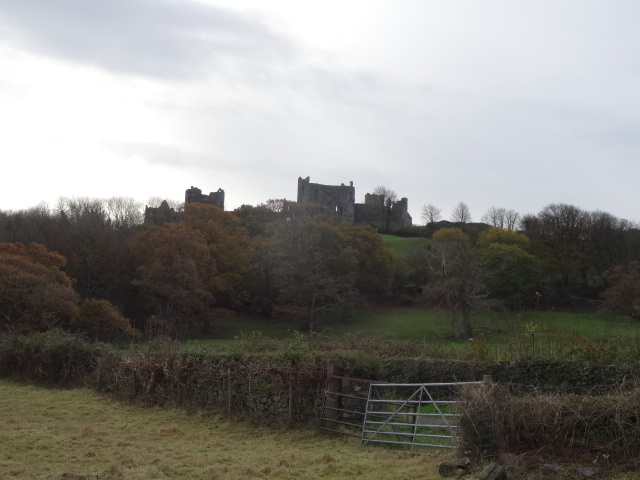
Kidwelly is a very small, attractive town at the mouth of the Gwendreath. It has both a priory church and large, well preserved castle. Both are very prominent, (spires are not so common, I think, in Wales - towers are either flat topped with battlements or have a saddleback); and they and the town that lies around them are Norman foundations, part of the conquest of southern Wales.


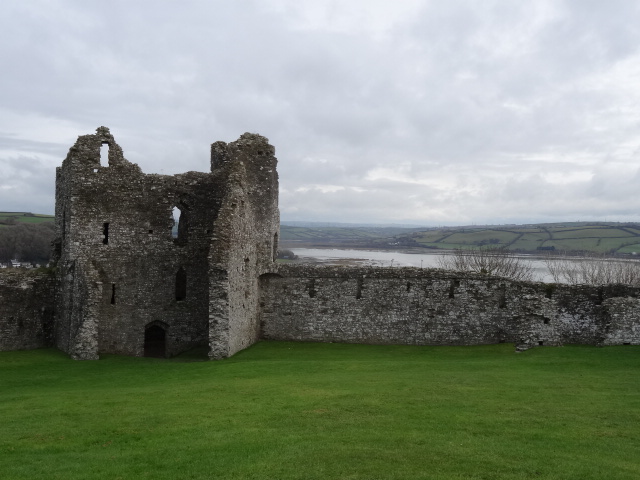
The Castle is great example of a 'concentric castle'. It stands high on a cliff above the river. The two inner baileys form a sort of 'D' shape. The walls bristle with towers. The great outer bailey or ward is now occupied by houses, though the outer gatehouse partly survives with an arch still across the street. The inner gatehouse, which is much more intact, is enormous, with a large Great Hall on the first floor.
The Priory church down in the town is a large, aisle-less cruciform church, founded in early 1100s by Bishop Roger of Salisbury as a daughter house of Sherbourne in Dorset. It has always also served as a parish church and was dissolved along with Sherbourne in 1539. In the later Middle Ages it seems to have become a pilgrimage centre.
Inside the priory church looking west. Wonderfully cool on a blisteringly hot day, with that welcome musty, old church smell. I love these wooden barrel roofs. St Mary's in Tenby has them, and you can find them too in Devon and Cornwall just over the Bristol Channel.

We drove west from there to Ferryside, a very small, mainly nineteenth century village and discreet seaside resort, on the shore of the Tywi estuary downstream from Carmarthen and opposite Llansteffan. There is a lovely wide sandy beach, and that same sort of silence we encountered at Laugharne. The views are wonderful. I took the opportunity to paddle. The bf refused. The water was deliciously warm, but he couldn't be persuaded. The railway line between Swansea and Carmarthen separates the village and the beach. We ate a very good fish and chip lunch at The Ferry Cabin which stands between the railway and the village square. Not surprisingly it was very busy. (The description in the 'Rough Guide to Wales' - 'chips-with-everything' - is unfair. The emphasis was very much on fresh local produce. If I remember rightly the owners are also farmers and it's beef from their cattle that's on the menu.) The village church, St Thomas, is High Victorian and a delight; a pretty much untouched Tractarian interior - dark, comfortable and solid.