Showing posts with label The Sixties. Show all posts

Wednesday, 8 July 2026

Something Nice To Eat


     Cookery means the knowledge of Medea and of Circe and of Helen and of the Queen of Sheba. It means the knowledge of all herbs and fruits and balms and spices, and all that is healing and sweet in the fields and groves and savoury in meats. It means carefulness and inventiveness and willingness and readiness of appliances. It means the economy of your grandmothers and the science of the modern chemist; it means much testing and no wasting; it means English thoroughness and French art and Arabian hospitality.  Imeans, in fine, that you are to see imperatively that everyone has something nice to eat.


     So said that eminent Victorian John Ruskin, and who's to argue with him.  He is thus quoted at the beginning of this beguiling 'short' (some 20 mins) directed by Sarah Erulkar, for the Gas Council.  As the dedicated reader of this blog will know I have a certain soft spot for these short films, documentaries, made to be shown in British cinemas before the main feature.  'Something Nice to Eat' is one of my favourites.  It is erudite, intelligent, playful and deeply stylish. Visually, it is a feast.  It may even be described as quintessential 'Sixties'.  After all, the model Jean Shrimpton does make 'a brief but intriguing' appearance.
     I have written briefly about Erulkar before on this blog, when I made mention of her wonderful film for the GPO 'Picture to Post', which is another visual feast. In 'Something Nice to Eat' her cinematographer was Wolfgang Suschitzky, who was also, you'll remember, the cinematographer for 'Get Carter'.  Between them they create some highly arresting and inventive imagery; food in particular is photographed in abundance and with sensuousness.  The fruit and veg stalls in Berwick St market are piled high with produce, both mundane and exotic; the butchers and the fishmongers displays are splendid. War and Post-war Austerity, this film may be saying, is over, banished.  Much use is made too of Schlieren photography (by Ronnie Whitehouse). The result is rather Psychedelic.  
     In both films Erulkar was also the script writer.  Here her words are narrated by David de Keyser, and the recipes presented by John Addey.  The cookery consultant was Margaret Costa of The Sunday Times Magazine.  Music by Johnny Hawksworth.
     In all a very classy production, especially when one considers it is essential an advert for the latest gas appliances.


 Something Nice to Eat


1967

Producer:               Anthony Gilkison Associates, The Gas Council
Director:                 Sarah Erulkar
Cinematographer: Wolfgang Suschitsky


Friday, 12 June 2026

St Cuthbert's Village II


     I now want to skip over the Pennines to Manchester and this BBC documentary, from 1974, about the redevelopment of the city on the 1960s.  Erroneously, the notes to this video claim it is the infamous Hulme Crescents; it is actually the Coverdale Estate, nicknamed 'Fort Ardwick' by the disgruntled residents.  It was designed by Manchester Corporation Architects Department, in collaboration with Bison Concrete Northern Ltd.  It was constructed, like St Cuthbert's Village, using prefabricated concrete slabs - the 'Bison Concrete Wall-frame System'.  The estate consisted of flats, maisonettes and houses.  As with the other two estates mentioned in this post, its failure was precipitous, and the film presents a churlish council struggling to keep up with the effects of its redevelopment policy, including apportioning blame to its own tenants.  'Fort Ardwick' was finally demolished in 1992

     The local MP Gerald Kaufmann said of it,

     'The scale of the buildings is often daunting. I have in mind Fort Beswick and Fort Ardwick in my own constituency. The design is frequently all too forbidding. That is why the two estates are called "Forts". "I am on the Fort", constituents tell me. Such developments are often unsightly. The approaches are not attractively landscaped and are often strewn with litter and debris.

     'Refuse disposal is too often haphazard and infrequent, and this can lead to the proliferation of insects and vermin which are already fostered by design defects. There was a penetrating article recently in The Guardian pointing this out. The caretaker service often is insufficient to meet the needs, where the service exists at all. Too many developments in my own constituency and that of my hon. Friend have no caretaker service."

     'The despair of some tenants can be summed up in a remark made to me by a lady who lives on Coverdale Crescent, more commonly known as "Fort Ardwick", which is now perhaps the best known deck access development in Britain. A few weeks ago, on one of my visits to see the estate, I had a long discussion with a number of the residents. One of them said to me, "If Labour wins the election, it ought to do two things: abolish the House of Lords, and demolish Fort Ardwick."


     We underestimate the complete dislocation that working class people suffered as a result of these schemes.   By the end of the 60s the Post-War vision of the New Jerusalem began to crumble and few years later it seemed that Modernism was itself defeated.  For some on the left, including perhaps the director of Get Carter, Mike Hodges, it caused a cognitive dissonance.  The failure of such estates as St Cuthbert's Village, really wasn't the result of corruption, but an intellectual failure.  I think, that in some respects, it caused the breaking of the social contract.


Monday, 8 June 2026

St Cuthbert's Village I

Apologies, for the version of this article I posted earlier, for some unknown reason an previous draft was published, and not the finished article.  Mea culpa.


     I want to go back now to the Tyneside of the early 1970s and one of the locations used in the film 'Get Carter', the Modernist St Cuthbert's Village, Gateshead.  (I really can't show you the scene in question, not simply because of any reasons of copyright.)  It serves as a prime example of the sort of urban re-development that took in the first three decades after the end of WWII in Britain's major cities, as local and national government tried to solve the housing crisis.  It was miles away, figuratively and physically, from the 'New House Book'.

     St Cuthbert's Village was the work of the local council, and was opened by the Prime Minister Harold Wilson on April 7th, 1970.  It was, I suppose, quite a coup for the local council that the Prime minister should give his support in such a way.
    What was produced, however, was a sort of simulacrum, a stand-in for an actual village, like one of those cream substitutes so beloved of food manufacturers Post-War.  Grey and hulking.  It had neither church nor green, nor school.  Facilities were planned but they were late off the starting block and arrived after the residents.  There was no traditional urbanism.  It was a sort of enclosed community, introverted and not wholly integrated in the warp and weft of the community that surrounded it.  A sort of ghetto.

     The concept belonged to the Borough Architect, A Leslie Barry.  He talked of a 'village community', but all that actually meant in practice is that, like a good many architects and planners of the period, he wanted the strict segregation of pedestrians and motor vehicles.  The site was a steep slope on the south bank of the Tyne, opposite Newcastle city centre, between between Bensham Rd and Askew Rd..  The estate overlooked a rail marshalling yard and the High Level Bridge that carried the East Coast Mainline into the midst of the city.  Historically, the area had been known as Windmill Hills, and before slum clearance in the mid 60s, the site had contained a dense network of terraced housing.
     The actual design was shared, it seems, between Douglas Wise (of Douglas Wise & Partners) and Clifford Tee & Gale, consulting architects to the contractors Stanley Miller Ltd.  The majority of the buildings etc. were constructed of pre-cast concrete sections using the 'Miller Wise Mouchel' system (MWM for short).  The estate consisted of a single tower, or point, block and a dense checker board of four, six & eight storey maisonettes, everything connected by a series of aerial walkways.  It was designed to house 3,500 people. Construction began in 1967, and the cost all in, was, I believe, £3,700,000.  At the time it won a government award for 'Good Design in Housing'.


   1987 View of St. Cuthbert's Court and six-storey blocks
   The University of Edinburgh Tower Block Project


   1987 View of St. Cuthbert's Village
   The University of Edinburgh Tower Block Project


     However there were problems almost immediately - flats were damp and roofs leaked, and it was difficult to heat the flats.  The project limped on for some 25 years, waxing in problems both structural and social, before it was demolished.  Its fate matched that of another council estate of the period, the nearby Clasper Village.


Thursday, 21 May 2026

Here We Go Round the Mulberry Bush

     
     It is the late Sixties, let us say 1968 as it is the year of this film's cinematic release.  It is a Saturday - likely the morning - in a New Town in southern England.  (It is actually Stevenage.)  The town, and particular the Town Square, is busy with shoppers.  Among them is 17 year old Jamie McGregor - sixth form pupil at the local Grammar School.  He is cycling around delivering groceries for a local supermarket.  His mind, however, is not his Saturday job, but elsewhere on another sort of job.  Sex.  Crumpet.  Skirt.  His mate Spike is getting it; even his younger brother is getting it....
     That evening Jamie goes on a date of sorts. His first. It is unsuccessful, as these things often are. 
     And so begins a year of comedic adventures as Jamie bounces from relationship to relationship battered, bruised but undimmed.  Here's the full list of runners: 'runny old Linda'; church-going Paula (and her mate Cath); affected Caroline Beauchamp; ditzy Audrey; and cool, leggy Mary Gloucester, doctor's daughter.

     Clive Donner's 1968 film is an adaptation of Hunter Davies debut novel of 1965, 'Here We Go Round the Mulberry Bush'.  Screenplay by Hunter Davies and Larry Kramer, who was also Assistant Producer to Clive Donner; Cinematography by Alex Thompson; and score by Steve Winwood, Traffic, and the Spencer Davis Group - who also appear in the film playing at a young persons' disco at the local parish church. No parochial event that; in perhaps the most stylish scene in the film, the band - all in white - perform upon a circular revolving stage in the midst of a room lined in black engineering bricks, while a cool, well dressed crowd of the beautiful people dance around them.  It put in mind, momentarily, of Jacques Demy's wonderful 1967 film 'Les Demoiselles de Rochefort' with its mix of Nouvelle Vague (almost complete use of location filming) and heightened reality.  Would the Spencer Davis Group really have played a event in the local church hall?  (If you haven't already watched 'Les Demoiselles de Rochefort' then you should.  It's a treat.)
     The cast is excellent.  A 23 year old Barry Evans, playing Jamie, leads a cast of relative new-comers, some of whom went on to become household names here in the UK such as Christopher Timothy, and Diane Kean.  I think, however, the older members of the cast such as Michael Bates and Moira Frazer, playing Jamie's parents, have the edge when it comes to characterisation and dialogue.  One of the faults of films of that period is that they tend to sprawl about, as though the director is easily distracted (or self indulgent), and the narrative structure suffers as a result - think 'What's New Pussycat?', 'Casino Royale', and 'The Charge of the Light Brigade'.  It was as if films were suddenly subject to centrifugal force.  The Mulberry Bush is not totally immune from these tendences as there are a number of 'dream' sequences of various degrees of naughtiness, but their ability to disrupt the narrative is mainly held in check.

     As you may have realized by now I rather love this film, and I recommend a watch.  It's all very 'Sixties' and all rather innocent.  A long way from 'Get Carter'.  What a difference a mere three years make.  Gone is the charm, the innocence, and the optimism.
     It is a comedy of manners but in some ways is also a pre-cursor of the sex-comedy of the 1970s - the comedic bedroom scenes, the coitus interruptus -  and many of the cast would later appear in that peculiarly British genre: Barry Evans starred in 'Adventures of a Taxi Driver' & 'Under the Doctor'; Adriene Posta in both 'Adventures of a Taxi Driver' & 'Adventures of a Private Eye'; Diane Keen in 'The Sex Thief'; Christopher Timothy in 'Up Pompeii' & 'Eskimo Nell'; George Layton in 'Confessions of a Driving Instructor'.  The prize, however, must go to Sheila White, who appeared in all four of the 'Confessions' films.  I simply didn't know that so many were made!

Here we go Round The Mulberry Bush

1968

Producer:               Clive Donner
Director:                 Clive Donner
Cinematographer: Alex Thompson

Friday, 1 May 2026

'Charlie Bubbles'

    Last week we watched 'Charlie Bubbles', a 1967 British film starring Albert Finney, Liza Minnelli, Billie Whitelaw, Colin Blakely, and written by Shelagh Delaney.  Finney also directed. The producer was the actor Michael Medwin, who with Finney had founded the production company 'Memorial Enterprises' in 1965.*  Well, what's not to like? you may think.  As you can see it has all the ingredients for success - strong cast, talented script writer. You would be, however, be wrong.  The result is decidedly flat-footed.  Finney plays the eponymous hero, a successful novelist, who - accompanied by his secretary (Minnelli) - goes on a picaresque journey back to his roots in the North. (North of England that is.)  Not as bad as the adaptation of Iris Murdoch's 'A Severed Head' I reviewed in 2024 - 'Charlie Bubbles' has its moments, after all - but still a dud.


Charlie Bubbles

1967

Producer:               Michael Medwin
Director:                 Albert Finney
Cinematographer: -

* Memorial Enterprises not only produced 'Charlie Bubbles'. They were also responsible for, amongst others, 'A Day in the Life of Joe Egg', 'Privilege', and 'If....'.  they also produced a stage play: Julian Mitchell's 'Another Country' in 1981.


Tuesday, 28 April 2026

'Mlinaric on Decorating'

      I've had this book - large, hardback, excellent photography - on my shelves for years now, but as with any 'recently' published book I feel a bit reticent about posting images from it, but here goes....

     Mr Mlinaric, born in 1939, is one of Britain's foremost interior designers, though now retired.  He has worked for the likes of Mick Jagger and the Rothschilds.  As a child he was inspired by a number of chance encounters with remarkable interiors; Widcombe Manor near Bath, home of Jeremy & Camilla Fry; Leixlip Castle, home of Desmond & Mariga Guinness.  Ireland, in general, stirred his visual imagination: Dublin, 'a perfect Georgian city, shabby and seedy, old-fashioned, with little shops with turf fires burning', and the decaying country houses of the Ascendancy, 'when a celling came down, the family just closed the door and moved to another room.  They wouldn't sell their houses, hoping for a better days, and as a young man found that very romantic, just holding on and keeping things.'  There is something very poetic about these sentiments. He trained at the Bartlett, moving from architecture to interior design after a year.  He was part of the whole Swinging Sixties thing, and apparently knew everyone, some of whom, such as Ozzie Clarke moved in the circles documented in Peter Schlesinger's 'Checkered Past'.  There is a short documentary ostensibly about young men, including Mlinaric, with long hair made in 1967 by the BBC.  One way, perhaps, of seeing that whole 'Swinging Sixties' phenomena is as an attempt to re-enchant the world, to revive the poetic and the mystical.


     David Mlinaric seems, from the beginning of his career, to have worked in two styles, one contemporary and one traditional.  It is the latter that interests me and in particular there
 are three schemes from quite early on in his career which I think are quite masterful: Thorpe Hall (1970-72), interesting not only because it represents his own taste, but was done with such assurance for somebody in their early thirties; Beningborough Hall, (1977-79), for the National Trust; 'An Eighteenth Century Lodge', (1977-1979).  It was this last scheme that I remember from an early edition of World of Interiors.  Later work in this style is to be found at Luggala (1997-2006), Waddesdon Manor (1990-2002), and Milgate Park (2002-2006).  At times it is Neo-Classical, at other times almost Neo-Victorian.  Sometimes, interestingly, 'Sixties'.  Perhaps it never went away.  (Though Thorpe Hall stands almost out of time.)  Anyway, Mlinaric moves with ease and admirable skill between styles, and with this remarkable talent he has contributed to the public realm here in the UK with restoration of Spencer House, London; the Royal Opera House, Convent Garden; The National Gallery; The National Portrait Gallery; and the design of The British Galleries at the V&A.  His knowledge must be encyclopaedic. 


Mlinaric on Decorating  Mirabel Cecil & David Mlinaric, Francis Lincoln Limited, 2008


Friday, 10 April 2026

'Checkered Past: A Visual Diary of the '60s and '70s'


But I sat back and looking forward
My shoes were high and I had scored
I'd bolted through a closing door
I would never find myself feeling bored


     I've been neglecting the blog of late, certainly neglecting the visual side of things, not being that happy.  It's all become a bit wordy.  Then lunchtime, for some reason, I suddenly thought of Peter Schlesinger's wonderful book 'Checkered Past: A Visual Diary of the '60s and '70s', published 2003 by Vendome Press.  I discovered this book on Ben Pentreath's Inspiration Blog over a decade ago now, and it has been a firm favourite of mine ever since.  It is a book of a slightly melancholic beauty.  Schlesinger's photographs are ravishing, sometimes possessing an ethereal quality, the result I think of the use of film.
     'Checkered Past' documents the American artist's ten years, or so, living in London from the late '60s to the late '70s.  When David Hockney returned to Britain in 1968, Schlesinger - then his lover - followed.  They settled in the then slightly seedy Notting Hill in w London.  In those days those grand stucco houses were subdivided into flats and bedsits.  It was a life poised between the bohemian and the Beau Monde.  A life that included, amongst a cast of seemingly thousands, such 'Somethingofthechamelon' favourites Cecil Beaton, Patrick Proctor, David Hockney, Min Hogg, Gala Mitchell, and Celia Birtwell; the social, the arts, applied arts and the intellectual. Socialites and plutocrats.  A life partially covered in Jack Hazzan's 1973 film 'A Bigger Splash', which purportedly covers the aftermath of the end of Schlesinger's relationship with David Hockney, and the creation of one of Hockney's most well known paintings, 'Portrait of an Artist'.
     It is a world that is slowly slipping from our grasp.  It essentially ended in the mid-70s after the Oil crises.  I think it was Sir Roy Strong, who moved in the same circles, who said that it was the last social great period, or words to that effect.  Certainly a more colourful world both in terms of the visual but also the character of those depicted.  There was definitely more place for the eccentric and the intellectual.


Checkered Past: A Visual Dairy of the 60s & 70s  Peter Schlesinger, Vendome Press, 2003

Friday, 19 June 2020

Smashing Time

     The other night we settled down to watch that satire of Swinging London, 'Smashing Time', starring Lynn Redgrave and Rita Tushingham. Another film bought to you by those lovely people at Talking Pictures. 
     The screenplay is the work of the Jazz singer, raconteur and haute bohemian George Melly (no fan, it has to be said, of the whole mythos of Sixties London) and is essentially the picaresque, if not at times farcical, tale of two northern lasses who come up to London to make it big. And make it they do, only to find that it it really isn't all that smashing after all. The satire is a little scatter-gun, as the film nobly takes it upon itself to parody nearly all the tropes of the period, including (oddly) the trend in restaurants specialising in British cooking. That said it does have a few telling moments. Perhaps more subtly critical are the background shots of London itself - tired, care worn and grimy. Not obviously a place where dreams are made. The cool and the groovy are rare things. It has to be said that the humour is very slapstick at times - not a thing that I particularly enjoy, but there are all sorts of cameos from any number of British character actors to make up for it.

Smashing Time

1967

Producer:                Roy Millichip, Carlo Ponti
Director:                  Desmond Davis
Cinematographer:  Manny Wynn

Thursday, 4 June 2020

The Ballad of Tam Lin

 
O I forbid you, maidens a'
That wear gowd on your hair
To come or gae by Carterheugh, 
For you Tam Lin is there


     Gosh, it has been a long, long time since I posted a film review, and the meantime I've seen plenty of good films.  Perhaps I ought to do some catching up.
     Anyway on Sunday evening I sat down with the bf to watch the remarkable and decidedly odd film 'The Ballad of Tam Lin' aka 'Tam-Lin', 'The Devil's Widow, 'The Devil's Woman' - the only film to be directed by the Anglo-American actor Roddy McDowal. A rare thing then, and perhaps the only movie to be based upon a British folk ballad, the eponymous 'Tam Lin'. The ballad is native to the eastern marches of Scotland, but its origin lies in the Scottish medieval Romance - a tale of abduction and rescue, the interplay of the Seen and Unseen, which in this case is the fairy realm. Thomas of Echeldoune, True Thomas, like Tam, had a run-in with the Queen of Elfland in the same sort of area. A coincidence?
     The film ingeniously follows the narrative structure of the ballad, moving in time but not space, placing the action in the contemporary Britain of the late 60s/early 70s. Visually, then, very stylish, as one might expect from a film of that period. It calls on a number of Late Sixties tropes such as the Occult Revival and pyschedics.  The action centres on the sybaritic 'household' - a motley collection of all sorts of beautiful, and not so beautiful, people - of the the mysterious Michaela Cazaret, 'Micky', played by Ava Gardner resplendent in Balmain. A subtle, charismatic performance. Look out for Jenny Handley, Peter Hinwood, Sinead Cusack, Madeline Smith and Bruce Robinson amongst the hangers-on.
     The film opens in Micky's London house - in Regent's Park, I think - where Tom Lynn is sharing Micky's bed. By the end of the day however Micky and her entourage of Lotus Eaters have arrived at her country house (the wonderfully romantic Traquair House) in the Scottish Borders.
     All, as you can imagine, is not as it seems (it seldom is), and as the film progresses the viewer is shown the murky depths beneath the glamorous but brittle surface. The catalyst for this process of revelation is the arrival of a stranger Janet, played by Stephanie Beacham in perhaps her first film role, though not an outsider as such for she is from the real world. Tellingly she is the daughter of the manse. Bored a little with rural life she is rather dazzled, and perhaps a little scared by what she sees on that first disconcerting encounter. One of the household she meets on that first visit is Tom. They meet subsequently by chance in the open countryside. Tom even then, one feels, is beginning to pull on his leash. There is a desire in him to explore the world. The two fall in love, Janet becomes pregnant and Micky jealous and vindictive. She wants her revenge and upon her orders Tom is pursued and abducted. There follows perhaps the most unsettling part of the film when the household (a new household, mind you, Micky having got bored of the old crowd) attempts to murder a drugged and hallucinating Tom. 
      A film then that is about the end of the Sixties, the collapse of that seductive dream, as Britain lurched into economic crisis and conflict. Watching 'Get Carter' a film of roughly the same vintage one feels the same thing, except in that film the victims are all really piling up for all to see.
     Both the film and ballad are a dramatization and indeed mythologizing - a mimetic representation - of a sort of passage rite from Tom in which he finally leaves (a prolonged) childhood, escaping from a dominant, monstrous mother figure (both ballad and film are rich with Jungian archetypes) and entering into the world of men. Earlier in the film Janet tells Tom to 'grow up'. In that final scene Tom undergoes a type of Baptism by fire and water emerging, just as in the ballad, that new man. 
     Both of us wished McDowall had made more films.


The Ballad of Tam Lin

1970

Producer:               Alan ladd Jr, Stanley Mann, Anthony B Unger, Henry T Weinstein
Director:                 Andy McDowall
Cinematographer: Billy Williams

Monday, 5 March 2018

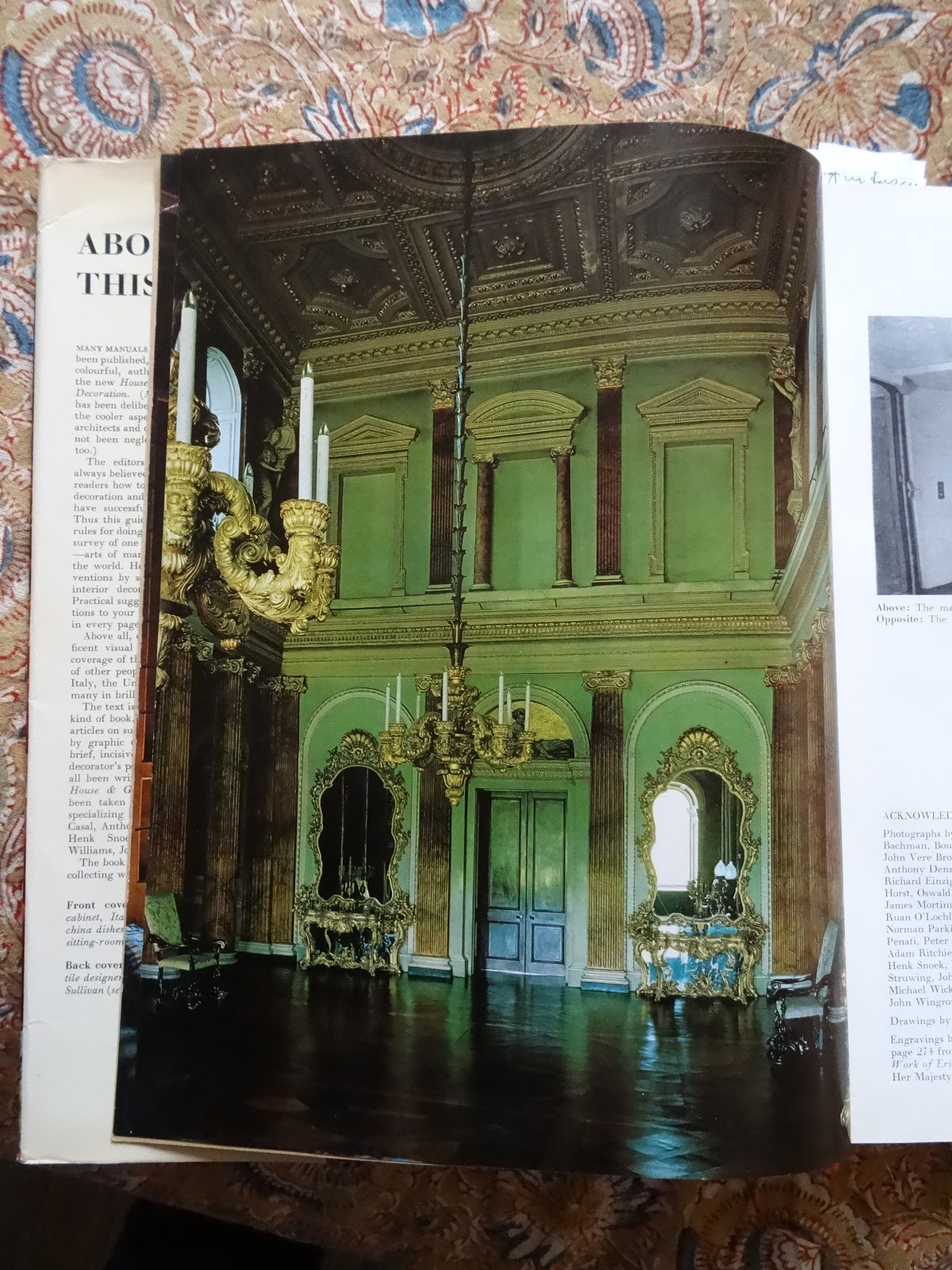
House & Garden Guide to Interior Decoration

     Another lucky charity shop find here.  'The House & Garden Guide to Interior Decoration' dates from 1967 (my copy is a 2nd edition from 1969) when the multi-talented Robert Harling was editor. (I really must do a post about him.)  Anyway the book is a wonderful period gem, marvellous in every way, full of strong, confident designs and colours such a contrast to today's bland, safe interiors. Clever and witty too. Below is a small selection - favourites, yes - of a vast array images this fascinating book contains.


Friday, 20 May 2016

'English Style'


     What can I say about this superlative book?  Written by Mary Gilliatt and published by Bodley Head in 1967 it is a truly beautiful thing to behold.  Not only is the photography, by Michael Boys, simply wonderful and often very atmospheric, but the design, by John Bigg, is terrific.  In all a really stylish, well considered production.
     I have coveted this book ever since it appeared on my friend Ben Pentreath's blog, and finally, now, I have my own, my very own copy.  Anyway here is my selection from this lovely book - not an easy task not only due of the sheer quality of the photography alone but because I could happily spend quality time in any one of the homes illustrated.  However there are, obviously, some I prefer to others. In fact Mary Gilliatt's selection is incredibly diverse, disparate even.  (A notable omission, I've just realized, is John Fowler.)  What, however, does hold them together is a common thread of eclecticism - a sort of portmanteau of styles and artefacts that is witty and clever and urbane and for her that is the English Style.  It displays the innate conservatism of English taste and it's rejection of High International Modernism.  Or a least a deeply ambiguous attitude to it. It is also in the last analysis humane.

     For those discerning few who read both this blog and Ben's I hope this isn't too repetitious a post.


The Chelsea home of  Robin & Lucienne Day


The weekend cottage, in Suffolk, of Terence and Caroline Conran


The London home of architect Mr Nicholas Johnston


In the home of architect Mr Roger Dyer


The London flat of Mr & Mrs Peter Hall


The London flat of Mr John Vaughan, critic and photographer


The flat of design consultant Kathleen Darby


In the London flat of Mr Klein Lichtenstein


The Oxfordshire home of Mr David & Lady Pamela Hicks


The London flat of Miss Anne Trahearne


The dining room in the Kensington Palace apartment of HRH Princess Margaret and Lord Snowdon


The bedroom of Professor & Mrs Fleming, Zoffany House, London


The London drawing room of Mr Hardy Amies


Bedroom by Jon Bannenberg


Daneway House, Gloucestershire


Stratton Park, Hampshire, designed by Billy McCarty


The London house of Mr David & Lady Pamela Hicks


A London flat designed by Billy McCarty


The Hampstead flat of Mr Leslie Waddington