Showing posts with label Orthodoxy. Show all posts

Wednesday, 23 April 2025

St George

 Happy St George's Day


Sunday, 20 April 2025

Happy Easter!


Christ is risen!


Happy Easter to you all!


Christ is risen from the dead, trampling down death by death and upon those in the tombs bestowing life!


Wednesday, 20 November 2024

St Edmund, King & Martyr

    Exult, O Holy church of the English nation; behold unto thee is given to praise Edmund, the illustrious king and most invincible martyr, who, triumphing over the prince of this world, most victoriously ascended unto Heaven.


     Today is the feast day of St Edmund, King of East Anglia, martyred this day in c869 AD.  I'm not quite sure where the text quoted above comes from, but I think it may be from a Sarum Antiphoner. In the Middle Ages Edmund was one of those saints, along with St George and St Gregory the Great, associated with the realm of England.  His cult was deeply popular; there are some 78 churches dedicated to him in England with, unsurprisingly, the majority being in East Anglia and Essex.   He is also depicted on the Wilton Diptych. Apparently (according to wiki) it wasn't until the Tudor period that St George became the sole patron Saint of the nation.

Tuesday, 23 April 2024

St George

 Happy

St George's Day

to you all!


Deliverer of prisoners, protector of the poor, healer of the infirm and defender of Kings, victorious martyr George, pray to Christ our God for the salvation of our souls.
Orthodox Troprion


Sunday, 31 March 2024

Christ is risen!


 Happy Easter!


Christ is Risen!


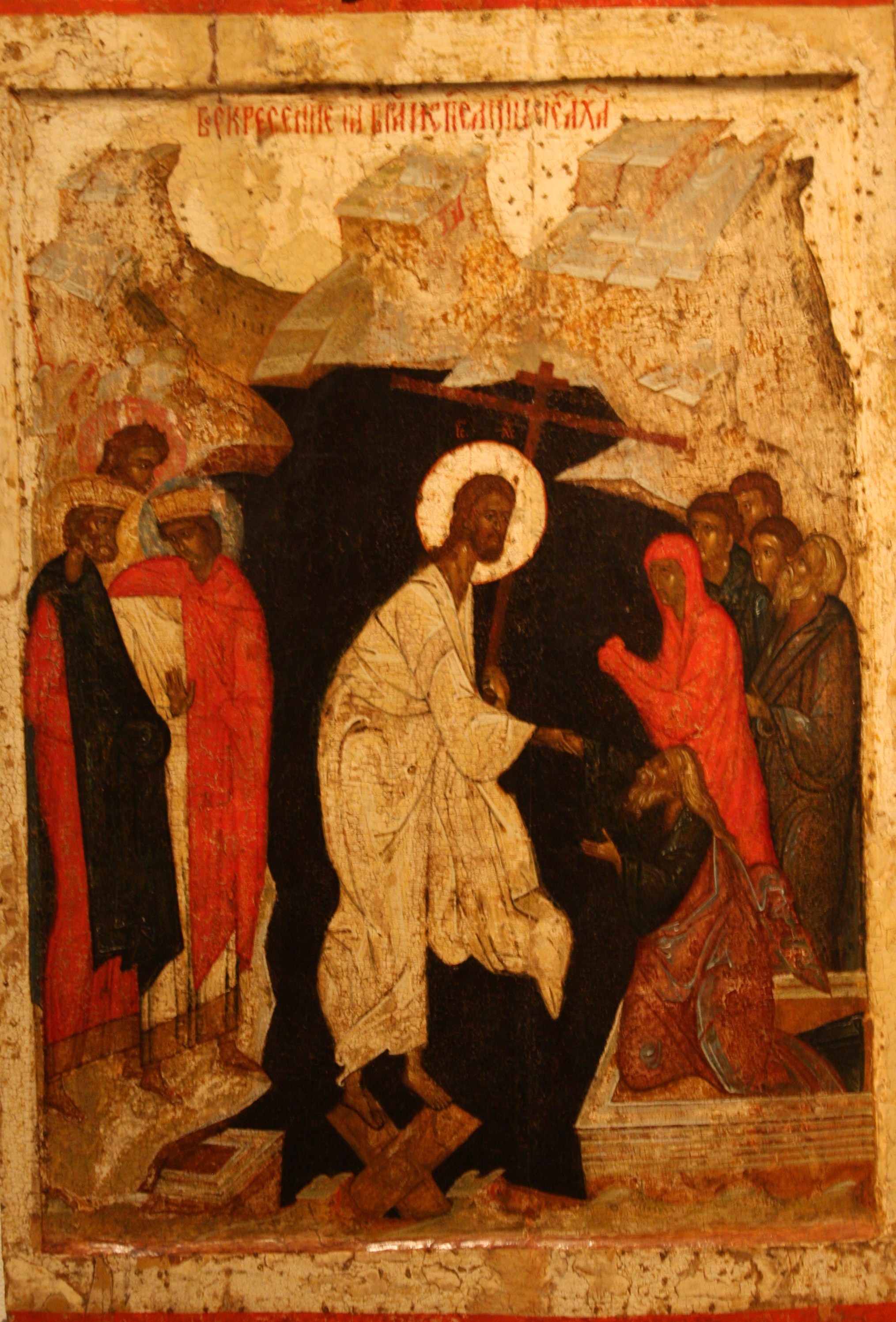
Christ is risen from the dead, trampling down death by death and upon those in the tombs bestowing life!


Russian icon of the Anastasis  from the Icon Collection of the Sweden National Museum


Tuesday, 10 December 2019

'These Russian wanderers are wandering still': 'Laurus' by Evgeny Vodolazhkin


     Spiritually I've been drifting eastwards for years - a long drawn out process of becoming. It's not as though I think the Orthodox Church, or the other oriental churches such as the Copts or the Suryani, are perfect - far from it, only that these churches have the greatest potential to become so. The churches where 'axial alignment' is most likely to take place. Although I am still technically an Anglican, my heart is elsewhere. Most times I attend an Anglican service I feel a little part of me dies. It's not just Anglicanism; I know I'd feel the same in any other western church. Simply Western liturgy, as it is now, and has been for centuries, is an inadequate vehicle for encountering and participating in and with the divine. I'm inclined to extend my doubt to Western theology per se. The events of the summer here in the UK where a crazygolf course was installed in the nave of Rochester cathedral and a helterskelter in that of Norwich, have confirmed this. It is embarrassing. And now in this last week (it was a couple or more months ago now - this post has been a long time in gestation) a picture has appeared of seminarians confessing to a group of houseplants at Union Seminary in New York. Terminal decadence?  Who knows and who really cares anymore? They are in effect only symptoms of a wider cultural malaise.  Modernity from both inside and outside the church is in the process of shredding it.

     'He that findeth his life he shall loose it; and he that loseth his life for mysake; he shall find it.'

     'For the time being his only a blade of grass torn up his roots and blown through the air. And he feels it, and suffers for it, suffers often acutely!'


   It was a relief, then, months ago now to read 'Laurus', a novel by the Russian historian Evgeny Vodolazkin, English translation by Lisa C Hayden.  Here was something that was so deeply satisfying on so many levels: artistic, literary, intellectual and spiritual. At times it is deeply moving. (Here I feel I have to add an obligatory disclaimer: I am not commending a return to the superstitious world of the Medieval Russian Principalities. I wouldn't want to be misinterpreted after all! And the society depicted is deeply superstitious, bafflingly so at times.)  Anyway 'Laurus' has been awarded all sorts of prizes but no prize should ever be wielded by a reviewer as a reason to go and read a novel. As I've never won that many I'm ambiguous about them - they probably are more political than the organisers care to admit and are probably also only of transitory significance. I tend to ignore them. Even the Nobel Prize.
     Back to the novel. Deep in the bosom of Holy Mother Russia, that is the Orthodoxy of the time before the Petrine 'Reforms', before even the reforms of Patriarch Nikon and the schism of the Old Believers, in a society both organic and pre-Modern, rural and often isolating, a boy, Arseny, is raised by his grandfather, the local folk healer. Arseny has a gift for his grandfather's trade. A great gift. And concomitant with such a great blessing comes, as so often in life, a great price. That price, and it seems that Arseny cannot as a result accept death, is what pushes him out, firstly into the larger Russian environment and then further out still into Western Christendom and then the Middle East. Driven into the desert for the rest of his life haunted by his failure, forsaking houses, or brethren or sisters or father or mother or wife or lands*, unable to make a long lasting bound with another human being, endeavoring always to heal and save and cheat death. In spiritual terms his has entered into the state of Podvig that is 'spiritual struggle', what in Greek is called 'Catharsis.' I think some would describe Arseny as a marginal character, by which I mean one who dwells on the margins. I have to say I fight shy of such a description, as it is a misunderstanding of the central role of such figures in Russian, and indeed wider Orthodox, spirituality. Looking back now through the mist of several months I wonder how much autonomy, how much agency Arseny has in this process of spiritual being. At some points he is like a leaf carried on the wind of the Holy Spirit as he wanders through the bitter cold of a Russian winter barely, it seems, conscious. Arriving in the mercantile city of Pskov he (almost) finds himself a Holy Fool, the 'yurodivy'. I mean by that not some middle class bloke who dresses up as a clown occasionally for the benefit of middle-class Anglican congregations and then goes home again to the comfort of home, but somebody who has abandoned everything - home, possessions - even sometimes clothing - including the ability to be rational for the sake of participation with the Divine. Such figures continually re-occur in Orthodoxy, both consoling and disturbing. Paradoxical. But then Orthodoxy, unlike the West, has always found space for paradox. Alexy himself at one point lives with the bounds of a convent cemetery in a hovel he has constructed himself.
     Thankfully Vodolazkin does not the weigh the narrative down with too much explanation - that recurrent sin, as I have mentioned before, of much Sci-fi and fantasy writing. And this novel is in a way a sort of fantasy novel in that Vodolazkin is engaged on some sort of Tolkeinesque sub-creation, for Medieval Russia is almost as far removed from our times and concerns as Middle Earth. Better just to throw the reader in and hope they can swim. A writer should make the reader do some work after all. Not that the novel isn't alive with wondrous and intriguing detail. It is one of its delights and provides so much compelling atmosphere. Vodolazkin is a scholar in the department of Old Russian Literature at the Institute of Russian Literature (commonly referred to as 'Pushkin House') in St Petersburg, and is therefore well placed for such an endeavour. Detail is one way in which the writer can show and not tell. (Possibly one of the greatest exponents of that was the French catholic novelist Francois Mauriac - a novelist I think everybody should read.)
     'Laurus' is a book that stands in line of descent from the works of Dostoevsky and Pushkin before him, sharing a number of themes such as the spiritual role of Russia and the individual's spiritual struggle particularly in face of tragedy. The quotes above are taken from Dostoevsky's speech at the unveiling of the Pushkin Memorial in Moscow on June 20th 1880, describing Pushkin's character Aleko from his poem 'The Gypsies'. Dostoevsky uses Aleko as a metaphor for the rootless nineteenth century intelligentsia, but one feels, perhaps wrongly, that Arseny is like Aleko. He is both deeply encultured in the society around him and yet alienated from that wider Russian society by the potency of his gift and the inexpressible weight of grief his carries and the consequent fear of death. Arseny presents to us a character that has failed to integrate fully his self, and that failure is the fuel for the narrative drive. His journey is an attempt to achieve that integration. In some respects then Arseny is a extended metaphor of our own spiritual restlessness and our inability to deal with death.
     I really can't recommend this book highly enough. Read it!

*  Matthew 19:29

Sunday, 12 February 2017

London II: The Russian Orthodox Cathedral

     We walked through Hyde Park, and then plunged into the maze of residential streets north east of the V&A our goal goal being the Russian Orthodox Cathedral in Ennismore Gardens.  A building that has been recently been restored, and I was eager to see what had been done and experience its Orthodoxy.
     The cathedral, however, started out as an Anglican parish church, designed in the 1830s by Lewis Vulliamy (although work didn't commence for another decade).  In the 1850s Robert Louis Roumieu designed a sky-rocket of a campanile, which thankfully wasn't built. The present bell tower dates from the 1870s.  The interior, like many post-reformation Anglican churches of the eighteenth century onwards, is based on the early Christian basilican form - nave, aisles and apse.  We've met the form before on this blog.  The interior is very vertical in feeling.  The great columns are made of cast iron.  In 1892 Owen Jones's decoration was replaced by Arts and Crafts architect Charles Harrison Townsend and the artist Heywood Sumner, who decorated the nave walls with sgrafitto and the triumphal arch over the apse with mosaic.  The apse decoration, by Derwent Wood, dates from 1911. The work is excellent, and it was really pleasing to see that the recent restoration has respected the history of the church.
     Researching for this post I was faced with the same issue that afflicted my research on Houghton Hall last year; none of the secondary source materials seem to quite agree with each other.  It could be that the west front is original, and merely modified by Harrison Townsend i.e. the porch, which has very Byzantine detailing.  However the design, which is based on San Zeno, Verona, is nothing like that in 1850s perspective drawing illustrated in 'Victorian Churches', (Country Life Books, 1968).  I suspect that the whole façade is by Townsend in collaboration with Sumner who made the sgraffito decoration in the porch. The central panel over the door is not mosaic as claimed in one guide book. Either way it's a vast improvement on that illustrated.  When a student in west London a friend and I attended the Divine Liturgy one Sunday when the very holy Anthony Bloom was archbishop, and the place, as far as I can remember, was a little shabby.  There wasn't much money available then, I suppose.  Money, judging by what has recently been achieved, is now plentiful.  And rather splendid, and light filled, is the result. Not, thankfully, as lavish as I feared.


Wednesday, 5 October 2016

London and Walsingham


     It's been an eventful week.  A week ago today I took the train into town and a wonderful party at the Art Workers Guild in London's Bloomsbury.  Think architecture meets interior design, meets journalism, meets academia, meets literary London.  The host was my friend Ben Pentreath; the occasion was the launch of his stylish new book 'English Houses'.  With beautiful photography by Jan Baldwin its a lavish, seductive book.  The hall of the Guild (by F W Troup 1914) was decorated in the best Pentreathian manner with armfuls of dahlias that Charlie, Ben's husband, had brought up from their house in Dorset. I'm sure the waiters had been chosen as much for their looks as their hospitality skills. In the long years of caring it was the sort of invitation that came along rarely, and one that would be invariably declined.  The logistics of it would have been just too much hassle. Initial nerves were overcome, and I had a lovely evening meeting new people and catching up with old friends. I briefly met Ben's business partner Bridie Hall (it was her birthday) and Max, her dog and a total charmer.  Ben and Gabby Deeming, the Decoration Director of House & Garden magazine, both made speeches.  And I left with my copy of 'English Houses' autographed.  'Result', as they say.


       The other event of the week was of a totally different nature. And one I'm reticent to speak of, partly because at times I am such a low-grade Christian, but that was in its quiet way such a profound experience that I feel compelled to share.  On Saturday I joined a local pilgrimage party and headed east across the great, flat extent of the Fens and into Norfolk and to Walsingham. Here is my post from last year.  The morning's weather was superb again. Walsingham has this amazing air of serenity that, I think, is quite unique. The sun was warm and the apple trees were heavy with fruit in the garden of St Seraphim's church, like a painting by Samuel Palmer. The afternoon was, however, unfortunately wet.  After attending two indifferent services in the Anglican shrine (Pilgrim Mass and Sprinkling - both meagre food for pilgrims) I found myself attending Orthodox vespers upstairs at the Anglican Shrine.  The chapel was minute - hardly really more than a landing.  So narrow a space that the iconstasis had room only for two doors instead of the usual three.  An elderly priest lead the service, supported by a choir of one - I think it was his wife. From such meagre resources was created something incredibly moving, incredibly spiritual and powerful. Numinous. Transcendent.  The congregation varied between two and seven, but that didn't matter.  It had a deep integrity that somehow what was going on downstairs in the Anglican bit simply did not possess.
     I've been attracted to Orthodoxy for a long time, but rarely attended a service.  The opportunity has rarely arisen.  To attend therefore something that is so freighted with expectation is to risk disappointment.  I needn't have worried, the experience exceeded expectation.  I need to return.

Thursday, 15 October 2015

Walsingham I


     Walsingham is one of the major pilgrimage sites in Britain, and since my late teens the place has a held a deep attraction to me-  a place of refreshment, a place of incredible serenity, that is also in quite my favourite part of the world: North Norfolk.  In the Middle Ages it outshone all other Marian shrines in England such as Ipswich, Willesden or Egmanton, vying with, and eventually outpacing, the great shrine of Thomas a Beckett at Canterbury in popularity.  Pilgrims travelled from across northern Europe to visit.  Suppressed at the Reformation, the shrine was revived between the Wars, on a different site, by the then spikily anglo-catholic parish priest, Fr Hope Patten.  The church commissioned by Hope Pattern from Milner & Craze, 1931-7, looks like it has dropped in from suburban London and has decided to stay.  At least it has a pantiled roof.
     Regardless of the attractions of the shrine, Walsingham is a beautiful, if somewhat faded, village - the affluence of the North Norfolk coast has yet to trickle south.  Village, however, is not quite an accurate description, for the High St, in particular, has a bit of an urban feel. The Shell County Guide to Norfolk is happy to call it a small town.  There are old buildings and several lovely Victorian shop fronts, which once housed the butcher and the baker but are now crammed with any amount of saint-sulpicerie.  There are also the remains of the Priory, which sheltered the original shrine, and now part of the grounds of a small country house, and the friary - again part now of a house. The religious live dominates: retired clergy slowly wending their way home with the shopping and nuns cautious behind the wheel of an automobile as they navigate the narrow streets. Unfortunately 'The Martlet', which was a fantastic stationers and book-bindery, has closed earlier this year; however there are a couple of good antique shops and an excellent farm shop.
     One thing to look out in the following photographs for are the black-glazed pantiles.  A speciality, I think, of East Anglia, if not Norfolk only.  I can't think of anywhere else.
     And then, quite unexpectedly and quite deliciously on the very edge of the village, and formed out of the former railway station, is a Russian Orthodox church.
     Anyway, on Saturday, with all my contradictions and stupidities, I went on pilgrimage.  The weather was perfect, and it was in its way quite a profound experience.  Here are some of the images I took.