Showing posts with label John Fowler. Show all posts

Sunday, 24 April 2016

Grimsthorpe Castle I

   A week ago the bf came over for the weekend, and on the Sunday afternoon after lunch we drove over to Grimsthorpe Castle - a place of great beauty and tranquillity in the gentle, undulating landscape of south west Lincolnshire.

   The castle is an atmospheric concretion of hundreds of years of building and decoration, of both the monumental and domestic, and the cumulative effect is wonderful, and each visit increases my attachment. Without boring you too much with the history of things, the house developed out of a rectangular courtyard castle of which one tower (King John's) survives.  The most dramatic and architecturally important development came at the beginning of the 18th century with the building of the present north front and forecourt.  It is the design of that master of the English Baroque Sir John Vanbrugh - his last work, in fact -  and is the only complete section of Van's plan to rebuild the whole castle.  With his death the work just ceased.  Although I am a great fan of his work I have to admit that I'm pleased that the old house was not completely replaced - it has that layered, accidental quality I admire in a building.  In contrast the monumental north façade the south façade is the most domestic in scale, the east is the most varied, punctuated as it is by a series of great bay windows that light the state rooms.  The west façade was rebuilt in a quiet Tudorish Gothick in the early nineteenth century.

   The interior is a delight.  (But, alas, no photography is allowed in the house.) There is the great pomp and spatial ingenuity of the Vanbrugh's Great Hall and attendant spaces - quite breath-taking.  However apart from that complex and monumental sequence of spaces, the interiors are, perhaps, more domestic than you would encounter in many Country Houses, and none the worse for that.  The enfilade of state rooms is itself quite short - there is, for instance, no 'state bedroom' to complete the sequence; and it could be that they occupy the same place as the Tudor 'state' rooms.  (Van's plan was to put an enfilade of state rooms in the west wing with the chapel at one end (N) and the state bedroom at the other, in the manner of an English royal household.) It may come as a surprise to some to realize that the decoration of the interior is largely twentieth century and the work firstly of that unsung Arts & Crafts architect Detmar Blow, and secondly John Fowler who worked at Grimsthorpe over a number of years in the Mid-century.  Their work is a triumph, uniting the various periods of architectural activity in the house in a cohesive whole.
   The gardens are a delight too, and illustrate how in the last two centuries garden design in Britain returned to formality.  Happily.  The eastern sequence of formal garden and walled potager is particularly impressive, the latter, developed in the 1960s, is a pioneer in the revival of that form of garden.

The photographs are in the order I took them


Friday, 25 March 2016

'John Fowler, Prince of Decorators'

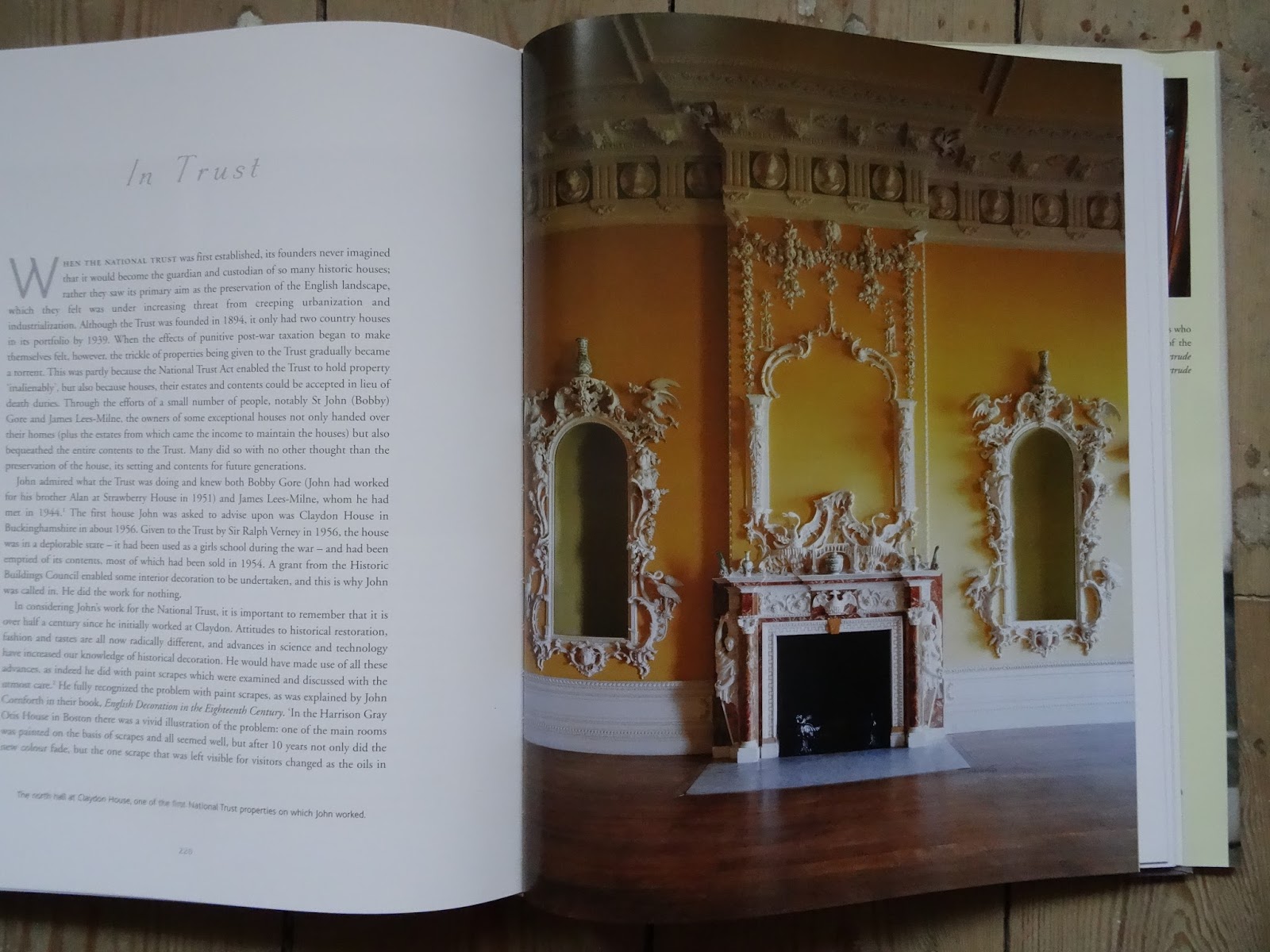
   Perhaps because I'm about to embark on a major redecoration of my house, but my passion for Interior Design has burst back into life and it has expressed itself, naturally enough for me, in book buying. A just over a week ago a hardback edition of book 'John Fowler, Prince of Decorators', by Martin Wood arrived.  It is a sumptuous thing, full of beautiful photography.  Full too of ideas.

   John Beresford Fowler, 1906-1977, was the leading traditional interior decorator for about fifty years in the mid-century.  That doesn't mean that he was not innovative; the 'Country House Style' that seems so much a permanent part of the English scene is largely his development. Honed over a number of years it didn't reach its maturity until the 1950s, though he started his career in the early 1930s. His professional career was dominated (possibly too strong a word but they were both so very important in the formation of his taste and decorating style) by two women, Sibyl Colefax and Nancy Lancaster.  It was with the later he created what has often been called one of the finest rooms in London: the Yellow Room at Colefax and Fowler.  His work was, unsurprisingly, by and large domestic. In addition to any number of private clients, he worked on a number of schemes for The National Trust.  Rarely did he do anything of a public or monumental nature apart from the odd commission for a select number of Oxbridge colleges.  If the photographs in the book are any to go by this was a shame.  His knowledge was vast and intuitive, and, I think, seldom wrong.

   John talked about 'humble elegance', and perhaps of all his work it was most on display in the home and garden he created at 'The Hunting Lodge' a remarkable early 18th century building - Neo-Jacobean - an eye catcher that originally formed part of the landscaping at Dogmersfield Park.  He bought it in 1947 rescuing from near neglect, furnishing it in exquisite taste and laying out a superb garden with a great lawn flanked by lines of pleached hornbeam leading down to a lake.  (I don't think that he, or David Hicks (more anon) for that matter, is given enough credit as a garden designer.) It continued as his weekend retreat until his death when it was bequeathed it to the National Trust.  The current tenant is Nicky Haslam.

   Although John was heavily influenced by eighteenth century and early nineteenth English taste (no William Morris fabric visible in this book) to be honest Fowler's taste isn't quite mine, and very often it is just too fussy for me.  I think my taste is just that little bit more severe, and that is often the benefit of having a book like this; it hones one's own taste.


John Fowler, Prince of Decorators  Martin Wood, Frances Lincoln Ltd, London, 2007