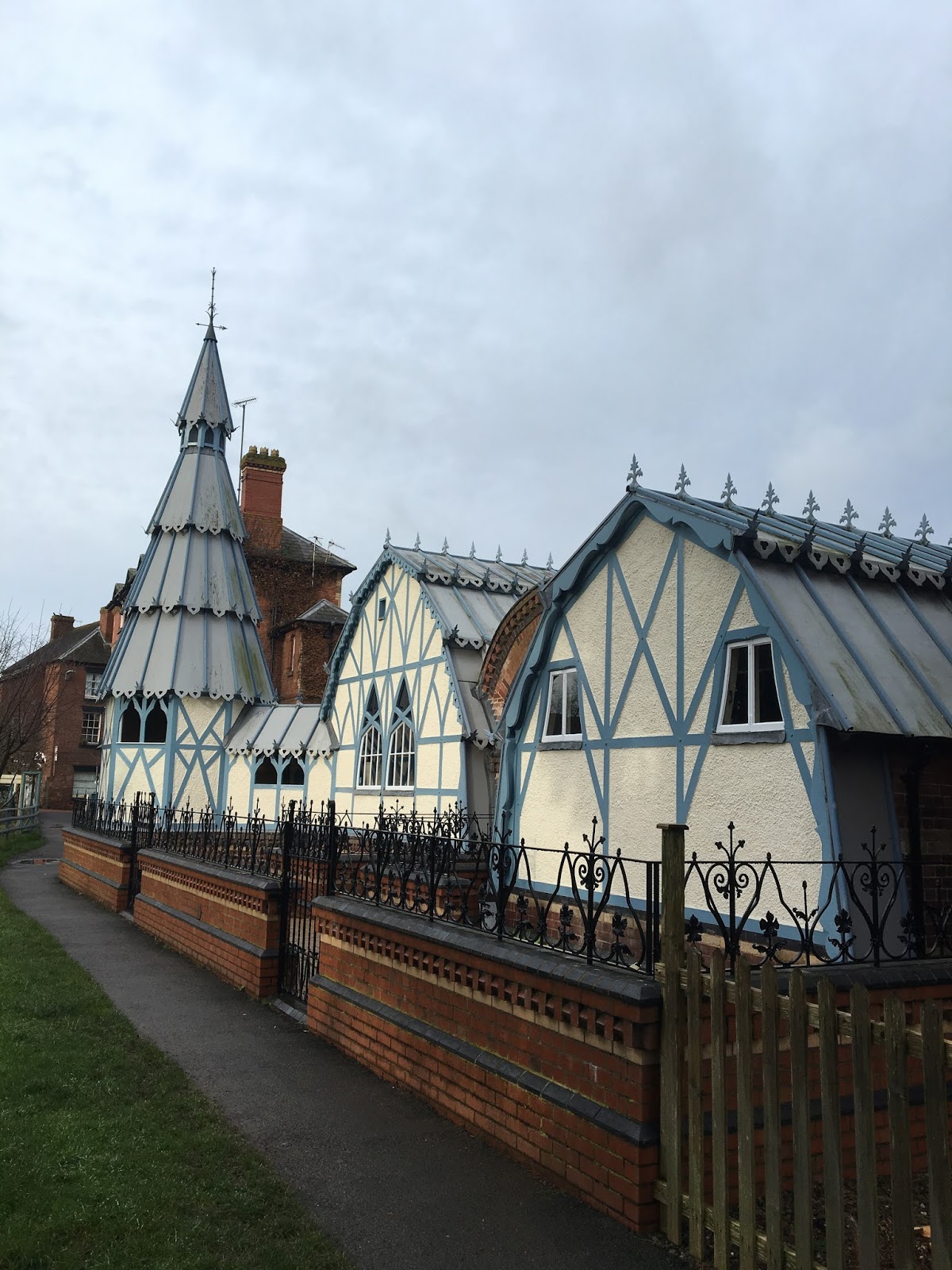
We had a further three stops on the way to Bewdley; Monkland Cheese Dairy (we really do recommend a visit), Leominster, and our third, which concerns us here, St Michael Tenbury Wells. From the burgeoning Late Gothic Revival at Kinnersley back to High Victorian Gothic.
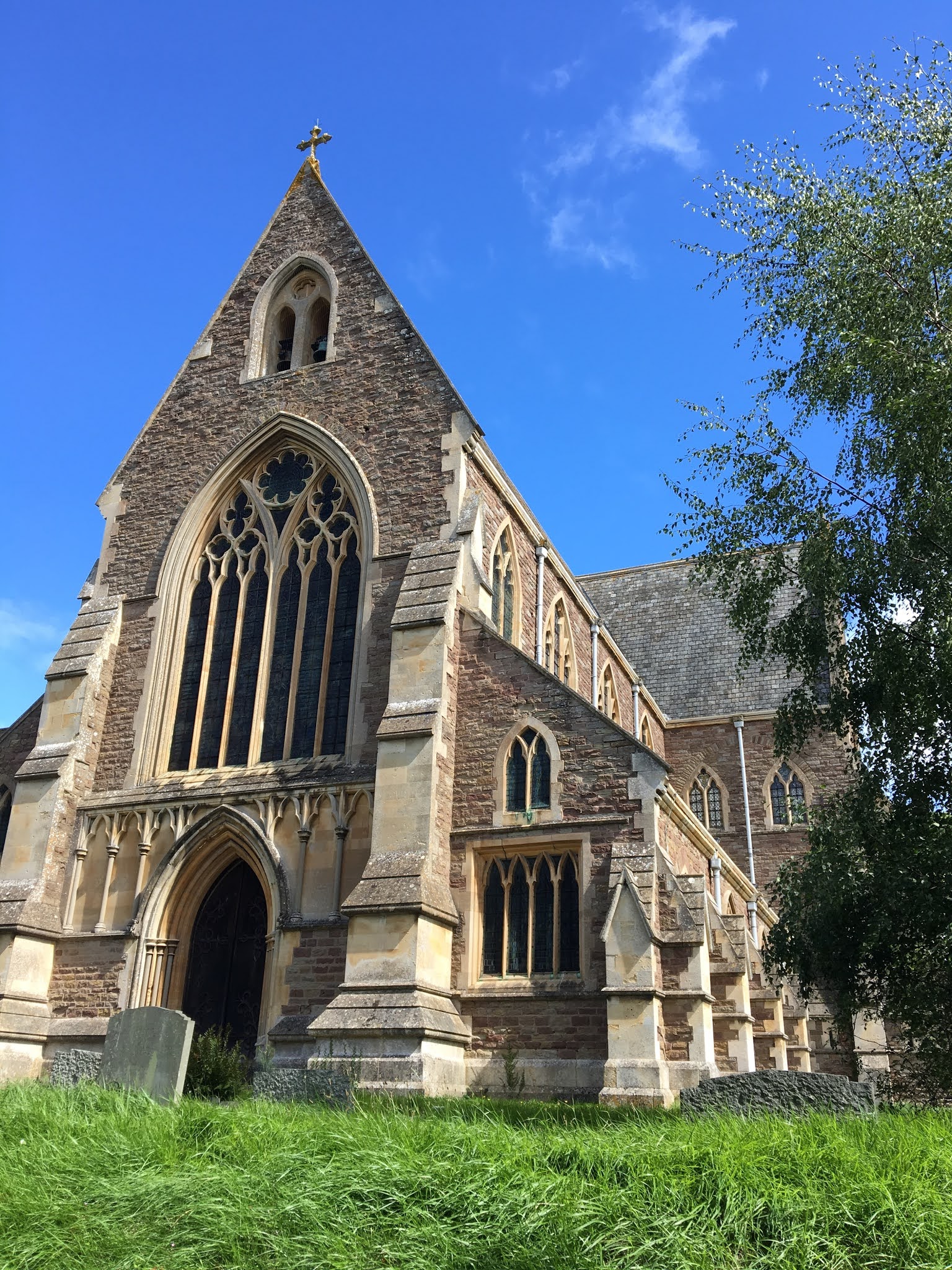
This, it has to be said, is a quite extraordinary building, best Camden Society approved middle-pointed, built both as parish church and school chapel, for it is part of a complex of buildings, such as All Saints, Margaret St or All saints, Boyne Hill, Maidenhead. Fruits all of the Tractarian movement intended to develop and nurture the spiritual and intellectual lives of the surrounding people and that have their origins in the work of Pugin, particularly in his polemical book 'Contrasts'. Here church and school are parallel to one another linked, umbilically as it were, by a cloister so as to form a quadrangle open to the west. From a distance the church looks like a gigantic scale model of a French High Gothic cathedral that had been dropped into the unsuspecting Worcestershire countryside, and to some extent it is a building out of time and place, for although it partakes to a degree of local materials and local styles it isn't vernacular like St James back in Kinnersley. Something is different, and that is, I suppose, that it is a product of an industrialising society, of Modernity. It is to a certain point self-conscious design, while Kinnersley organic. A building that at one time in the mid 20th century would provoke hatred among many architects and critics, but love in others such as Sir John Betjeman. Perhaps a building constructed out of antinomies. Changeable. Mannered - it is no mere copy of a medieval building, but an imaginative, thoughtful, if not wilful, set of variations on a theme. The details are ever inventive, and seem occasionally to move into unknown territory. Restless even, certainly it has that relentlessness and intensity common to that stage of the Gothic Revival. Earnestness, and muscularity are terms often used in this context. That context being a forceful reaction to the good manners of most 18th and early 19th century architecture. The architect was Henry Woodyer (1816-1896) one time pupil of William Butterfield. It was built for that remarkable man Sir Frederick Ouseley - professor of music, priest, composer and Baronet - with the intention of not only satisfying the spiritual requirements of the local population but playing a national role in the revival of English church music, a role it played until the closure of the school in 1985. Since then the church has continued parochial, and until June this year the school occupied by another educational establishment. The building is now empty and apparently up for sale. I wish I had known this at the time as I would have taken some photos of the school buildings.
Alas, due to the current events we couldn't gain entrance, so here are the photos I managed to take of the exterior of the chapel.