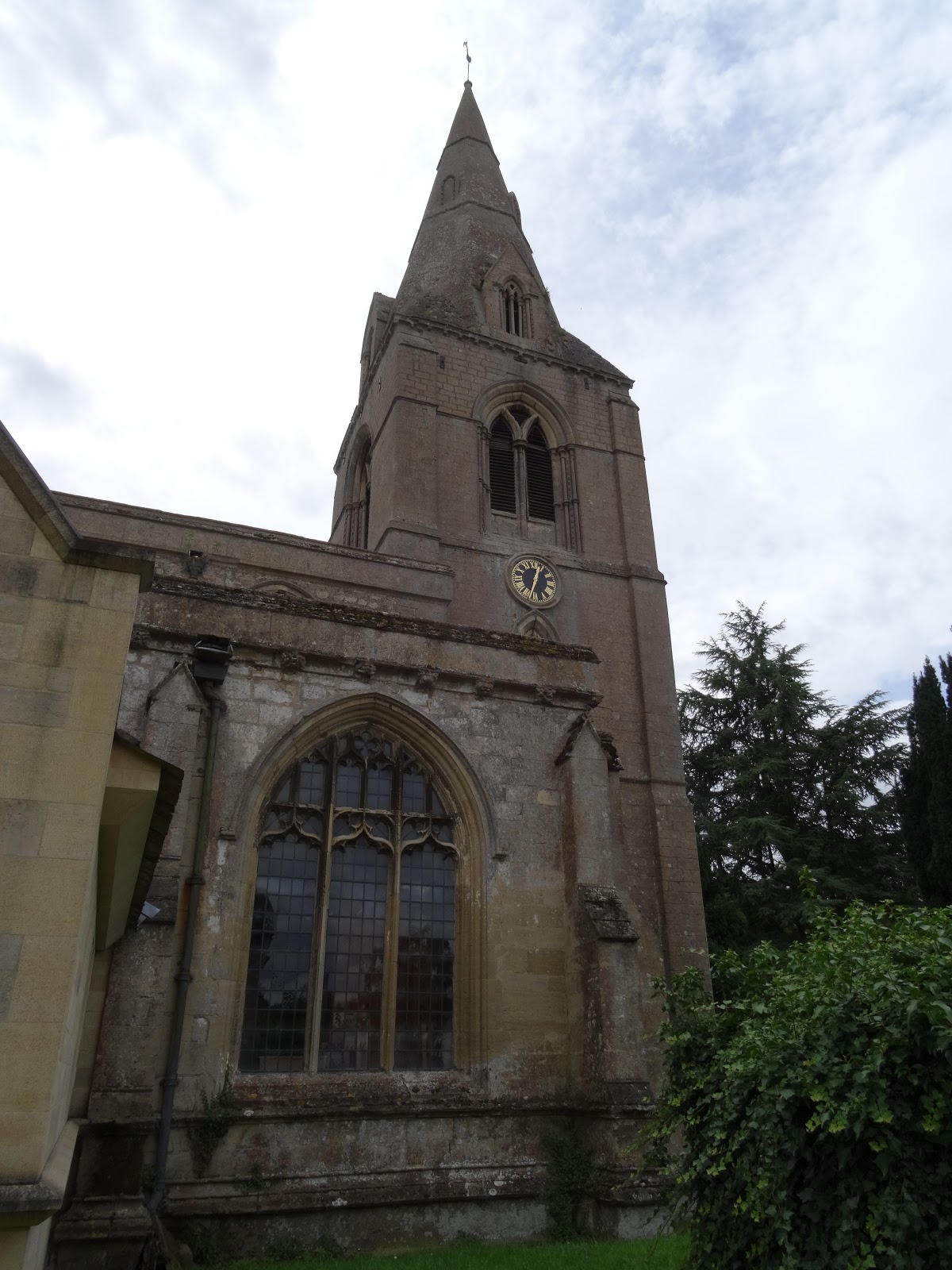
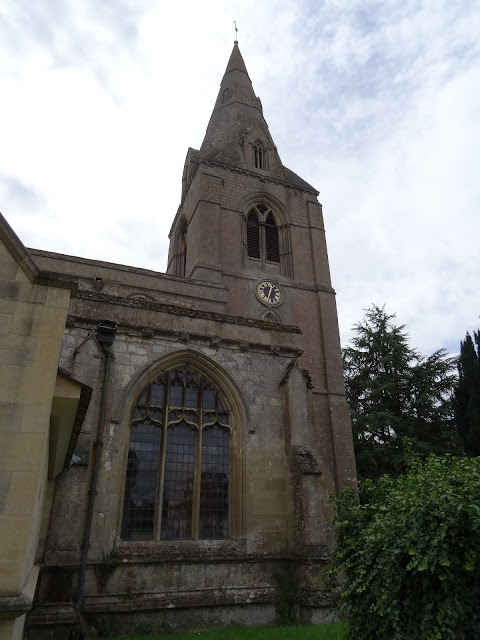
A fortnight ago A paid a visit and we headed off to Stamford for lunch and where I had three drawings in an exhibition in the Arts Centre. On the way we stopped off at Ryhall as I really wanted A to see the village church. Ryhall church is something I've been familiar with all my life, the spire - which is visible from the main road - acting as a sort of promissory note of the good things to see below. However it was only this year on a blisteringly hot day that I actually, finally went inside. It did not disappoint.
Ryhall sits in a bend of the Gwash at the very eastern edge of England's smallest county, Rutland, and the older parts of the village are very pretty. It is a place of soft undulating hills and great open arable fields and grey limestone, a long way it feels from the heart of the county where the landscape is that bit more pronounced, sometimes dramatic, the agriculture is mainly pastoral and the villages of are of orange and gingerbread coloured marlstone. See my posts on Oakham and Uppingham to get an idea. Oakham, the county town is definitely 'East Midlands'; Ryhall more 'Lincolnshire', perhaps even a little 'East Anglia' for it is here that the sky begins to really predominate over the landscape.
Anyway back to the church. It really is superb. Small and, as they say, 'perfectly formed' The tower and spire are noble Early English, strong and handsomely proportioned. The nave and chancel Perpendicular gothic. Quite a work-a-day design in that the parapets are quite plain and there are no pinnacles; a robustness that compliments and harmonises with the tower (18.09.2019: Thinking about this this morning, they represent a continuation of the Decorated way of doing things as though the Perp windows are later insertions, which they are not. Just goes to show the limitations of stylistic labels! Think of the academic discipline of 'architectural history' as a sort of equivalent to Biology and its taxonomy. Both Enlightenment projects.) Not that the masons didn't have fun; some of the tracery design is quite unusual, and there all sorts of beasties and strange faces haunting the architecture. The west end of the north aisle has the remains of a anchorite's cell. It could be that these scant remains mark the site of the hermitage established by St Tibba, the Anglo-Saxon saint who I've mentioned before on this blog who first entered into the religious life at Castor under the her cousins Kynesburga and Kyneswitha. Like Castor, Ryhall was a small place of pilgrimage.
The interior is very spacious and deeply satisfying; and, as you might expect from all those large perp windows and lack of stained glass, is light-filled. There is more interesting sculpture on the Early English arcade, and there are a host of monuments in the chancel. The earlier ones are the most interesting, though, I suppose, more metropolitan critics would dismiss them as a crude and provincial. Who cares? They're very enjoyable. Alas there is probably too much modern clutter, which seems to plague churches these days and detracts from the aesthetic, and far more importantly, from the spiritual atmosphere of the place. It needs to be removed.




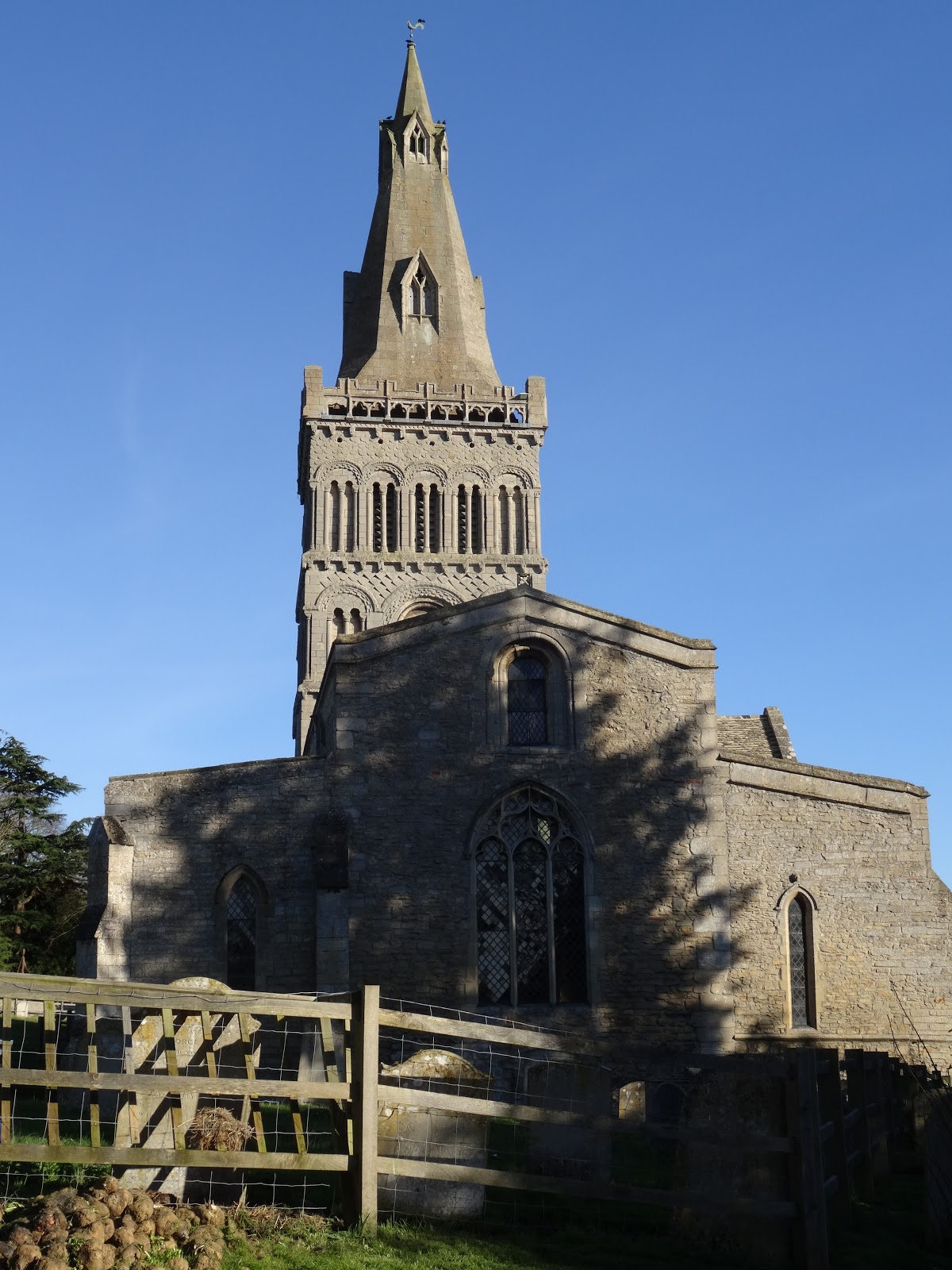
Just a couple of miles south, and in the valley of the Nene, is Castor, a large stone built village, that being quite so close to Peterborough has a slight urban feel to it. There are however some very attractive houses. We, though, were there for the church, and rather special it is. Firstly it has what must be one of the finest, most satisfying Norman towers in the country. Superlative. Secondly it has a fascinating early history: St Kyneburga is built within the remains of a massive Late Roman structure - 'palace' and 'praetorium' are banded about by historians. Before you get too excited there really isn't that much Roman to be seen, just the odd sizable junk of masonry. Anyway a convent was founded here in the 7th century by the Merican Princess Kyneburga, her sister Kyneswitha, (daughters of King Peada), and their kinswoman Tibba who later became a hermit at Ryhall between Bourne and Stamford. The coming of the Vikings put pay to the monastery and later Castor, like Ryhall, became a place of pilgrimage, one of many small shrines that dotted the country before the Reformation.
History lesson over. The church is charming. The outside has lots texture from the rubble walls (re-used Roman materials), and a couple of ancient carvings: over the porch, a 'Christ in Majesty', and over the priest's door on the south side of the chancel one recording the consecration of the church. Inside there are all sorts of cross vistas to be had as this is a cruciform building. The aisled nave contains an altar dedicated to St Kyneburga. The crossing piers are stout Norman work with wonderful carved cushion capitals - the vault is a late medieval insertion and suitably robust. The chancel is long and, when we were there, light filled. The north transept which is Norman, is filled with the organ, but the south transept is early Decorated and austerely elegant and spacious. But, alas, the furnishings are not commensurate with the architecture, and it is a little cluttered in places.


Saturday and a friend popped over. It was a glorious day and we headed south of the border to Cambridgeshire to look at two remarkable churches: St Mary, Marholm and St Kyneburga, Castor.
Marholm sits of the southern edge of the Welland valley. Its situation is very beautiful, on the southern edge of the village and over looking a wide pasture that dips down to a small stream lined with willows. The church is small and low, and there cedar trees in the churchyard. It really is idyllic. The tower is late Norman, short, blunt and austere. The chancel, grand and very fine late Perp commissioned by Sir William Fitzwilliam and completed by 1534; the nave between has a Perp clerestory and Victorian aisles. However, lovely though the architecture is, what makes the church is the connection to the Fitzwilliams at nearby Milton Hall, for this is an estate church and is, as one would expect, immaculately cared for. It also explains why the church is usually locked - to protect the Fitzwilliam tombs. Another visit is in order, when there is time to spare to get the key.