Tuesday, 10 December 2019

'These Russian wanderers are wandering still': 'Laurus' by Evgeny Vodolazhkin


     Spiritually I've been drifting eastwards for years - a long drawn out process of becoming. It's not as though I think the Orthodox Church, or the other oriental churches such as the Copts or the Suryani, are perfect - far from it, only that these churches have the greatest potential to become so. The churches where 'axial alignment' is most likely to take place. Although I am still technically an Anglican, my heart is elsewhere. Most times I attend an Anglican service I feel a little part of me dies. It's not just Anglicanism; I know I'd feel the same in any other western church. Simply Western liturgy, as it is now, and has been for centuries, is an inadequate vehicle for encountering and participating in and with the divine. I'm inclined to extend my doubt to Western theology per se. The events of the summer here in the UK where a crazygolf course was installed in the nave of Rochester cathedral and a helterskelter in that of Norwich, have confirmed this. It is embarrassing. And now in this last week (it was a couple or more months ago now - this post has been a long time in gestation) a picture has appeared of seminarians confessing to a group of houseplants at Union Seminary in New York. Terminal decadence?  Who knows and who really cares anymore? They are in effect only symptoms of a wider cultural malaise.  Modernity from both inside and outside the church is in the process of shredding it.

     'He that findeth his life he shall loose it; and he that loseth his life for mysake; he shall find it.'

     'For the time being his only a blade of grass torn up his roots and blown through the air. And he feels it, and suffers for it, suffers often acutely!'


   It was a relief, then, months ago now to read 'Laurus', a novel by the Russian historian Evgeny Vodolazkin, English translation by Lisa C Hayden.  Here was something that was so deeply satisfying on so many levels: artistic, literary, intellectual and spiritual. At times it is deeply moving. (Here I feel I have to add an obligatory disclaimer: I am not commending a return to the superstitious world of the Medieval Russian Principalities. I wouldn't want to be misinterpreted after all! And the society depicted is deeply superstitious, bafflingly so at times.)  Anyway 'Laurus' has been awarded all sorts of prizes but no prize should ever be wielded by a reviewer as a reason to go and read a novel. As I've never won that many I'm ambiguous about them - they probably are more political than the organisers care to admit and are probably also only of transitory significance. I tend to ignore them. Even the Nobel Prize.
     Back to the novel. Deep in the bosom of Holy Mother Russia, that is the Orthodoxy of the time before the Petrine 'Reforms', before even the reforms of Patriarch Nikon and the schism of the Old Believers, in a society both organic and pre-Modern, rural and often isolating, a boy, Arseny, is raised by his grandfather, the local folk healer. Arseny has a gift for his grandfather's trade. A great gift. And concomitant with such a great blessing comes, as so often in life, a great price. That price, and it seems that Arseny cannot as a result accept death, is what pushes him out, firstly into the larger Russian environment and then further out still into Western Christendom and then the Middle East. Driven into the desert for the rest of his life haunted by his failure, forsaking houses, or brethren or sisters or father or mother or wife or lands*, unable to make a long lasting bound with another human being, endeavoring always to heal and save and cheat death. In spiritual terms his has entered into the state of Podvig that is 'spiritual struggle', what in Greek is called 'Catharsis.' I think some would describe Arseny as a marginal character, by which I mean one who dwells on the margins. I have to say I fight shy of such a description, as it is a misunderstanding of the central role of such figures in Russian, and indeed wider Orthodox, spirituality. Looking back now through the mist of several months I wonder how much autonomy, how much agency Arseny has in this process of spiritual being. At some points he is like a leaf carried on the wind of the Holy Spirit as he wanders through the bitter cold of a Russian winter barely, it seems, conscious. Arriving in the mercantile city of Pskov he (almost) finds himself a Holy Fool, the 'yurodivy'. I mean by that not some middle class bloke who dresses up as a clown occasionally for the benefit of middle-class Anglican congregations and then goes home again to the comfort of home, but somebody who has abandoned everything - home, possessions - even sometimes clothing - including the ability to be rational for the sake of participation with the Divine. Such figures continually re-occur in Orthodoxy, both consoling and disturbing. Paradoxical. But then Orthodoxy, unlike the West, has always found space for paradox. Alexy himself at one point lives with the bounds of a convent cemetery in a hovel he has constructed himself.
     Thankfully Vodolazkin does not the weigh the narrative down with too much explanation - that recurrent sin, as I have mentioned before, of much Sci-fi and fantasy writing. And this novel is in a way a sort of fantasy novel in that Vodolazkin is engaged on some sort of Tolkeinesque sub-creation, for Medieval Russia is almost as far removed from our times and concerns as Middle Earth. Better just to throw the reader in and hope they can swim. A writer should make the reader do some work after all. Not that the novel isn't alive with wondrous and intriguing detail. It is one of its delights and provides so much compelling atmosphere. Vodolazkin is a scholar in the department of Old Russian Literature at the Institute of Russian Literature (commonly referred to as 'Pushkin House') in St Petersburg, and is therefore well placed for such an endeavour. Detail is one way in which the writer can show and not tell. (Possibly one of the greatest exponents of that was the French catholic novelist Francois Mauriac - a novelist I think everybody should read.)
     'Laurus' is a book that stands in line of descent from the works of Dostoevsky and Pushkin before him, sharing a number of themes such as the spiritual role of Russia and the individual's spiritual struggle particularly in face of tragedy. The quotes above are taken from Dostoevsky's speech at the unveiling of the Pushkin Memorial in Moscow on June 20th 1880, describing Pushkin's character Aleko from his poem 'The Gypsies'. Dostoevsky uses Aleko as a metaphor for the rootless nineteenth century intelligentsia, but one feels, perhaps wrongly, that Arseny is like Aleko. He is both deeply encultured in the society around him and yet alienated from that wider Russian society by the potency of his gift and the inexpressible weight of grief his carries and the consequent fear of death. Arseny presents to us a character that has failed to integrate fully his self, and that failure is the fuel for the narrative drive. His journey is an attempt to achieve that integration. In some respects then Arseny is a extended metaphor of our own spiritual restlessness and our inability to deal with death.
     I really can't recommend this book highly enough. Read it!

*  Matthew 19:29

Tuesday, 26 November 2019

Own work: Bethania Chapel

     A busy few days: Sunday - 'Stir-up Sunday' - was spent making a Christmas cake and yesterday a trip to that attractive market town of Ledbury to meet the brother. We stopped off in Monmouth on the way home. A return visit for me, finding I had forgotten much since that previous visit. The place is rather attractive, and busy. A return visit is a must. Today I managed to finish my latest collage, another, small, depiction of the Bethania Chapel, Morriston, Swansea.


Thursday, 21 November 2019

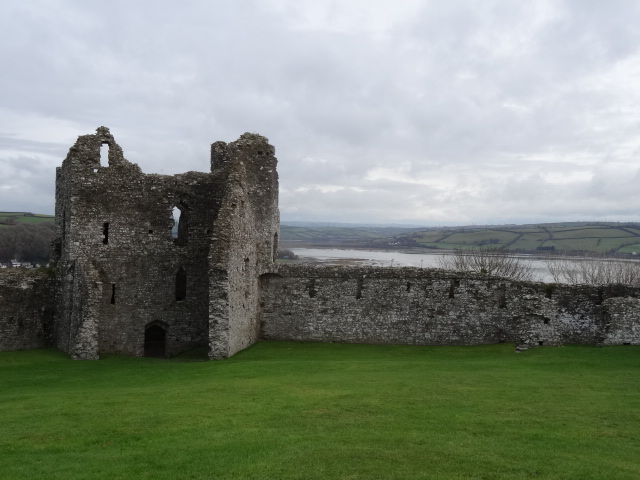
Llansteffan Castle

     A busy weekend we've had of it. Saturday was spent at the 'Festival of Senses' in Llandeilo doing a bit of Christmas shopping, while yesterday we drove over to Llansteffan on the beautiful Towy estuary. Good weather on both days was a welcome bonus after all the rain of late.
     Llansteffan is a village clustering between the foot of steep wooded hills and the beach. A small, discreet seaside resort, a bit higgledy-piggledy really, but none the worse for that. Mainly Victorian by the look of it and all colourwashed including the church but not its tower. The church is mainly Perpendicular.
     High on a headland south of the village and at the very mouth of the river stands the castle. All dark grey and hoary rubble. Most of the finer stone, which would have been used for the details such as windows and doors, has been robbed out. Some details remain on the upper floors of the great gatehouse, which in the later Middle Ages was converted into the main lodgings. A donjon. Judging by those remaining details it must have been a pretty fine place to dwell. 
     The site is ancient - the castle defences utilise the earthen ramparts of an Iron Age hill fort - and strategic - controlling the mouth of the Towy and hence access up stream to Carmarthen and the upper Towy valley. The views  in themselves are worth the climb from the village: east over the estuary to Ferryside and south out across the mouths of the Gwendraeth and Loughor estuaries to the western tip of Gower. Quite haunting, that view south, on a cold winter's day.


Wednesday, 20 November 2019

Own work: Life Drawing LVI

     After a long gap (over a year) I have finally returned to the life-drawing studio.  Here are my efforts - not too bad considering. It was a two hour session with a number of poses of increasing duration as the morning went on. Apologies for the photography. I find the photography of life drawing difficult.


Friday, 15 November 2019

Own work: 'Rocks and Cave, Pennard'

     Latest painting, after a short-ish hiatus: 'Rocks and Cave, Pennard'. Mixed media on 300gsm watercolour 30x26cms. What more can I say?


Thursday, 14 November 2019

Dune I: The Discontents of Modernity

'I had this idea that charismatic leaders ought to come with a warning label on the forehead: 'May be dangerous to your health.''


'When religion and politics ride the same cart when that cart is driven by a living holy man, nothing can stand in their path.'


I Introduction: The Discontents of Modernity


     I've been reading around Jung for several weeks now. He is endlessly fascinating. That mix of the intellectual, the spiritual and the artistic. One way of understanding the rise of Jordan Peterson is to see it as part of a larger Jungian revival. Perhaps Jungian thought is a way through the crisis of Liberalism, of Late and Post-Modernity, that is laid upon us.  It is certain that we have culturally, spiritually and possibly politically driven ourselves up a dead end.
     So discovering that Frank Herbert (1920-1986) had read Jung, as well as Nietzsche, I decided to re-read Dune (which I had first read in the early Eighties when the David Lynch film came out), and - as a long-term project - all the sequels Herbert wrote. From doing a little research into them things get pretty weird. Not that 'Dune' isn't pretty weird of itself. There are some rather strange things going on. I should add here that Science Fiction (and fantasy fiction) is something I don't normally read, perhaps, I have to admit, out of literary snobbery. It is certainly something that serious literary types look down upon. There are a small number of exceptions to this general rule: H G Wells, J G Ballard, George Orwell, for '1984' and Aldous Huxley for 'Brave New World' - but then who reads Huxley's early works now, and who, save the New Agers, the later quasi-mystical works such as 'Island' and 'The Doors of Perception'? I suspect Herbert may have read them, or at least been aware of them and of Huxley himself down the coast in Southern California and a user of mescaline. Both men had various degrees of interest in Vedanta. One feels that Huxley's influence is close in this book, perhaps most obviously in the similarities between the Seitch Tau Orgy and the 'Solidarity Service' in 'Brave New World'.
      (I feel the influence of the Jungian psychologist Erich Neuman (1905-1960) is close at hand too, especially his book 'The Great Mother - An Analysis of the Archetype' of 1955, but more of that later. I would also add, 19.10.22, the French philosopher and mystic Henri Corbin, but I'm not sure how Herbert would have come across Corbin's work as only two of Corbin's books had been published before 1965 when Dune was published, and only one of those in English. Were Corbin's ideas already in circulation in certain proto-New Age Groups on the American West Coast?)
     Dune, then, is an exception to the rule, and I have to admit I find it fascinating. Compelling, even. Perhaps not for the quality of the writing as such (it hasn't changed my opinion about the literary quality of sci-fi to be honest) but for the ideas and imaginative vision. It is the use of Jungian ideas, archetypes and so on, that gives this story its heft, its continuing resonance. Their presence, via Campbell, helps explain why the first Star Wars film succeeded and their absence why the subsequent films waxed in failure until they reached the bathetic 'Rise of Skywalker'.
     The Lord of the Rings, which is without doubt better written, falls into that same category; and having said that I've been struck with a number of similarities between the two works. Not an obvious parallel perhaps, though both authors could be described as conservatives, though of somewhat different stripes - Herbert being a sort of Thoreau-esque frontiersman, doughty and independent. Be that as it may, both books are an attempt to address, and come to terms with, through the use of mythological metaphor, the gargantuan horrors of the twentieth century, depicting societies that are poised at the point of monumental change - a change that is only achieved by the shedding of blood in war, and in the case of the Dune sequence much blood. Untold amounts. In both books the main character undergoes a series of trials and initiations that lead to an altered (higher) consciousness. Being burdened with a power beyond their comprehension, (and that of their companions and the wider society around them), and that makes living in the real, mundane world ultimately unbearable, they are compelled in that process of change to make a bitter renunciation, rather like the knights in the Grail legends. Perhaps you can see the Ring in the LOTR as an inversion of the Grail. Another link between both books is the almost inordinate length of vision; thousands of years are traversed in which the events described are set against a vast panoramic view of history. Both books explore ideas of destiny, fate and agency. Tolkein, Herbert, and Huxley for that matter, were all concerned with where Modernity has gone wrong and in particular with the disenchanting of the world, and its effect on the individual, society and environment as humanity waxes in alienation. 'Dune' however contains themes such as religious and political fanaticism, terrorism and the rise of dictatorship that are alien to Middle Earth. It is a novel, too, saturated with the emerging drugs culture of the 1960s. 
     A novel about the opening of the 'Doors of Perception'. A rich, complex and multi-layered work then, of almost infinite interest, that reflects not only Herbert's wide field of reading but also his autodidactism - for good and ill.


Tuesday, 5 November 2019

Own work: Lettering

     Continuing my series of lettering as gift here's the one I finished only this morning for the bf's mum - it's her birthday today. Perhaps not quite a successful as the others mainly because the right hand serifs are, perhaps, too long.