Monday, 20 July 2015
Abergavenny Priory
Our final port-of-call on what was a busy day of sight-seeing was Abergavenny - a lovely market town in Mid-Wales. The priory church is full of good things: a good set of late Medieval choir stalls, a plethora of tombs (Medieval and later) and a remarkable sculpture, in wood, of the sleeping Jesse. It is about life-size and would have formed the base of a monumental sculptural group culminating in a figure of Christ - a 'Tree of Jesse'. It is a rare and fortunate survivor. Of the church the crossing, transepts and chancel (with chapels) are Medieval; the nave is Victorian replacement for the replacement of the Medieval structure. The nave is not too bad, rather G F Bodley in style. Like the priory at Kidwelly that we visited last year it was founded, along with a castle, by a Norman aristocrat (in this case Hamelin de Bohun) as part of Norman invasion and settlement of Wales.
Wednesday, 15 July 2015
Holiday IV Raglan Castle
Our next stop was the mighty Raglan Castle. As far as Welsh castles go it is not as famous the great Edwardian castles, like Harlech or Caernarvon, however architecturally it gives them a good run for their money. It is a large and deeply accomplished Late Medieval design - a Perpendicular Gothic interpretation of Late Gothic French domestic design, both formidable and luxurious. There is an outer and inner bailey, the latter consisting of two courtyards connected by the screens passage at the kitchen end of the Great Hall. From the second courtyard access is gained by a bridge to the great donjon - 'The Yellow Tower of Gwent'. Hexagonal in plan, it stands isolated in the outer bailey surrounded by its own moat and wall. It was both the final place of refuge during a siege and a flanking defence for the main gate to the inner bailey. After a long siege during the Civil War - like the rest of Wales it was a Royalist stronghold - the castle was dismantled, and thereafter left to decay.
Monday, 13 July 2015
Tuesday, 7 July 2015
Own Work - Life Drawing XI
Here are the two drawings I made at last week's life drawing, the penultimate session of the academic year.
Saturday, 27 June 2015
Own Work - Life Drawing X
A mixed bag this week, two poses of an hour each. The first went well, the second was a bit of a disaster. Here are both for your delectation and delight.
Monday, 22 June 2015
Holiday III Tintern Abbey
Friday morning found us standing outside Tintern Abbey. It's hard to know what to say about this building it is so well known. But let's start with the easiest bit, some facts: it was founded in 1131, and the abbey church rebuilt in stages in the second half of the 13th century; it remained pretty much unaltered until 1536 and the Dissolution of the Monasteries.
For the next two centuries it passed into relative obscurity - the domestic buildings robbed for building stone, but the church left oddly intact - until the late Eighteenth century when it became a locus for the secular cult of Romanticism, and it has been painted, photographed and written about repeatedly ever since. It is, rightly, still on the itinerary of tourists and day-trippers.
Rightly, because the church is such an elegant, slightly austere design, as befits a Cistercian house, and its setting is magical. The reasons for choosing this particular place to found an abbey are obvious. It is incredibly idyllic, beautiful. An enclosed, remote place.
The proportions of the church are superb. The style is Geometric Decorated with touches of that next stage of Decorated Gothic, Reticulated - eg. the great west window. Everything is clear and lucid. There is no triforium as such but a plain, blank wall, like you might find in some Medieval German churches.
The first tours to the Abbey were started by The Rev. John Egerton, who lead parties of friends down river from Ross-on-Wye. Thomas Gray, the poet, and later William Gilpin, Anglican priest and aesthetic theorist, made the 'Wye Tour', as it became known, in 1770s in search of the picturesque;
"The first source of amusement to the picturesque traveller," Gipin wrote, "is the pursuit of his object - the expectation of new scenes continually opening, and arising to his view."
The Wye valley with its winding course and steep valley offered much to the 'picturesque traveller' including the Abbey, then overgrown and surrounded with small scale industry. Gilpin though confessed he wanted to get a ladder and assault the abbey church with a hammer to make it more picturesque for “though the parts are beautiful, the whole is ill-shaped”. The Abbey was only seen for its scenic, landscape value; for other later visitors the melancholic emotions it stirred. Gilpin wrote up his travels in 'Observations on the River Wye and several parts of South Wales, etc. relative chiefly to Picturesque Beauty; made in the summer of the year 1770', published in 1782. This did much to publicize the 'Wye Tour' and Turner, Coleridge, Wordsworth all followed in Gilpin's wake. "Lines written a few miles above Tintern Abbey" ('Lyrical Ballads') was written on Wordsworth's second visit in 1798.
Labels:
architecture,
Tintern Abbey,
Wales,
William Gilpin,
William Wordsworth
Sunday, 21 June 2015
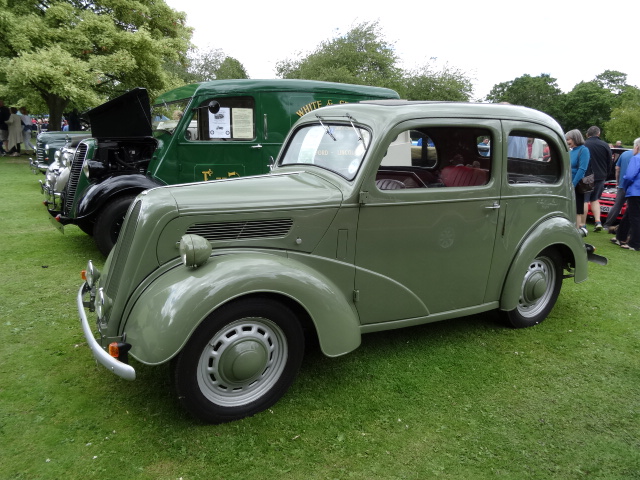
Classic Car and Bike Show 2015
The year has come around again and it is summer, the solstice, my father's birthday and once again The Bourne Classic Car and Bike Show. Alas it could also be the last, as the guys who organize things are getting a-weary. New volunteers and organizers are required. As avid readers of this post will know this is one of my favourite local events. It's all very mellow. This year there were more cars and bikes than ever. Here are my faves from this year's show.
Subscribe to:
Posts (Atom)