Saturday, 9 May 2015

East Bergholt and Flatford Mill


     Back to those lovely early spring days the bf and I spent in Suffolk and Essex.

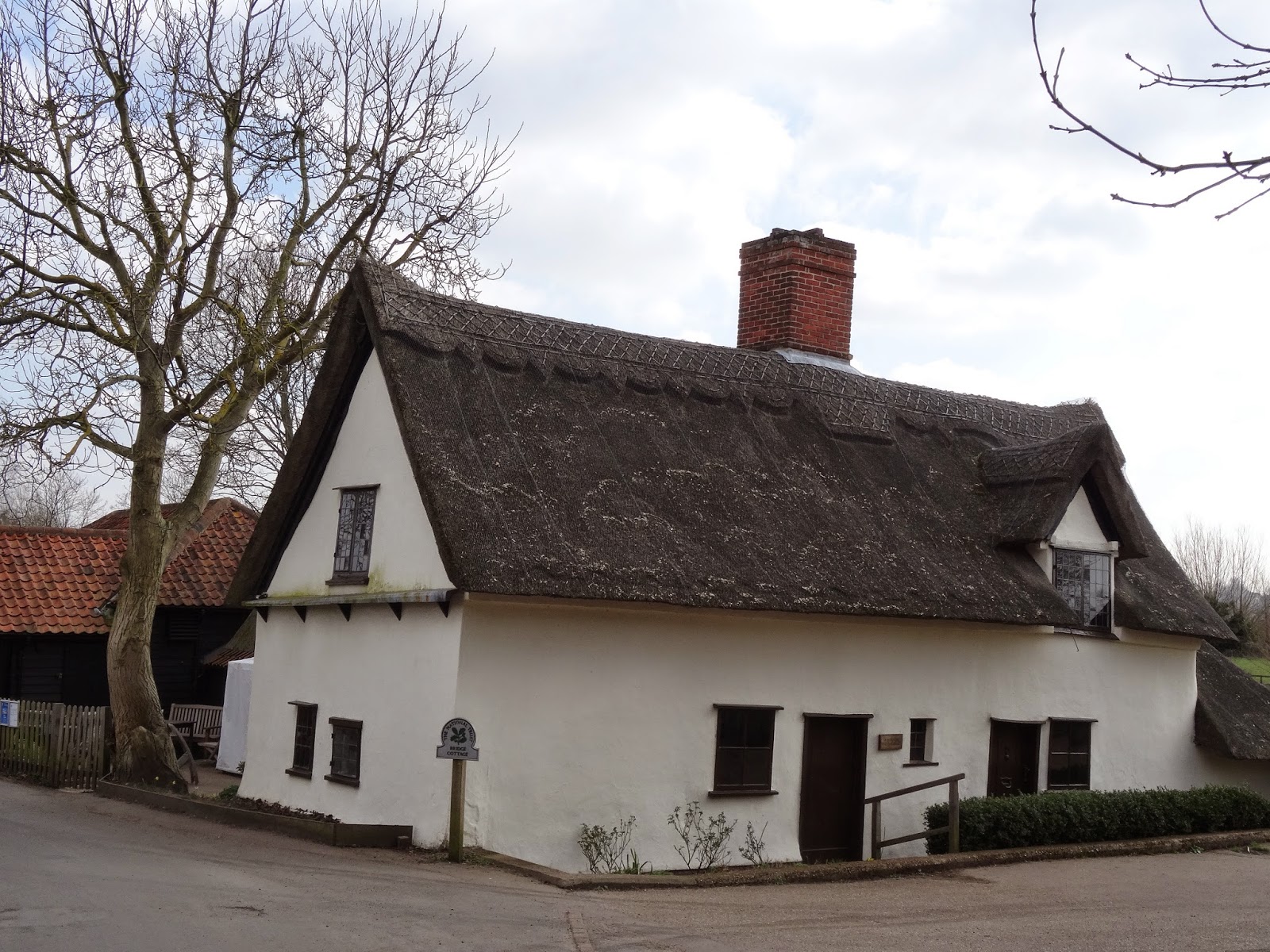
     After the church at Stratford St Mary we headed east down the Stour valley to East Bergolt and Flatford Mill.  It is the association with the artist John Constable that makes the valley of the Stour, know at this point as 'Dedham Vale', and marketed as 'Constable Country', famous and a place of secular pilgrimage to tourists.  It has however a deep intrinsic beauty of its own that should not be overlooked. A beauty, and an associational, emotional value, that caused Constable to paint this, to him, familiar environment. For Constable was a local lad, born in East Berholt, his father a miller and the owner of Flatford Mill; and it is the small, almost commonplace view from in front of Flatford Mill that he depicted in perhaps his most famous painting: 'The Haywain'.   And I suppose, it is these associations that may have given the area some added protection from development and industrialization.
East Bergolt itself is a large somehow sprawling village. Quite attractive. The church is large, late Medieval, another wool church.  It is remarkable architecturally because the west tower has never been finished but left as a ruin, and the bells are hung in a strange but rather beautiful ground-level bell cage on the north side of the churchyard. The sort of structure that was a great influence on Arts and Crafts architects. In the village is Constable's studio. Flatford Mill itself, along with Willy Lott's Cottage and another property which forms the visitor centre, are owned by the National Trust, and have an intrinsic beauty that, one would have hoped, would have preserved it from demolition regardless of its national, cultural importance.


Saturday, 2 May 2015

Other films

      We did watch a couple of other films during my stay: 'Carry on Nurse' and 'Le rayon Vert' by Eric Rohmer. We are nothing if not eclectic in our tastes.
      The second in the series, 'Carry on Nurse' is a good ensemble piece. Most of the familiar cast are there: Hattie Jacques, Charles Hawtrey, Joan Sims and Kenneth Williams. And there are cameos from the likes of Leslie Philips and June Whitfield, who would later return in 'Carry on Abroad' and 'Carry on Girls'. The film does, however, lack a bit narrative drive and comes across really as a series of sketches. It is though rather funny at times - the comedy being much 'cleaner' than in later films. And Marianne Stone makes her first 'Carry on' appearance.
       'Le Rayon vert', (1986), is another kettle of fish all together - a product of a completely different cinematic outlook. Though it does have in common with 'Carry on Nurse' a certain interest in ordinary lives. Briefly it is the story of Delpine, and her attempts to find a fulfilling holiday. Watching it I was reminded of two things: firstly there is the strong similarity to 'Céline et Julie Vont en Bateau' by Jacques Rivette, 1974, which I watched at the bf's several weeks ago and didn't like. 'Le Rayon Vert' I liked very much. It had a wonderful charm to it, and at points I was quite moved. 'Le Rayon Vert' I should explain is not only the title of a novel by Jules Verne (reference was made to that in the film), but a rare optical phenomenon connected to the setting and rising sun. Both films feel improvisatory; they both come at the end of the Nouvelle Vague; they were made on limited budgets. The camera work was also quite similar, and both are set, partially at least, in a Parisian summer.
       Secondly I was put in mind of the work of the English novelist Barbara Pym, and her concerns are, perhaps, not so far from either 'Carry on Nurse' or 'Le Rayon Vert'. Again there is the interest in the ordinary, of lives where, really, nothing much ever happens. And like the heroine of 'Le Rayon Vert' the main protagonists of Pym's novels, invariably women, fail to recognize the opportunities presented to them, for they are alienated from the serendipitous. The only difference being that in 'Le Rayon vert' Delphine learns finally to find happiness.


Carry on Nurse

1959

Director:                 Gerald Thomas
Producer:               Peter Rogers
Cinematographer: Reginald Dwyer


Le Rayon Vert 

1986

Director:                 Eric Rohmer
Producer:               Margaret Menegoz
Cinematographer: Sophie Maintigneux

I also talked about:

Céline et Julie Vont en Bateau  

1974

Director:                  Jacques Rivette
Producer:               Barbet Shroeder
Cinematographer: Jacques Renard


Wednesday, 29 April 2015

'Medea'

     I have been punished.  The bf read my last post over my shoulder and he has taken his revenge:  Pier Paolo Pasolini's 'Medea', starring Maria Callas.  Made in colour in 1969, it has a certain shared visual and auditory aesthetic with another film released in 1969: 'The Colour of Pomegrantates' by Sergei Parajanov.  And like that film, 'Medea' is intense, mesmeric and difficult at times to watch.
     Pasolini's film takes as its starting point Euripides tragedy 'Medea', but goes further in developing his screenplay by depicting events that in the play are only spoken of, thereby breaking the Aristotelian Unities of Time and Place, but achieving a far greater dramatic and cinematic effect than would be achieved by the mere direct translation of the play into film.  An example of this is the manner in which Pasolini contains Medea's life within that of Jason, her husband: the film opens with scenes from Jason's childhood - 'Every thing is sacred', explains his tutor and guardian the centaur Chiron - and ends with Jason struggling to understand the terrible events that have just occurred.
     Both films also share a interest in ritual.  The viewer is introduced to Medea in a long scene early in the film in which we watch her, as priestess, preside over a fertility rite, a sparagmos, in her native Colchis (filmed in the strange, haunting landscape of Cappadocia) in which a human victim is sacrificed, dismembered and blood and organs are fed to the growing crops. The remnants of the victim are then burnt.  And it is in her role as priestess, before the Golden Fleece, that Jason first encounters Medea.  It is a fleeting encounter, perhaps even a dream, but enough to encourage Medea to steal the Golden Fleece and flee to meet with Jason.  In an act of utter ruthlessness she slays and dismembers her brother Absyrtus, scattering his body parts, echoing the earlier sacrifice, but here the act is an act of utter utility - simply a way of diverting her father from her pursuit.  In her escape with Jason and their journey to Greece we witness Medea's loss of spiritual power - a process that perhaps begins with the slaying of her brother and culminates with her ritual redressing as Greek.
     The later scenes take place some ten years late in Corinth, (where they, according to the legend, have gone into exile).  Medea has been abandoned by Jason who is now betrothed to the King's daughter Glauce.  Medea is distraught and in plotting her terrible revenge regains her powers, and uses them to do terrible things.

     An outline knowledge of the legends of both Jason and Medea would be useful in understanding the action as it unfolds on screen.  A note too that Pasolini working in collaboration with Elsa Morante supervised the strange hieratic score that contributes so much to the film.


Medea

1969

Director:                 Pier Paolo Pasoloni
Producer:               Franco Rossellini & Marina Cicogna
Cinematographer: Ennio Guarnieri

Tuesday, 28 April 2015

'Ikarie XB 1'

     I'm staying at the bf's, and consequently I've been subjected to another obscure film.

     In this case 'Ikarie XB 1', a Polish science-fiction of 1963 which we watched over two sessions concluding this lunchtime.  Shot in black and white, it is an at times stylish account of an expedition upon 'Ikarie' from earth to Alpha Centauri to find life, and is based  on the novel 'The Magellenic Cloud'  by Stansilaw Lem.  The director Jindrich Polak also wrote the screenplay with Pavel Juracek.  At times it reminded me of an number of other post war films which the bf has shown me, in particular 'L'annee Dernier a Marienbad' by Alain Resnais, and the films of Michaelangelo Antonioni.  The music, by the Czeck composer Zdenek Liska (1922 - 1983) is particularly striking: Modernist and suitable futuristic.  It's odd to realise how Modernist music was allowed to flourish under the Communist regime then in power in Poland.

    These films come along in quick succession, once or twice a month.  He's got something planned for this evening after the washing-up.  He's even now selecting something with which to torment me.  Heaven knows what.  I don't think they often warrant a full review, so I've introduced this sort of mini-blog to record for my own sake what I've seen as much as to review them.


Ikarie XB 1

1963

Producer:
Director: Jindrich Polak
Cinematography:  Jan Kalis


Addendum 05.05.2015

   Perhaps Ikarie (Polish for Icarus?) can be viewed as a de-sacralised spiritual journey, a materialist equivalent to 'The Pilgrim's Progress' (1678, John Bunyan) - the encounter, for instance, with the Dark Star being a kind of spiritual catharsis, a necessary purgatorium before the adventus at, and participation in the mysteries of, the new planet.  Actually for all its 'art house' qualities the plot is essentially a simple linear narrative.  Oddly those qualities, in particular the sense of remoteness, of a lack of directness in the acting that you find in Antonioni's films such as 'La Notte' where it is used to underline the characters alienation, while contributing initially to a sense of unease in 'Ikarie XB 1', even of doom, mean that at crucial dramatic moments the film is not quite taut enough.


'According to Queeney' - Beryl Bainbridge

   I've always been attracted to the character of Beryl Bainbridge, (1932-2010), but up to now had read nothing by her.  Browsing in the new Foyles in London the other week for a book to read I decided to make amends and made my way to the 'B's and there was 'According to Queeney' (2001) as a token example of her large literary output.  I'm not usually one for 'Historical fiction' (not quite sure why) so I was a little trepidatious.  Perhaps one of the reasons for this hesitation was the fear that it would be weighted down with historical detail. What else to do with all that research?  This does not happen in this novel.  Bainbridge's fluid, easy style soon put me at ease.  A style that seems to owe something to Waugh, and reminds me, also, of both Colette and Mauriac - perhaps Flaubert too.
   This book, make no mistake, was a brave undertaking for 'According to Queeney' is the story of Dr Johnson, one the great men of English letters, and the curious relationship between him and Hester Thrale, wife of the Southwark brewer Henry Thrale.  In passing we meet any number of the great and the good of eighteenth century London society: Boswell, Reynolds, Dr Burney and his daughter Fanny, and also, at the other end of the social spectrum, the residents of the somewhat chaotic, dysfunctional home of Johnson. All these are people who have long been the subject of scholarly research and some popular imagination.  (A new biography of Johnson servant/secretary Francis Barber has only just come out.) And here I have to confess to myself knowing something about Johnson and the Thrales.  It is unlikely therefore that anybody could come to this novel with out some pre-formed idea of what the characters ought to be like. And this makes a minefield for a novelist.  Bainbridge navigates her way, however, with immense skill.  It is totally convincing, and quite captivating.
   The image on the cover of this particular edition is a reproduction of the Reynolds double portrait of Mrs Thrale and her daughter Queeney.  Hester is in some sort of reverie, aware but not interested in her daughter who looks inquisitively at her mother.  The portrait presents a sort of summary of the complex, at times contradictory, relationship between mother and daughter that forms the other narrative strand in this novel: a sort of benign indifference, perhaps a wearisome tolerance, from the mother and need, that turns to cynicism, from the daughter, who is a intelligent, sharp girl.  Mrs Thrale is depicted as more interested in the formation of a cultural salon at her residences in Southwark and at the then rural Streatham, and interested too in a succession of men, including Dr Johnson, who could be her lovers, and all seemed destined to become tutors to her daughter.  Johnson, the 'Great Cham', taught Queeney Latin.  Perhaps this was a contrivance of Mrs Thrale to make the presence of so many unattached men in the Thrale household acceptable to her husband, but there is a sense too that Queeney is a special project of her mother. Certainly Queeney is the only one of her children who Mrs Thrale involves herself with. The child is taken on trips and social visits, but is often made to think her presence irksome to her mother, although Mrs Thrale is quite happy to use her daughter as a spy when it suits her.  This close interweaving of their lives means that Queeny is often a witness to adult dramas and transactions. (Contrary to expectations the narrative is not in the first person but in the third person, which gives us more access to those occurrences than had if Queeney was relating these events directly to us.)
   Towards the end the novelist Fanny Burney flits across the pages almost ghost-like, hardly speaking but - one feels - doing a lot of listening.  (Here Bainbridge appears to have been influenced in Burney's description of her own self, but apparently that is as much a self-construct of Burney's as it is an accurate self-portrait.)  Bainbridge is perhaps like Burney; her tread is very light. And yet her ability to suggest, and to manipulate the reader is is deeply assured.

Monday, 20 April 2015

St Mary, Stratford St Mary

   Back to our jaunt into Essex the other week.  I was visually struck by the church of St Mary, at Stratford St Mary, standing at it does on the northern edge of the Colne valley at the point where the n-s road meets the old Roman road to Colchester.  It is a genuine Late Medieval church but given a thorough restoration at the end of the 19th century like an illegal steroid injection.  Just look at the tracery in the north porch windows, like something out of the Medieval Holy Roman Empire. The inscriptions in the flushwork are genuine, and like that at Long Melford hint at contemporary high levels of literacy - otherwise why bother if nobody could read?  Inside wasn't at all unpleasant; lofty Late Perpendicular Gothic, although everything as been given a thorough re-tooling.  However the nave roof looked pretty, and pretty genuine, and there were some equally pretty patterned glass in the south chancel chapel and painted screens.  I suspect who ever painted the screens also painted the mural on the north wall of the chancel.  The south side is blank.  Pity.
   Beside the church were a couple of very old and very attractive houses, but life in them must be difficult with the A12 thundering along behind them and the village street in front a busy sliproad.


Friday, 17 April 2015

'The End of the Affair' - Graham Greene

   I thought I'd make a return trip to Greeneland, having read 'Brighton Rock' some months ago.  And it was a odd experience.  At times, as I read, it was a visit I did not want to repeat, for they do things differently over there.  And in its underhand, sly sort of way it was quite repellent.  At times.  And I write as a christian, although not a terribly good one.  So you would think I would be on side.
   For the want of a clever sound bite I thought I could define 'The End of the Affair' thus: 'a meagre work for a meagre time'.  I mean that it is a novel set just after the war (published 1951) in a time austerity and rationing, and somehow that is reflected in the story - and I don't mean in an obvious "Where's my ration book?" sort of way.  I think I mean it's a bony, awkward read.  I should rephrase my soundbite: 'an austere novel for an austere time'.
   In a way it's a novel about poverty, not a lack of money per se, but a general sort of shabbiness and down-at-heel in a nation that had fought itself to exhaustion.  Perhaps I could even substitute 'drab' for meagre.  Because it's that too, set as it is in what sounds a very drab suburb of London. (Greene lived for a while on the north side of Clapham Common.) The poverty this novel is interested in is of the spirit.  It's not just an attitude that infects the characters: Greene, the writer, seems to have to little interest in, say, food, or decor, or any of those telling little details such as you might find in a much better religious novelist as Francois Mauriac. At least none caught in my memory.
    'The End of the Affair' is about a novelist, Bendix (He has a Christian name which is hardly used.  The use of the surname is enough to suggest all sorts of alienation) and a husband and wife, Henry and Sarah Miles.  Henry is a high minded civil servant who is busy building Jerusalem.  What historians refer to as the 'Post War Settlement'.  Perhaps we are to contrast husband and wife - a hint of W B Yeats poem 'The Seven Sages' -his 'A leveling, rancorous, rational sort of mind / That never looked out of the eye of a saint / Or out of drunkard's eye.'  Sarah, obviously not the Whig in that relationship, does, in her own way, both.
   As the title suggests the novel deals with the aftermath of an affair; an affair between Bendix and Sarah that occurred a year or so beforehand in the last months of the War (and shadows of Greene's own affair with Lady Caroline Walston); an affair that was like the sudden flare up a firework, though not a particularly ostentatious firework as far as I can remember, or, if I were to be really honest, care.  And that is the problem (my problem) with this novel; I ended up not really caring about any of the characters.  There seemed little in the way of redeeming feature in any of them.  In the end I felt the whole thing false, unnatural.
   It was a struggle to get to the end though thankfully there were times when the book suddenly did splutter into life. Firstly there was the point when the  narrator changed from Bendix to Sarah, when the reader is presented with  excerpts from Sarah's diary.  Then there was suddenly an immediacy of language that hitherto the novel has lacked.  It is the narrative of Sarah's transition from 'drunkard' to 'saint' as she wrestles with her nascent faith, when she turns from Henry's earthly Jerusalem to the heavenly one.  Left bereft by Henry's vocation, and unsatisfied with her affair with Bendix, she makes her own in God.  And I suppose that is it: Greene was happiest when writing to, or about, God.  We see this later in the novel in the scene with priest who comes to Henry's for dinner.  Thirdly, and unconnected with the previous two, there is the meeting between Bendix and Waterbury, when Greene allows us to contextualize Bendix in the wider world of literary London.  Indeed the novel until that scene is particularly narrow and claustrophobic.  It may explain the poverty of spirit I mentioned above: Bendix is a man obsessed, certainly riven with jealousy, with no eye for anything else. Oddly that dinner scene invoked in me a number of similarities with Evelyn Waugh's 'Brideshead Revisited', published in 1945 - not at all obvious I suspect - but they are there never the less: the hard fought rearguard action against God, the clash over the wishes of the deceased/dying.  Both books, one suspects have the same didactic purpose - both, after all, are about conversion.  Both narratives are circular - are about revisiting the past.  And both, of course, are novels about War - both the historic event and the war within ourselves between faith and sin as witnessed by Sarah Miles in 'The End of the Affair' and Lady Julia in 'Brideshead Revisited'.
   As a result of reading this book I suspect that Greene was a thorough going Augustinian with a poor view of humanity after the Fall and it's 'harsh necessity' of committing sin.  And I suppose that must be at the heart of my dislike for this novel.