The two drawings from last Thursday's class - the first pencil, the second biro. The model retained the pose through out the morning.
Tuesday, 14 March 2017
Sunday, 12 March 2017
The Hard-won Image: Paul Nash at Tate Britain
In the first, dark room there were trees. Lots of them lining the walls. I was standing in the Paul Nash exhibition in Tate Britain, just over a week ago and it was very crowded - very popular, and a little oppressive. But then it was a Saturday afternoon. And on the walls are a series of mainly watercolours, mainly of trees. The types of trees are clearly articulated. Figures are rare and those there are seem somewhat awkward. There is a general tightness of technique. It is very pastoral and delicate. And there the main themes of Nash's work are established. He remained faithful to them throughout his working career.
Even in the the second room, where the contrast in subject matter and technique could not be greater, the themes remain. This is the first of two rooms dedicated to Nash's response to conflict. In this case World War I. The work on display is on a far greater scale to that first room, the medium is now oil. That particular change seems to have come out of the blue. There is a sense of place and there are trees too, blasted and shattered things. These are not images so much of a world shattered by mechanized warfare, but a world denuded of meaning, shorn of immanence. Victim, perhaps of Modernity itself.
Nash (1889 - 1945) is credited with being among the first Neo-Romantic artists. Neo-Romanticism is a rather nebulous grouping of 20th century British artists - there was never such a thing as a manifesto - but what they did do was combine Romantic sensibility with elements, such as the visual language, of European Modern Art. Neither does it share the formalism of the Bloomsbury group such as Roger Fry, for it is an art of place, sensibility and ideas. And, I think, Nash is first and foremost an intellectual artist. And one, I suspect, for whom the image is hard-won. There is an almost utilitarian quality of the painted surface, none of the sensuality of paint one would associate with an older contemporary such as Singer Sergeant or Lavery. Although the work he produced in the high intensity of WWI is influenced by the Vorticists, which, I suppose, represents the high point of British Modernism, his interests, and his aims, are essentially different from theirs. Nash's attitude to Modernity, like those of the other Neo-Romantics, was ambiguous. And this, it can be argued separates the Neo-Romantics in general from European Modernism.
I would also argue that it was the two great cataclysmic conflicts of the twentieth century, WWI & WWII, that (partially, at least) released Nash from the tightness of technique and awkwardness of composition I mentioned above. A change forced upon him by the exigency of putting oil on canvas at a time of emotional turmoil.
Pictures of Nash seem to show a large robust man with a face like a Hanoverian monarch. These images belie the truth that Nash's health was seldom good and the effect on him of the battle fields of the Western Front was traumatic. To recover he buried himself in nature, in place, and the work of this post-war period we see the growing influence of European Modernism. Perhaps my favourite work of this period is 'Wood upon the Downs', a work of strange mystery. Nash seems to have absorbed any number of, sometime contradictory, influences - Cezanne, de Chirico; and I think it telling that of all those influences the most important to act upon Nash was that of the Surrealists, an art of the mind if ever there was. The art of this period was on the whole new to me. I found the interiors and the assemblages of found images the most intriguing. But still Nash was, like British art itself has continued to be throughout the 20th century, obsessed with both place and object - the extraneous subject to the canvas. Nash's interest in contemporary Modernism perhaps was partly utilitarian in that it provided him with a language in which he could explore certain themes both intellectually and emotionally upon the canvas.
In the final two rooms (there are six in all), the rooms dedicated to work Nash produced in the last five years of his life, there is some of the most moving and a times radiant work produced in the last century by any British artist. 'Totes Meer' of 1940-1, with its great swelling sea of crashed German aircraft, is truly outstanding work of deep emotional impact and resonance, but it those last landscapes painted when he was to all intents and purposes dying and was living in Oxford, that all those influences and interest reach a synthesis which of all his work seems the most effortless. In these final works he returned to one of the places and subjects of the early works of that first room of the exhibition, the Wittenham Clumps - a group of trees that sprout from a couple of hills on the southern edge of the Thames Valley on the Berkshire/Oxfordshire border. A place rich in cultural and historical resonances. Nash first visited them in 1911, and said that they were of a 'beautiful legendary country haunted by old gods long forgotten'. I think the same could be said for his art.
Labels:
exhibitions,
London,
Neo-Romanticism,
Paul Nash,
Reviews
Monday, 27 February 2017
Burwell
The week before last and our annual trip to Suffolk and lunch at 'The Great House' in Lavenham. It seems an age ago now. Lunch, by the way, was delicious: Ox cheek and Lentils, Skate, Chocolate Marquise. And that evening our host prepared a scrumptious dinner of fried chicken and a sort of stir fried rice. We were truly spoilt, with a day of good food, good wine and good company.
On our return journey we stopped off briefly in Lavenham - (apologies for posting, again, images of the Little Hall Museum. I couldn't resist it) - before braving the busy A14. We had two ports-of-call in east Cambridgeshire before getting home: Anglesey Abbey and Burwell church. The former was heaving with visitors as it was snowdrop time and also half-term. It was rather like being in the middle of Cambridge on a Saturday.
Burwell church was an altogether quieter affair. A large church, St Mary was rebuilt in the 15th century in a very sophisticated Perpendicular Gothic. There are earlier bits at the west end. The mason is thought to have been Reginald of Ely - some of the motifs in the window tracery match those dating from the first construction period at King's College down the road in Cambridge where Reginald is known to have worked. The outside is built of flint, although there are a number of flint built churches in east Cambridgeshire very few display flushwork. I wonder why that is? Anyway inside it's a rather grand affair, perhaps the grandest parochial nave in Cambridgeshire, rather than homely; the nave soaring overhead supported on slim piers of dressed clunch, and light pouring in from every direction through the vast windows. No expense was spared by the look of it; the walls above the arcades are fully panelled (no inert wall surface at all), and the walls between the immense chancel windows are decorated with oversized image niches. There is a sort of reasonableness to it all, but not much mystery. A delicacy too, an almost brittle quality to the architecture; and the architecture is all, for there are few if any fittings of worth. A contrast one suspects to the Middle Ages, when colour and fittings would have added, I would hope, that missing sense of mystery. The church was restored thrice in the 19th century by John Edlin and Blomfield (x2). I think it must be to Blomfield that the dubious credit goes for the slightly weird green light in the chancel.
Saturday, 25 February 2017
Sunday, 19 February 2017
London III: The V&A
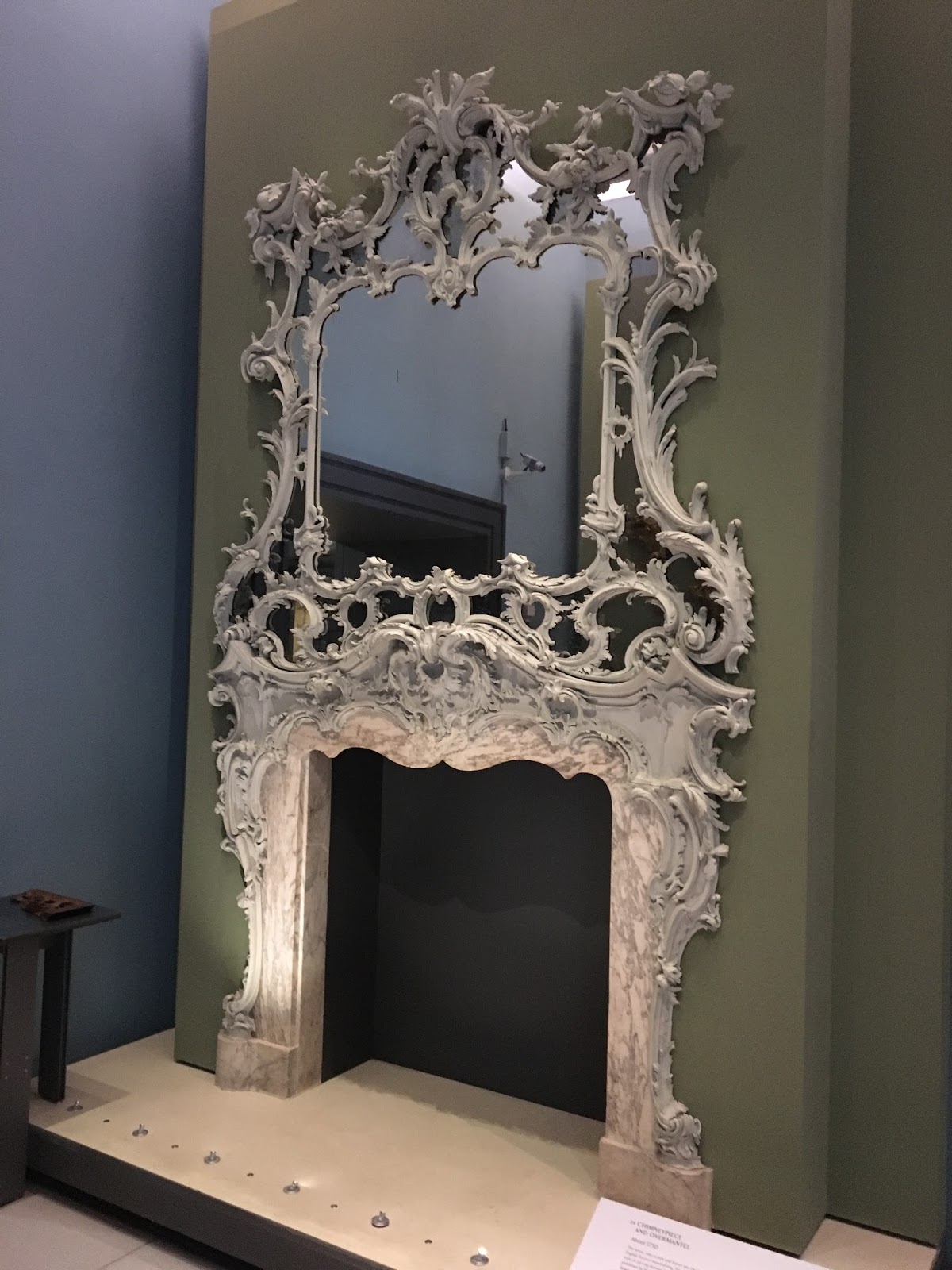
Then off to the V&A. A return visit fro the both of us. For me it was a return after years away and I was aware of the changes. The new-look courtyard, with its rather minimalist fountain, was pretty underwhelming. It was very busy but upstairs in the British Galleries things were much calmer. I particularly wanted to see these galleries (there are two) as the interior designer David Mlinaric, with others such as Christopher Gibbs and the architectural historian John Harris, acted as historical consultant in the representation of the galleries that occurred in the 1990s. The galleries contain some fantastic objects, and it has to be said some pretty strange things too. I have to confess to being a little disappointed with the overall, slightly over powering design, but the colours that Milnaric and others helped to choose were fantastic. No white box Modernism.
Warning: on no account visit the Twentieth Century Gallery afterwards. They were a terrible disappointment both in terms of contents and display after all that colour and beauty. Plenty of the white box Modernist gallery, and both it and the contents were drab and banal. It confirmed what I heard a critic say about Modernist design some years ago on BBC4 - something on the lines of: 'It promised so much and never failed not to deliver.' It certainly gave the lie to the idea that 'good design' - would somehow elevated the mass produced object and make it, like art itself, into a substitute for the spiritual, for the sublime. Echoes there of T E Hulme's 'spilt religion' and Marx's 'commodity fetishism'.
I felt the same sense of decline, if not failure at our next port of call. We took the tube to St James's Park - looking delightful in the late winter sunshine - to the ICA on the Mall. It was the brother's first visit. Neither of us were that impressed. The place looked and felt tired. A place too, I suspect, only for the initiate. We wandered off through the West End to an early dinner in the vibrant Dishoom Carnaby, which I've blogged about before. Pleased to say that our visit went very well - the Black Dhal in particular was unctuously, satisfyingly savoury, and the whole experience excellent.
Labels:
Dishoom,
England,
ICA,
London,
restaurants,
Victorian & Albert Museum
Monday, 13 February 2017
Own work: The Rustiche of Sebastiano Serlio XIV
Another completed painting from the Rustiche, XIV, of Sebastiano Serlio's 'Extraordinario Libro di Architettura'.
Subscribe to:
Posts (Atom)