Sunday, 12 February 2017

London II: The Russian Orthodox Cathedral

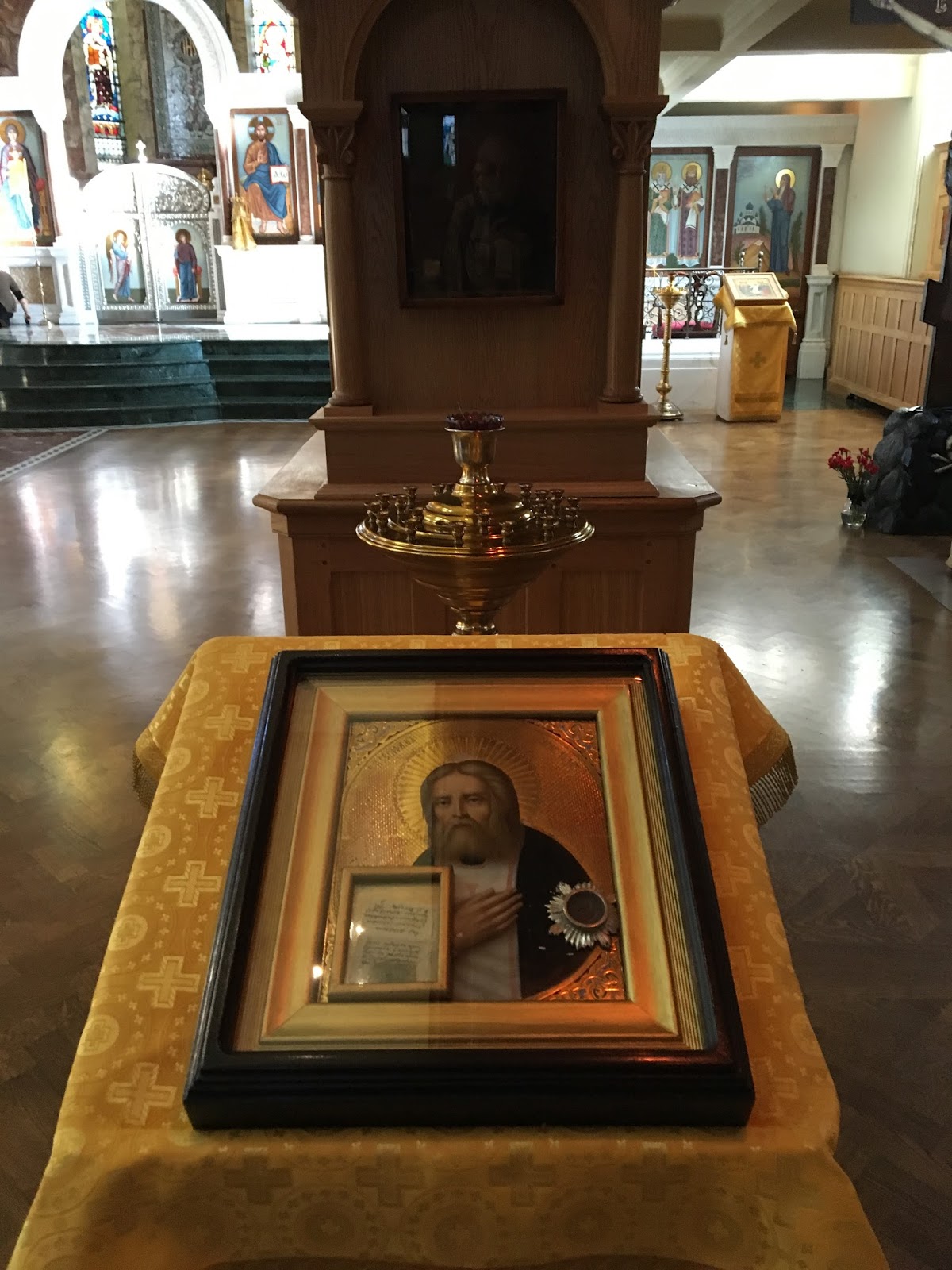
     We walked through Hyde Park, and then plunged into the maze of residential streets north east of the V&A our goal goal being the Russian Orthodox Cathedral in Ennismore Gardens.  A building that has been recently been restored, and I was eager to see what had been done and experience its Orthodoxy.
     The cathedral, however, started out as an Anglican parish church, designed in the 1830s by Lewis Vulliamy (although work didn't commence for another decade).  In the 1850s Robert Louis Roumieu designed a sky-rocket of a campanile, which thankfully wasn't built. The present bell tower dates from the 1870s.  The interior, like many post-reformation Anglican churches of the eighteenth century onwards, is based on the early Christian basilican form - nave, aisles and apse.  We've met the form before on this blog.  The interior is very vertical in feeling.  The great columns are made of cast iron.  In 1892 Owen Jones's decoration was replaced by Arts and Crafts architect Charles Harrison Townsend and the artist Heywood Sumner, who decorated the nave walls with sgrafitto and the triumphal arch over the apse with mosaic.  The apse decoration, by Derwent Wood, dates from 1911. The work is excellent, and it was really pleasing to see that the recent restoration has respected the history of the church.
     Researching for this post I was faced with the same issue that afflicted my research on Houghton Hall last year; none of the secondary source materials seem to quite agree with each other.  It could be that the west front is original, and merely modified by Harrison Townsend i.e. the porch, which has very Byzantine detailing.  However the design, which is based on San Zeno, Verona, is nothing like that in 1850s perspective drawing illustrated in 'Victorian Churches', (Country Life Books, 1968).  I suspect that the whole façade is by Townsend in collaboration with Sumner who made the sgraffito decoration in the porch. The central panel over the door is not mosaic as claimed in one guide book. Either way it's a vast improvement on that illustrated.  When a student in west London a friend and I attended the Divine Liturgy one Sunday when the very holy Anthony Bloom was archbishop, and the place, as far as I can remember, was a little shabby.  There wasn't much money available then, I suppose.  Money, judging by what has recently been achieved, is now plentiful.  And rather splendid, and light filled, is the result. Not, thankfully, as lavish as I feared.




Saturday, 11 February 2017

Own Work: Life Drawing XXXIV

      From last Thursday life drawing class; two one hour sessions.


London I: The Royal Artillery Monument

     To London on Tuesday and a day out with the brother.  After a wet, dull start in Lincolnshire I was greeted by brilliant winter sun on Piccadilly.  First stop was Shepherd Market, a tight, attractive knot of streets built to serve the more elegant streets around.  It has long had a raffish history - bohemian, and a haunt of high class prostitution.  It also has part in literary history; Anthony Powell, author of the multi-volume novel 'A Dance to the Music of Time' had a flat there.  Today it isn't as raffish, being mostly nice places to eat, galleries and boutique shopping.  A good place to explore though. Over the road on the other side of Curzon St. is one of London's more interesting bookshops Heyward Hill - Nancy Mitford ran the place during the War.
     From there we walked along Piccadilly to Hyde Park Corner.  Since the end of the Napoleonic Wars Hyde Park Corner has become encrusted with the memory of wars and conflicts.  In recent this years this process of accumulation has increased in volume and speed with some very questionable aesthetic choices.  What however drew me to make a return visit was an earlier response to conflict: the Royal Artillery Monument, (1921-25) - the work of Charles Sergeant Jagger (1883-1934) with the help of the architect Lionel Pearson (1879-1953). I think it one of most moving War memorials built post WWI.  It is also, I believe, an work of great aesthetic power and strength - a great mound of sculpted white Portland stone culminating in an over life-sized sculpture of a field gun - a Howitzer apparently.    Each of the four sides bears bass-reliefs of deep emotive power, and set before each a single bronze sculpture of a soldier - driver, captain, shell-carrier, and finally, to the north, the body of dead soldier. 'Experience in the trenches', he old the Daily Express at the time, 'persuaded me of the necessity for frankness and truth.'  Jagger, who had given up his Rome Prize to enlist, himself was wounded twice during the war and awarded the Military Cross for his bravery.
     Jagger was a sculptor of immense talent and psychological insight, who had trained in Sheffield and the Royal College of Art and been an apprentice silversmith at Mappin and Webb, but alas fashion being what it is, he is largely forgotten now, and there have been constant criticisms of the memorial.  We, however, were left speechless and humbled by the virtuosity of the work.  I even felt reluctant to ascend the steps to get a better photo.


Thursday, 2 February 2017

Own work: Life drawing XXXII

   I've been particularly tardy posting my life drawings.  These are from three weeks ago, at least!


Wednesday, 1 February 2017

Own Work: Inigo Jones

   I've been rather tardy with posting of late.  Here then is one of the pieces I painted last month and should have been posted at least a week ago: an arch designed by Inigo Jones for Ely House, London.