Saturday, 3 December 2016

Birmingham

     The bf and I went over to Birmingham on Wednesday to visit my family.  It was the bf's first proper visit.  We kicked things off with the City Museum and Art Gallery.  It has a fantastic collection of Pre-Raphaelite art, along with an outstanding collection of applied and decorative arts. The gallery itself is an opulent Victorian Renaissance style, part of the Council House designed by Yeoville Thomason.  West, over Edmund Street is a huge Edwardian Baroque extension by Ashley and Newman, connected to the original galleries by a massively rusticated bridge rich in sculpture.  The whole complex is really worth a visit.
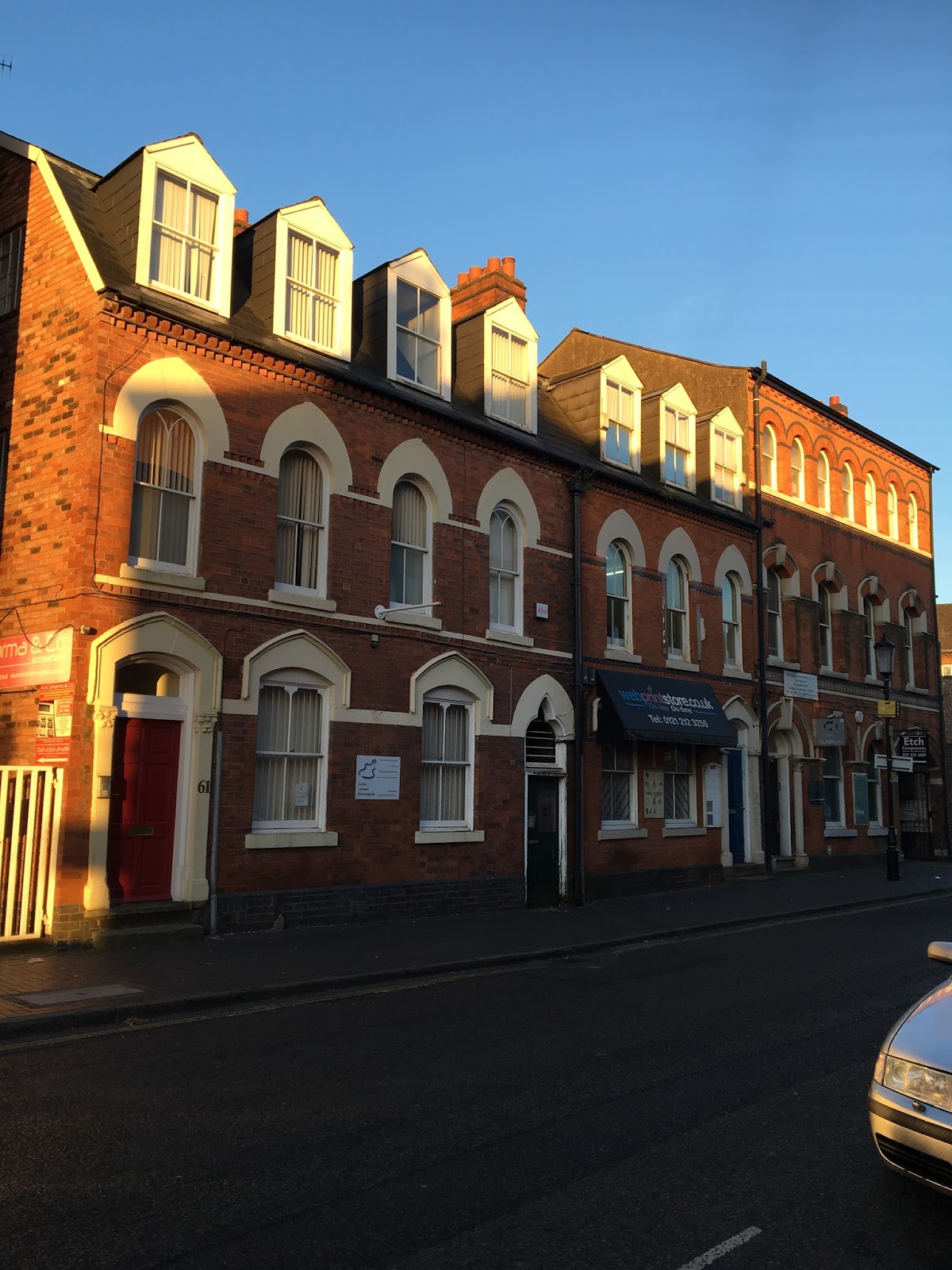
     The next morning we had a brief explore of the Jewelry Quarter before getting the train home.  Originally a Georgian suburb of the city it was slowly colonized by small scale manufacturing during the 19th century, esp the jewelry trade.  The buildings are an interesting mix of the original houses with 19th & 20th commercial buildings.  Most the of manufacturing has relocated and the area is undergoing a slow revival. It has a unique spirit of place.  A lot of the pavements are paved in hard dark engineering bricks.  The scale is low but dense.  Hard at times to think you are the midst of a vast sprawling city.   St Paul's church and the square around it date from the late 1700s.  The architect of the church - rather Gibbsian - was Roger Eykyns, the spire was not added until the 1820s.  Our goal, however, was St Chad's Cathedral by A W N Pugin, but more of that in my next post.


I can't help adding a comment (it is now 2025) with its rows of arched windows looks like something out of Late Antiquity; but the question is, keep the the later square goods entrance or re-instate the two missing arched windows/?


     We ate dinner at 'Otto' the pizzeria on Caroline Street in the Jewelry Quarter (just around the corner from my nephew's flat where we were staying).  Coppa, fresh pesto and rocket on a Margarita base for me.  We have a lovely sharing platter to begin with with garlic and Rosemary flatbread.  The hunter's salami, which was flavoured with fennel, was outstanding.  Breakfast was taken next door at 'The Eight Foot Grocer' - the name refers to the width of the premises, not the height of the grocer.  Both are housed in a former biscuit factory.  Elevenses were taken in Druckers, Great Western Arcade - a good excuse for tea and cake.


Tuesday, 29 November 2016

Own Work: Green Man V


     A further variation on the Green Man.


Own work: Life Drawing XXXI

      Last Thursday's class


Monday, 21 November 2016

Own work: The Green Man IV

  
      Another exploration of the Green man - a variation on my earlier Green Man II


Sunday, 20 November 2016

Own work: The Green Man III


     I've been continuing with my exploration of the enigmatic Green Man.  Not sure this is up to much, but here goes....


Own work: Life Drawing XXX

     From last weeks life drawing class, after several weeks away....


Monday, 31 October 2016

Thorney

     The theme continued.  Wednesday saw us in the fenland town of Spalding and the newly restored Ayscoughfee Hall.  Alas, they had ridded themselves of the immense flock of stuffed birds that haunted one of the rooms, but there was however a lovely temporary exhibition on William Stukeley and his garden designs - he planted circles of trees in imitation of megalithic circles apparently.  I recommend a visit.
     Anyway the real subject of this post is the visit we made on Thursday to Thorney, in the Fenland just east of Peterborough.  I had been there before as a child to the zoo that then existed there.  I haven't been back since, except passing through on the top of a double decker heading for King's Lynn, but it has always intrigued me.
     Like Crowland to the north, Thorney is built on a fen 'island' and is the site of an ancient monastic community.  Its oldest recorded name is 'Ancarrig' - the isle of the anchorites - referring to the community traditionally founded by Saxulf Abbot of Peterborough c.662.  In 870 it was sacked by the Vikings and three of the hermits there, Tancred, Tothred & Tova, were martyred.  The island reverted to wilderness and the name changed over time to Thorney to reflect its abandonment - the island of thorns.  In 972 a new monastery, Benedictine, was founded by St Ethelwold.  It soon began to amass a massive collection of relics, and became a place of pilgrimage.  In the 1530s the monastery was dissolved and abandoned, the stone being quickly carted off to use in Cambridge.
     I was not a disappointed pilgrim.  The village and the church are especially attractive, more like a village in the Great Limestone Belt to the west than a fenland community.  This is due mainly to the fact that Thorney was an estate village, owing its appearance to the Dukes of Bedford.  Rows of pretty cottages line the main street.  Around the remains of the abbey are rather muscular Victorian Gothic cottages and shops, and to the south of the church is a village green lined with older, grander houses.  The church itself is basically Norman (1085-1128), built under Abbot Guenther.  Sadly all that remains of the church are the west front and the five western most bays of the nave.  The church originally was nearly 300ft long.  The nave has been stripped of  clerestory and aisles.  In 1638, when the local fens were being drained to form the Bedford Level, the church was restored to use, apparently by Inigo Jones. The attribution though might be apocryphal. The west window and door, and the plaster vault inside date from that period. In the 1840-1 Edward Blore added a chancel of sorts - a crossing and transepts in a monumental, rather Germanic, Romanesque - making the church 'T' shaped in plan. The churchyard is crammed with monuments, the Georgian ones very distinctive, the relief sculpture being deeply cut and often bearing a representation of the Lamb of God.