Saturday, 21 August 2021

'The Architecture of Ireland'

     The majority of my books are in storage. Most of them subsist in the the bf's mum's garage. They are not happy, and their distress is my distress. We really, really need to move to somewhere bigger. It's like living a sort of exile. This week I had a rummage in a box right at the bottom of the stack and lamenting the damage to some of the books found an old favourite 'The Architecture of Ireland' by Maurice Craig, the publisher Batsford. I just had to bring it home, give it a little holiday. It was published in 1982, but the layout looks ten years older, and it is a delight, being both concise and full of engaging detail. It is also generously illustrated with both photographs and architectural drawings, mainly plans. It even has a couple of pages of photographs of 19th century masonry techniques. How could anyone not but be filled with pleasure at such generosity?
     Anyway, my main reason for this post is the rather moving concluding paragraph of the book. I hope I shall be forgiven for quoting it in full.

     "A hundred years of Irish weather have had their way with the latest buildings which have appeared in this narrative. Of all the influences which have moulded them, the climate must seem the most pervasive: its very fickleness a constant to be relied upon. Yet even the weather has seen secular changes in the past three thousand years. Geological time is measured in vastly longer spans, and the rocks beneath must be counted as even more permanent than the rain and wind above. Yet we have lived to see the relationship between the buildings and the rocks, for the first time in history ignored and abruptly set at naught. Nearly all the quarries from which these buildings came are now no longer open, and the sites and names of many are forgotten. The order of nature is now no more regarded than are those lesser orders which so long ruled the art, and now it is time that the account be closed."

     The end of history. Similar idea is to be found in W Douglas  Simpson's 'The Ancient Stones of Scotland'; the last chapter of which is entitled 'The end o' ane auld sang'. Modernity killed the tradition, in the process severing ourselves from our own pasts.
     The end of ane auld sang indeed.


     Short biographical note: Maurice Craig (1919-2011) was born in Northern Ireland and educated in both the UK and the Republic. He worked subsequently for the Ministry of Works in London.

Wednesday, 11 August 2021

Back to Gower


     I must down to the seas again, to the lonely sea and the sky.


     A two bus trip Monday to Pobbles Bay and Pennard on peninsular Gower. A blustery, cool day at that and plenty of walking done. But, if I have to be totally honest, not enough sketching. Still it was wonderful to see the sea again. The tide was out when I arrived leaving acres of smooth pristine sand at Pobbles Bay. I hope these photographs capture the dramatic nature of the coastline.


Monday, 2 August 2021

Gower

      We've been away for a couple of nights, staying at Port Eynon on Gower. It's been just the ticket. We've done a lot of walking, exploring the coast line between Port Eynon and Oxwich. Beautiful, remote and empty. The sort of landscape that sometimes leaves me a little uneasy. I really do need some humanity, and that is one of the reasons why I found lockdown so hard to bear. Gower is, in Diane Williams words, 'a land set apart'. Somewhere quite special. A poetic, 'thin' place.

      Wednesday afternoon took us to within sight of The Sands at Lower Slade. Yesterday we went further walking over to Oxwich via Oxwich Green. Horton and Oxwich Green are both delightful, but quite different. The last time I was in Oxwich was Boxing Day 2015 in very different weather; overcast and wild. The beach the haunt of fearless surfers. Yesterday it was full of holiday makers.

     Lunchtime was an extraordinary treat: we had lunch at The Beach House, Hywel Griffith's Michelin starred restaurant at Oxwich. The whole thing was purely serendipitous - the bf having, unbeknownst to me, emailed the restaurant in case of a cancellation - only for them to contact us when we were in Oxwich Green. It was needless to say marvellous. I had 'Flowering Courgette', 'Carmarthenshire Pork Belly' and 'Bara Brith Soufflé'. I'm still thinking about that soufflé. It was just exquisite. And the sherry, a Fernando De Castilla Cream Sherry, that was pretty damn good too. The return walk to Port Eynon was a sluggish affair.


     And then Friday morning a brief stop on the return journey in Penmaen to draw and photograph the church. Mostly Victorian, 1854-5 by R K Penson. Best 'Cambridge Camden Society' approved Middle Pointed. Lovely position on triangular village green.  


Monday, 26 July 2021

London II

   In the late afternoon I headed off to Westminster to meet a friend for drinks. I had to cross Victoria St which I swear is waxing in ugliness. It's never been one of London's finest streets but the new buildings going up there are really quite monstrous, quite outdoing their predecessors. Thankfully P does not work on that hideous thoroughfare, but in quieter more salubrious surroundings. Anyway I was early having misjudged how long it would take to get there from my hotel, so the only thing to do was get my phone out and start photographing some decent architecture. And there's quite a bit to see in this part of Westminster - a sort of hinterland south of Westminster Abbey of a human scale, a beautiful and telling contrast to all that verbosity that one associates with Westminster. 


   An early urban work by Sir Edwin Lutyens, built in 1905 for Archdeacon Wilberforce as a parish hall for St John's Smith Square, though designed a good 7 years earlier.


   The Tufton St façade of a late work by Goodhart-Rendel built for himself. How would one categorize this? Neo-georgian? Neo-Norman-Shaw?


   Oblique view of Mulberry House designed Sir Edwin Lutyens - for more details see below..


   St John's Smith Square peering out between the boscage. Another of the those all too few churches built by 'Commission for building 50 New Churches'. This beauty is by Thomas Archer who also designed St Paul's Deptford for the Commission. Perhaps the most continently Baroque of all the churches built by the Commission.


   Another view of Mulberry House: the main façade on to Smith Square. It was built for Reginal McKenna the Liberal Politician and banker. He was Chancellor of the Exchequer (1915-1916) in the Asquith's war time Liberal government. This a political house par excellence: apart from service areas (stairs etc) the first floor consists entirely of three immense rooms designed no doubt for entertaining. An austere design; with links, such as the use of brickwork, to Lutyen's work at Hampstead Garden Suburb. Later owned by another Liberal politician, the industrialist Henry Mond. He had the interior remade in the Art Deco style. Alas.


   Finally a close up of these exquisite Early Georgian Houses, with their inventive free detailing. A delight.


Thursday, 22 July 2021

'The Loved One'

     Recently finished 'The Loved One' by Evelyn Waugh. One of those short novels that punctuate his post-war literary output. A narrative exploring the vulgarity of popular culture in California (which in itself is the death of culture, or perhaps represents a culture of falsehoods, of simulacra, like one of those buildings in a American Ghost Town, that is all façade with a hut lurking shamefully behind), and its particular manifestation in the culture of death. It is soon evident in the novel that Waugh was in turns baffled, disgusted and intrigued by what he experienced on his trip to California in 1947, specifically a visit to the famous 'Forest Lawn Memorial Park' in Glendale which he satirises as 'Whispering Glades'.

     All that said this is an oddly jerky novel, at times a bit below par, and rather like football it is a game of two halves. The first half bears a certain resemblance in style to his early novels while the second is much tougher and, frankly, more compelling. To begin with we find ourselves in the world of ex-pat Brits, classy ones at that, struggling to make and maintain a name for themselves in Hollywood. It is precarious existence. The studio system ruthless and the Americans generally are largely indifferent. Some of the expats behave as though they were missionaries with a calling to maintain correct standards in the face of barbarism. One of those struggling along is the young poet, Denis Barlow. He is rather like one of those characters in Waugh's early novels such as Paul Pennyfeather in 'Decline and Fall' - an innocent abroad, more sinned against than sinning. Well, at least to begin with.

     Things begin to change when Barlow encounters death and enters the world of 'Whispering Glades', the realm of oleaginous Mr Joyboy to arrange the funeral of a senior member of the expat community. Then all of a sudden the narrative jerks off in a different, flinty direction. The funeral Barlow has had to arrange fails to materialise, and Barlow's expat community fades to the distance. Inexplicably one feels. Both would offer a rich seem of comedic potential. A bleaker narrative takes over and with a ruthless logic drives towards its bitter conclusion. 

     Waugh could always be a brutal, even spiteful writer. There is a recurrent cruelty in both his work and his life, and I think this is quite possibly its most naked display. However, it does save the novel.

Monday, 19 July 2021

London I

     To a eerily empty London a fortnight ago to attend the AGM of the Traditional Architecture Group. I have never seen the city so quiet on what was an ordinary week day, or seen so many empty shops, restaurants and cafes. It was not something I would want to repeat. The next day I took to wandering: in the morning around Bloomsbury and in the afternoon up to Camden and Hampstead revisiting student haunts. I found Camden a deep disappointment. Dirty. Shabby.

     The highlight was my peregrination around Bloomsbury, which I love more at each visit. There is still much to enjoy at a time when historic London seems to be under siege and the city just keeps getting uglier and uglier.


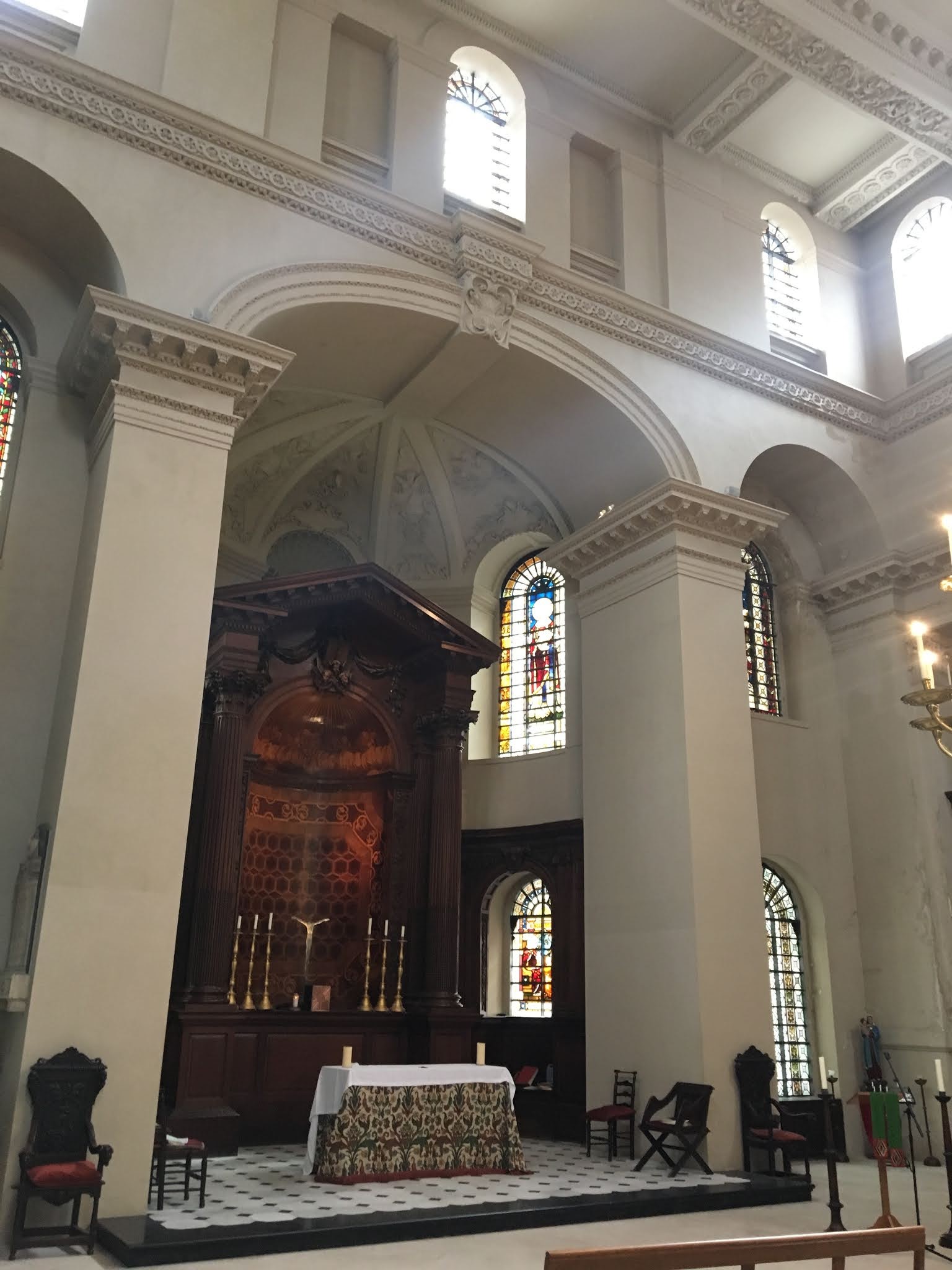
     I was very lucky to find Hawksmoor's wondrous church of St George open to visitors. It really is a quite extraordinary piece of architecture. Strange. Potent. Emotive. It stands just south of the British Museum on the edge of a wonderful, tight network of 18th & 19th streets like the one just above this text.
     Built as part of the Commission for Fifty New Churches, St George's, like Hawksmoor's other churches for the Commission, combines, some times forcibly, the 'basilica after the primitive Christians' with evocations of the Medieval and Classical Antiquity - here the Mausoleum at Halicarnassus and the temple of Bacchus at Baalbek. It is this forceful yoking together of such disparate elements that helps give St George's its power, its compelling strangeness - where else could you find a steeple topped with a statute of king George I standing a top an altar while below the Lion and the Unicorn prowl? And it's the strangeness of his work in general that has lead to Hawksmoor, and in particular his London churches, becoming the locus of all sorts of urban myths and occult associations fuelling, and fuelled by, writers such as Peter Ackroyd and Iain Sinclair. Is there any wonder? St George and Hawksmoor's other London Churches seem to stand outside time. To be unquantifiable. To stand against the Enlightenment, perhaps - to some at least. There is some merit in that idea if only because Hawksmoor's church seem to open a space for the idea of 'mysterium tremendum et fascinans' at a time of Deism.
     Be that as it may, St George's has an amazing heft - it has this sense sculptural solidity as though the church has been hewn from the solid block. It doesn't come as much of a surprise to find it took some fifteen years to build. An element of the barbaric to it too - just look at those massive, over-sized keystones. 
     Strong elements dominate the interior as well. I am intrigued by the way in which Hawksmoor obtains interesting and complex spatial arrangements by the simple expedient of moving and indeed removing elements of the arcade. Sometimes there is a resultant void and other times he 'replaces' stone with the wooden supports of the galleries. These galleries, (which were re-instated during the last restoration), act as though they are separate structures only moored to the vast edifice about them. A building of immense learning, complexity and monumentality, then. Alas, it has to be said however, there is a sense of creeping junk filling up the aisles.
 
     I love the English Baroque and in particular I love the work of Hawksmoor. It's a bit embarrassing therefore to find as I prepare this post that neither of them have featured in this blog as much as my interest would suggest. A shame that our native Baroque should have been such a short flowering, and a yet greater shame that it gave way to milk-and-water Neo-Palladianism.




Wednesday, 7 July 2021

Exhibition

     I'm very pleased, excited and not a little daunted (not to mentioned honoured!) to be finally exhibiting this year at my friend Ben Pentreath's shop 'Pentreath and Hall' in Rugby St., which he runs with Bridie Hall. 

     As you may be aware we have all been labouring under a little local difficulty and this exhibition had originally been planned for last year. 'The best laid schemes o' mice an' men/ Gang aft a-gley.' Anyway this will be my first solo exhibition in London and will run from 6th September until the 17th - so just under two months away. Do please pop-in to say 'hello' if you're passing!