Friday, 30 October 2020

'Die Nibelungen'

      Apologies yet again for not having posted anything of late but the whole lockdown thing has been corrosive of my equilibrium. The depression and anxiety have returned. It has only served to further my mistrust of the msm; their coverage has been at times alarmist. I'm thinking of yesterday's front cover of 'The Daily Telegraph'. So much so I have given up watching and listening to the news, the better to protect my mental health. There really has to be a better way of managing this crisis.

     Over this last week the bf and I have been making our way through the immense, the epic 'Die Nibelungen' and what a gargantuan piece of cinema it is. All four hours and forty five minutes of it. (But no where near the length of Jacques Rivette's 'Out 1; Noli me Tangere' which weighs in at a staggering 13 hrs. I barely got past the grunting.) A brave undertaking, none the less, by one of the masters of German cinema, Fritz Lang (1890-1976), who with his wife, Thea von Barbou , wrote the script. Lang was a leading exponent of Expressionism, and here that heightened language is blended with an Secessionist aesthetic; Lang being directly inspired the illustrations, by Carl Otto Czeschka, in an abridged children's version of 'Die Nibelungen', even it appears borrowing the title. Both film and book, and Wagner's Ring Cycle, are based on the 12th century German epic, the 'Nibelungenleid', which itself has deep origins in the Germanic oral tradition, and in real events in Late Antiquity.

     The film, unlike the Ring Cycle, stays pretty faithful to the original. It is essentially a story of love and revenge. The film is divided into parts 'Siegfried' and 'Kemhilds Rache'.  'Siegfried' is the story of the the eponymous hero, his love for Kremhild the sister of the Burgundian King Hagen, and his betrayal and murder. The second part is the story of Kremhid's revenge upon his murders. And a thorough job she makes of it. I should add here that each part is sub-divided into Cantos - reflecting, I suppose, the structure of the original text. (It does make it easier watching at home. You can watch it in instalments as we did.)  I suppose those divisions to make for a 'literary' film, but don't be put off; they have little, if any, effect on the narrative drive which reaches a suitable dramatic and compelling climax as the bodies pile up. This is a visually stunning film, beautifully shot. Sometimes rich and complex, sometimes austere. There is a strong hieratic quality to scene after scene - very often the camera is static and the actors compose themselves like those in Czescka's illustrations. Though, I suspect, that isn't the only artistic influence; Kremhild, played by Margarete Schon, looks as though she has stepped out of a painting by the Belgian Symbolist Ferdinand Knopf. Scenes are often framed with architecture or members of the cast. Costumes are eclectic - part Byzantine, part Gothic, reflecting the cultural interplay of a 12th century text and a narrative set in the collapsing Roman Empire. Eclecticism, too, in a setting that has dragons, magic, Germanic paganism and Christianity. At times a fairy-tale world of wonders - and horrors.


Die Neblungen                                                                                                       

1924

Producer:                Erich Pommer
Director:                  Fritz Lang
Cinematographer:  Carl Hoffman, Gunther Rittau, Walter Ruttmann

Thursday, 17 September 2020

'The River'

     More than likely in common with many other households in Britain we have a little ritual every evening after dinner that consists of sitting ourselves down in front of the television picking up the remote control and/or the Radio Times then complaining about the lack of something intellectually, emotionally engaging to watch. The word 'crap' is used. Repeatedly. Night after night, faced as we are by a never ending stream of mediocrity. Invariably we watch a repeat rather than 'live' TV. For months now we have been working the Doctor Who back catalogue. It is a cause of small wonder to me that a series that at times is so dreadful inspires such devotion.

     I really have little sympathy for the 'Defund the BBC' campaign, what after all would replace it? I was lucky enough to grow up during the Golden Age of broadcasting and it has left an indelible and welcome mark on my cultural and intellectual life. I'm looking to revive not remove. However I do wonder if its demise in now inevitable, along with say the mainline Protestant churches and the Universities - particularly the humanities departments. They really are, frankly, trashed. Some museums, newspapers and, here in the UK, the National Trust seem to be heading the same way. All of these organisations have positioned themselves as 'Blue Church'*. The recent BLM debacle post-Covid is not the real agent of this change, but the symptom of a greater cultural decline, which is a failure of purpose rooted in the collapse of narrative and in particular the collapse of religion. We are in the midst of a meaning crisis and Identity Politics, as Douglas Murray as so convincingly argued, is an attempt to establish a new metaphysics, a new meta-narrative. Yet another one, and one (I would argue) that has only intensified the crisis.

     Anyway enough with the pontificating, last week the bf came to the rescue and helped slough off the ennui with this wonderful film directed by Jean Renoir and based on the eponymous novel by Rumer Godden (1907-1998). It is a delight. Engrossing and visually rich. It seemed to me rather like the contemporary work of Powell and Pressburger, a feeling enhanced by the presence of actor Desmond Knight who appeared in a number of the latter's films.

     The setting is India during the British Raj, the time the early 1920s - the aftermath of WWI. Important that. The film is, essentially, the evocative  re-telling of Godden's own admittedly idyllic childhood. Not that it doesn't contain an iron fist in that velvet glove, but to explain that would be to reveal too much of the plot. It does however contain a familiar theme in Godden' work: the emergence from childhood of a young woman, with all its blind rages, joys and losses. A process here initiated by the arrival of a wounded American soldier, who inadvertently brings conflict in his wake as three characters vie for his attentions. The political situation in India as the independence movement gathered pace is handled tangentially. (It does not occur at all in the book.) 

     This will, no doubt, annoy some - but ignore the ire of the woke with all their simplistic puritanical censoriousness. (Intellectually its all pretty fraudulent in any case). Sit back and enjoy this quiet masterpiece. Of the two cinematic adaptations of her work - the other being 'Black Narcissus' - this apparently was Godden's favourite.

* for a definition of the 'Blue Church' and its opposite the 'Red Religion' see the work of Jordan Hall and Rebel Wisdom


The River                                                                                                               

1951

Producer:                 Kenneth McEldowney, Jean Renoir
Director:                  Jean Renoir
Cinematographer:  Claude Renoir


Saturday, 5 September 2020

St Cadog, Llanspyddid

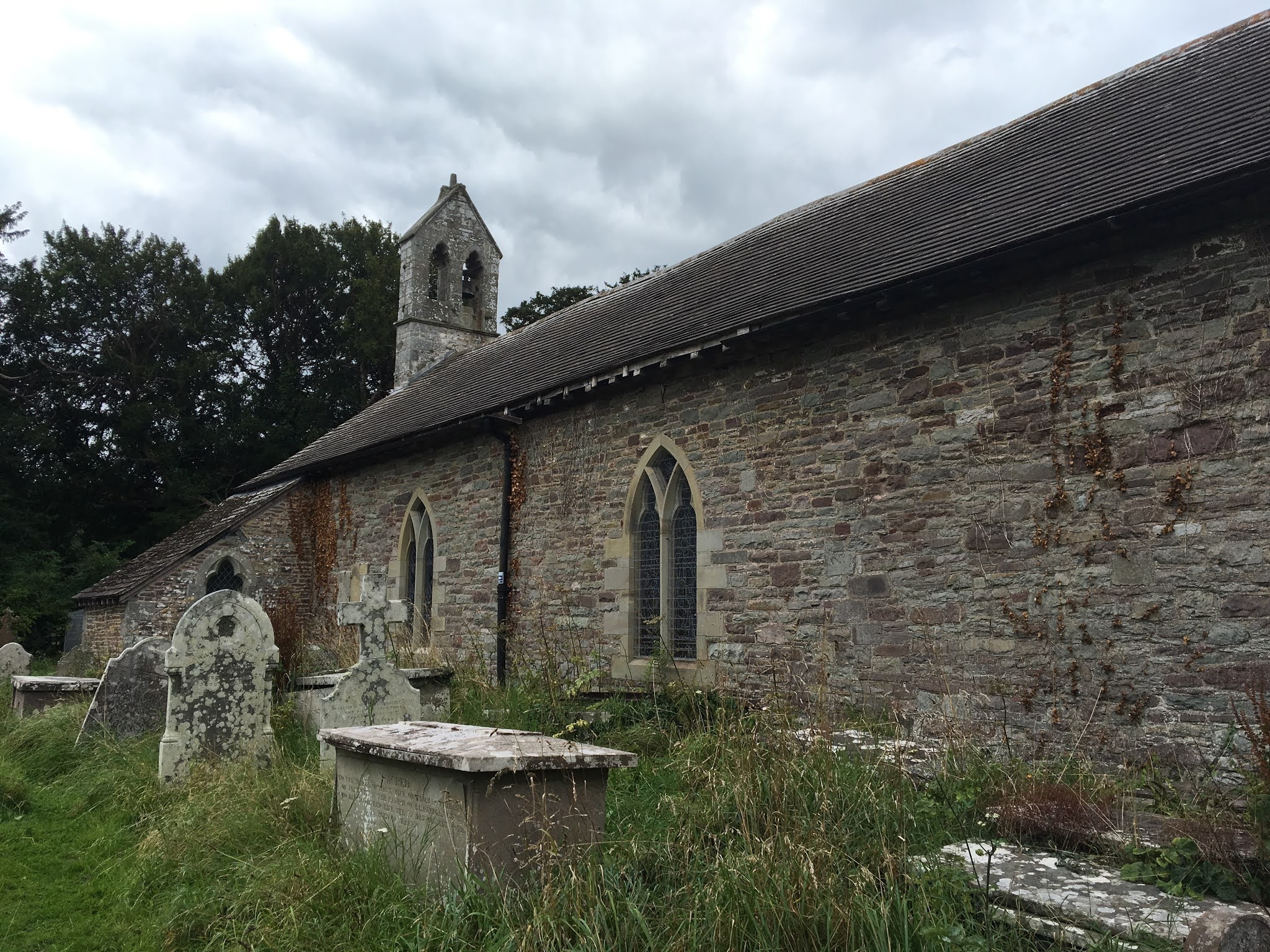
     On our journey back to the Infernal City we stopped briefly at Llanspyddid, between Brecon and Sennybridge (that whole valley of the Usk being some of the most beautiful countryside in Britain) so that I could photograph the church having noted, every time we pass by in the car, how beautifully it sits in its surroundings. An ancient place, dedicated to an early abbot of the monastery at Llancarfan in the Vale of Glamorgan. That picturesque quality is aided, I think, by the yew trees in the graveyard - the Ancient Yew Group has a system for classifying old yews: Ancient, Venerable and Notable and according to the The New Naturalist Library 'Brecon Beacons' edition (2014) Llanspyddid has one example of each. I didn't count how many yews are currently growing there (7/8 apparently), but there were once more: Edwin Poole in 'The Illustrated History and Biography of Brecknockshire',1886, mentions fourteen.

     Alas, on closer inspection it was all a bit of a disappointment - the church an orchestral player not a soloist. Its interest scenic rather than architectural. The graveyard is a mess - a visitor would be hard placed to find the pillar stone of the 7th-9th century AD that is traditionally said to commemorate Aulach, father of Brychan the founder of the ancient kingdom of Brycheiniog. And, to be honest, the church is somewhat lacking in interest. Not only was it closed but had the air of being abandoned. That said the porch, which by the looks of it was originally all of timber, and the little Victorian bell turret make a nice composition, but on the whole the church is somewhat dull. A simple unicameral structure like a Medieval church in rural Scotland. I suppose you could make the argument that St Cadog is a good example of how an ancient building, grown up in harmony with its surroundings, can fall foul of Modernity, and be left reeling. It suffered a restoration in 1886 at the hands of Charles Buckeridge of Oxford, though Edwin Poole praised it highly enough. Buckeridge who restored quite a number of churches in Breconshire, about twelve in all, was a pupil of George Gilbert Scott and heavily influenced by George Edmund Street, so you would think he might know better, though judging by Street's assault on North Luffenham church, perhaps not. The odd bit of research on the internet suggests that it did retain its Tilestone roof until the second half of the 20th century when it was replaced with artificial plain tiles. Artificial!! Buckeridge deserves some credit therefore for its retention at the time, when he could have easily swept it away and replaced it with slate. I suppose in its previous state the church must have resembled, somewhat, St James in Kinnersley. Buckeridge's bellcote is fine, but as for his east window the least said the better. And now, with the continuing decline in religious observance, indifference is completing the work. 

     I'm not a fan of comprehensive restorations - they tend to sweep too much away in the process, and after all an ancient structure such as this is an accretion of things, a layering of history, in which for good or ill each part has as a role to play. However here I would be willing to make an exception seeing Llanspyddid as a place that needs an 'unrestoration', a careful unpicking of Modernity.

     Richard Hall, (1817-1866), the local poet is buried in the churchyard.


Monday, 31 August 2020

St Michael, Tenbury Wells I

     We had a further three stops on the way to Bewdley; Monkland Cheese Dairy (we really do recommend a visit), Leominster, and our third, which concerns us here, St Michael Tenbury Wells. From the burgeoning Late Gothic Revival at Kinnersley back to High Victorian Gothic.

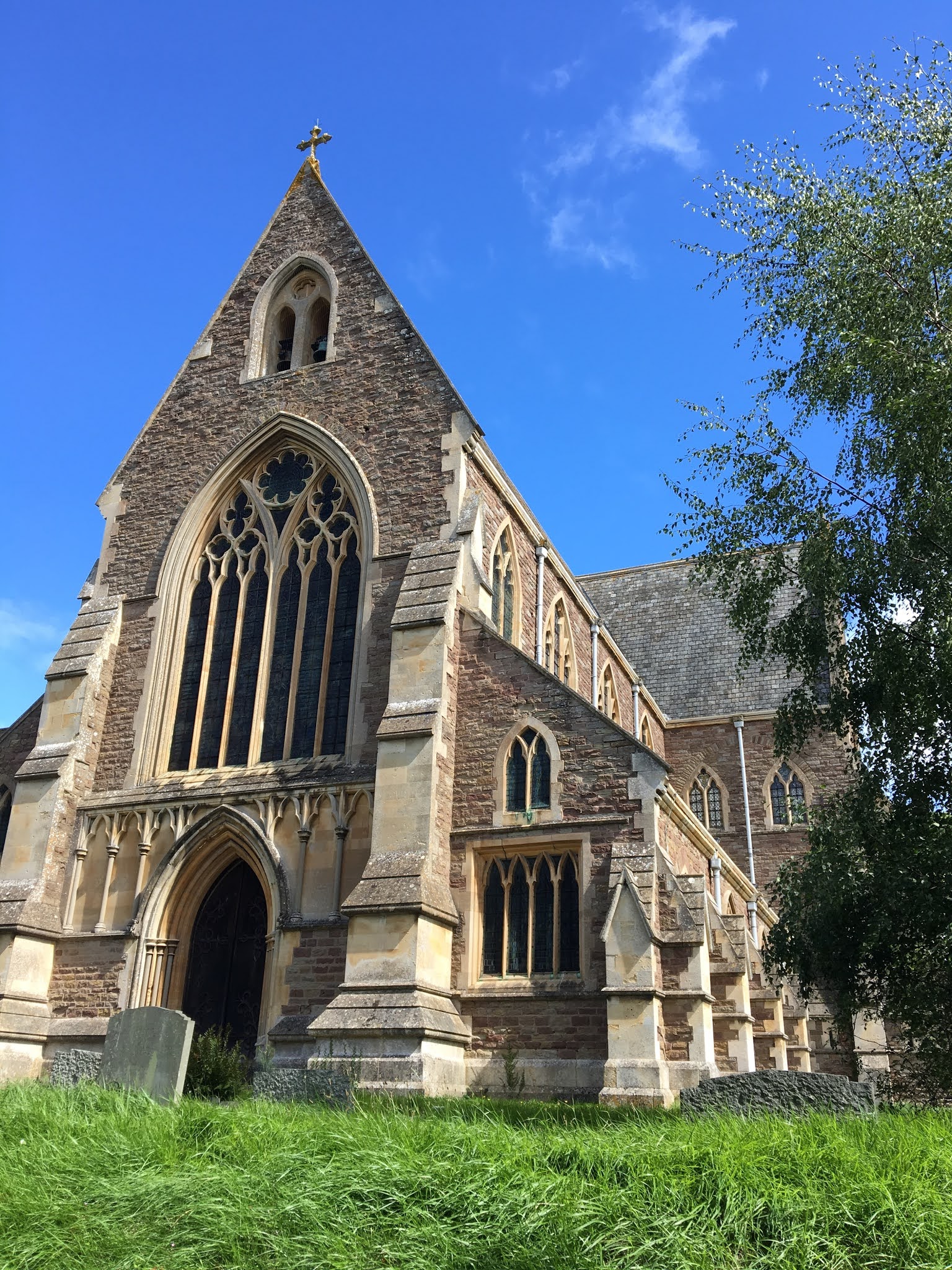
     This, it has to be said, is a quite extraordinary building, best Camden Society approved middle-pointed, built both as parish church and school chapel, for it is part of a complex of buildings, such as All Saints, Margaret St or All saints, Boyne Hill, Maidenhead. Fruits all of the Tractarian movement intended to develop and nurture the spiritual and intellectual lives of the surrounding people and that have their origins in the work of Pugin, particularly in his polemical book 'Contrasts'. Here church and school are parallel to one another linked, umbilically as it were, by a cloister so as to form a quadrangle open to the west. From a distance the church looks like a gigantic scale model of a French High Gothic cathedral that had been dropped into the unsuspecting Worcestershire countryside, and to some extent it is a building out of time and place, for although it partakes to a degree of local materials and local styles it isn't vernacular like St James back in Kinnersley. Something is different, and that is, I suppose, that it is a product of an industrialising society, of Modernity. It is to a certain point self-conscious design, while Kinnersley organic. A building that at one time in the mid 20th century would provoke hatred among many architects and critics, but love in others such as Sir John Betjeman. Perhaps a building constructed out of antinomies. Changeable. Mannered - it is no mere copy of a medieval building, but an imaginative, thoughtful, if not wilful, set of variations on a theme. The details are ever inventive, and seem occasionally to move into unknown territory. Restless even, certainly it has that relentlessness and intensity common to that stage of the Gothic Revival. Earnestness, and muscularity are terms often used in this context. That context being a forceful reaction to the good manners of most 18th and early 19th century architecture. The architect was Henry Woodyer (1816-1896) one time pupil of William Butterfield. It was built for that remarkable man Sir Frederick Ouseley - professor of music, priest, composer and Baronet - with the intention of not only satisfying the spiritual requirements of the local population but playing a national role in the revival of English church music, a role it played until the closure of the school in 1985. Since then the church has continued parochial, and until June this year the school occupied by another educational establishment. The building is now empty and apparently up for sale. I wish I had known this at the time as I would have taken some photos of the school buildings.

     Alas, due to the current events we couldn't gain entrance, so here are the photos I managed to take of the exterior of the chapel.  


Thursday, 27 August 2020

St James, Kinnersley

     Back to Worcestershire at the weekend for a family birthday with three stops en route. The first was the church of St James at Kinnersley in the far west of Herefordshire. Ever since we've been making this particular journey I've been intrigued by this church - it looks so beautiful from the road. A visit was a must particularly on learning that the church contained work by that great Late Victorian architect G F Bodley, and that the graveyard contained his mortal remains. Thankfully our visit did not end in disappointment. The church is a delight. Small, aisled, nestling under a vast roof of riven Herefordshire Tilestones of local sandstone. The square headed aisle windows are a delight - very elegant. Medieval or Bodley? There is a timbered porch and there's that wonderful, masculine tower. Architecture that seems in harmony with the landscape it inhabits.

     Inside there are two arcades, one sturdy, the other one light and lithe Perp Gothic. It has those small inconsequential capitals we saw in the choir of Malvern Priory.  There are a number of monuments too, the most spectacular being the Smalman monument in the chancel. Carolean and in need of much help. And then there is the work by Bodley. Most conspicuous and beautiful are the large areas of diaper pattern above the aisle arcades. They are fading a bit. The church is currently undergoing a restoration/repurposing; I just hope they do as little as possible to the wall paintings here.  They are in just the right state of 'pleasing decay'. However I think that Bodley's work in the chancel would probably benefit from a more proactive approach. I should add here that the work is not by the usual suspects but the then incumbent the Rev Frederick Andrews under Bodley's supervision. Andrews incumbency started in 1873 and ended in 1920. In addition to all the painted work there are Bodley tiles in the chancel (made by Godwin of Lugwardine, also in Herefordshire), organ case and beautiful wrought iron chandeliers like those at St Helen's Brant Broughton in Lincolnshire (Bodley restored the church there in the early 1870s) and were made by Coldron's in the village. I suspect they supplied the chandeliers here too. I suspect too, that the roofs were replaced by Bodley or in an earlier restoration by Thomas Nicholson in 1867-9. I would suggest also that the chancel was decorated first, the nave second.

     As I said the parish are currently busy at work on the church - there is much do. I only hope the work will not rob the church of its special atmosphere. As it is there is too much clutter.


Wednesday, 26 August 2020

RIBA Traditional Architecture Group Exhibition

     Put out the flags! Sound the Trumpet! Let each true subject be content to hear me what I say!

     The Traditional Architecture Group, of which I am an associate member,  is currently holding an online exhibition - the times being what they are. And I am pleased and honoured to have two works on display for your perusal and delight. Here lies the link.

Tuesday, 25 August 2020

Own work: Lettering

     The final one of an occasional series of the letters I've done to mark family birthdays.