Sunday, 20 February 2022

St Albans Cathedral II: The Nave

     And now for the interior, and the nave. 

     Firstly, and I think this is quite a rare thing these days, the visitor is left quite alone - there is minimum signage, there is no eager 'greeter' resplendent in coloured sash and there is no entrance charge. The building is left to speak for itself. Commendable. 
     Secondly, I feel that I have to point out a Medieval pilgrim would have experienced this building in a way quite differently to us, apart from the changes to the building, liturgy etc. The pilgrim would have had only limited access to this church, entering and leaving by a door in the N presbytery aisle, not through the great west door as today. One can't help but think they were a bit short changed. The rest of the church was, I believe, out of bounds to them. We are used, these days, to the nave being used as a great congregational space, but 'back in the day' the original purpose was simply to provide for a space for processions safe from the vagaries of the English weather. That, and bit of ostentation. Later, as it became common for monks to be ordained (originally they had be simply laity under vows) and for them to say mass everyday the nave was used to house additional altars it being the Medieval custom that an altar could only be used once a day to celebrate the Eucharist. We shouldn't imagine that these additional masses were in anyway congregational. They were solitary affairs. There could have been any number of these Low Masses going on at any time throughout the building. After the Reformation the nave became used, I believe, as a sort of covered cemetery, oddly echoing the original use of the nave of St Peter's in Rome.

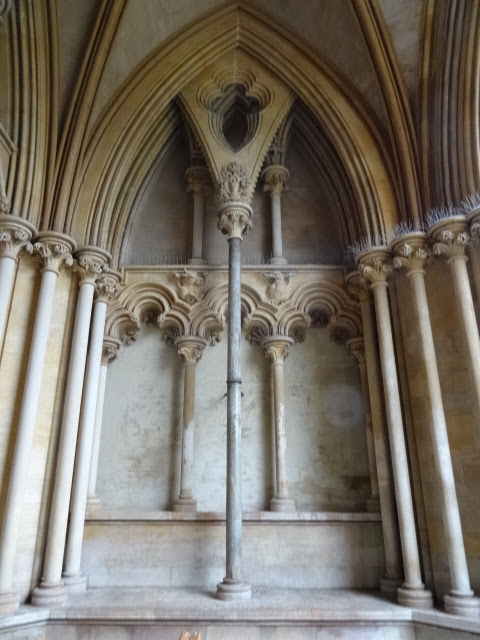
      So what did I notice stand there with the extremely long nave stretching out before me into the religious gloomth? The austerity of the space and its asymmetry. The south arcade has three periods of building and the north two. The Early English and the Decorated work both are very good, the Norman crude, massive and vigorous. And that neatly sums up the architectural history of the building for there are no major Perpendicular additions or alterations to the church, and as I mentioned in my previous post milord Grimthorpe did his utmost to remove all those Perpendicular intrusions he did find. Over this architectural mash-up is a flat Late Medieval ceiling - dark and a bit dull, except at its e end where it is painted. I think if had been a nineteenth century restorer I would have been inclined to remove the whole thing and replace it with a wooden tunnel vault, such as you might find in York Minster or Glasgow Cathedral. The intention of the Early English builders had been to vault in stone, but idea was quickly abandoned.  In fact the majority of roofs in the cathedral are of wood, the only original stone vaults being in the presbytery aisles; Hertfordshire being rich in timber and poor in good quality building stone. I wonder what the effect would have been if they had kept to their original scheme.

     Anyway these elements of asymmetry and austerity add to the sense of the parochial that permeates not only the nave but the whole church and which I mentioned when talking about the exterior. Not that that is a bad thing. This is also partly due to the lack those elements that we associate with the cathedral; for instance, there are no grand post-reformation monuments and very few from before. As for the furnishings in the nave; there is an excellent west window by Sir J N Comper, and a lovely font cover by Randoll Blacking. However of more importance are a number of precious medieval survivals. Firstly there is the medieval Rood Screen, built of stone like the one at Crowland in Lincolnshire. Apparently they were more likely constructed of wood like the surviving one at Peterborough, which alas is no longer in situ, but is currently in use as a parclose screen in the north transept there. It did however survive in situ into the nineteenth century, when Blore, I think, was let loose on the interior. I digress. Originally the Rood screen would have been surmounted by a depiction of the Crucifixion. In addition this sculptural group could be flanked by two seraphim standing on wheels, combining Old Testament imagery from the Books of Isaiah and Ezekiel. The second survival, and is really is a fluke of history, are the paintings on the Norman piers of the n arcade. They really are something special, and some display Byzantine influence. Originally they served as reredoses for those additional altars I mentioned above. 


Monday, 31 January 2022

Cambridge

     On that trip to London late last year I had a welcome return to Cambridge. It was a  Saturday and the city was incredibly busy. The train north from King's Cross packed. Cafes queued out. I wandered around the familiar streets in search of old favourites, old haunts, wary of change.


Tuesday, 25 January 2022

St Albans Cathedral I: The Exterior

     I really must apologize for the tardiness of this post it is nearly two months since I took the Thameslink train north from St Pancras to St Albans. I am not over the effects of Lockdown. Anyway I was in London for the annual TAG Awards and pre-Christmas party. A catch up with friends. I took the opportunity to have a weekend away from the Infernal City. I hadn't been St Albans in years, decades when I think about it. At the time the city made little impression on me. However the old centre is very attractive, and there is much to enjoy with street after street of pre-modern houses - George St is particularly fine. And there are the remains of the Roman town of Verulanium.  However St Albans both benefits and suffers by its proximity to London. Housing is very expensive and it is inordinately busy and congested. But at least it's not like Reading.

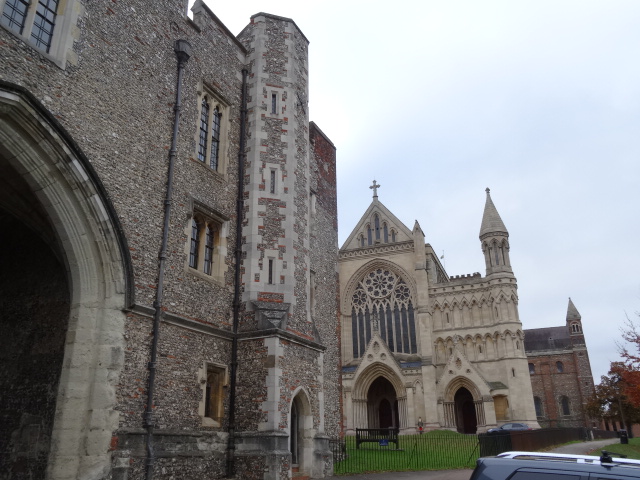
     This post was originally going to begin with: 'Poor old St Albans, in turn abbey, parish church and finally cathedral, has suffered so much and so repeatedly in its long history.' Which sounds dramatic and, I hope, intriguing, but isn't really that accurate. Other cathedrals and greater churches have suffered more: Lichfield, for instance, was in ruins at the end of the English Civil War. In Wales the cathedrals of St David's and Llandaff were themselves largely ruinous by the mid-nineteenth century. So St Albans is no means unique in having a rough time of it after the Reformation. At least it stayed roofed and relatively intact at time when it must have been very difficult for the congregation to pay for the upkeep for what is a vast building. And oddly parochial it still feels for such a large and important building - for St Albans has one of the oldest and most continuous histories of any church in the British Isles. It stands long and low, atop Holmhurst, now Holywell, Hill, almost shorn of context, overlooking the valley of the Ver, on the site traditionally associated with the Protomartyr Alban's passio. Depending on who you read that event has been placed anywhere between 205 and 305AD, though the money these days is on the middle of that range, that is during the reigns of either the Emperors Decius or Valerian. Contemporary scholars tend also, I think, to believe that the Cathedral marks not the site of the martyr's execution but his grave and later his cella memoria in an area known to have contained a Romano-British cemetery. Either way it is a place of considerable historic importance and continuity. Tantalising. 

     The current building dates back from the time of the Paul of Caen, 14th abbot of the monastery. The massive central tower dates from this period and like the rest of Paul's monastic church is constructed of spolia, that is material garnered from the ruins of Verulamium down in the valley, in this case mainly bricks. It is this use of spolia that makes for crude and powerful architecture. Barbaric splendour, if you will, commensurate with the martyr's Antiquity, his Romanitas. It is also some of the earliest Norman work in the country. So we are lucky to have retained it. 

     One of the richest abbeys in England St Albans was, apparently, inept at managing its finances so that it was never wholly rebuilt which allowed for the retention of the Norman central tower.  And then came the Reformation. The Abbey church became parochial, the monastic buildings with the exception of the Great Gate demolished, and the town took on the almost unequal struggle of maintaining such a vast building. But survive it did, only, in the late nineteenth century to run into Edmund Beckett, 1st Baron Grimthorpe. Lawyer and 'controversialist', Beckett was rich, domineering and an amateur architect who volunteered both his money and his meagre talents in the continuing restoration of the church when Sir George Gilbert Scott died in 1878. It was, I suppose, an offer that couldn't be refused, but it was an unequal match and a lot of damage done, texture lost. 

     The result is a rather odd patchwork of materials and styles. It lacks that cohesiveness and sublimity that one associates with cathedrals. It is a muted presence in the city. We are back to that sense of the parochial. From the west the tough, majestic tower is engaged in a uneven struggle with the inordinate length of the nave. Grimthorpe to his credit did, I think, realise this but his west front does little to address the aesthetic problem. I should add here that the west front does contain three Early English porches, which though heavily rebuilt are very stylish, sophisticated pieces of architecture. Gilbert Scott thought very highly of them. That said the w front seems almost completely disengaged with what it is going on behind. To get a better sense of the massive scale and vaulting ambition of Abbot Paul it's best to go down either Waxhouse Gate, or Sumpter Yard, where the tower looms over transepts and presbytery.

     The underlying reason for this lack of 'cathedralness', lies in the the geology. Hertfordshire possesses no good building stone. There is chalk but that is really not suitable for exterior work. It weathers far too easily. And there is flint. The nearest good hard wearing freestone is available from the Limestone Belt and that would make is expensive to transport, and that is why the Norman builders resorted to spolia and why, I suspect, the work of later abbots was always so tentative.


Tuesday, 30 November 2021

St Laurence, Bradford on Avon

    St Laurence's church is a remarkable and special survival, a virtually intact late Anglo-Saxon church. The first sight of which was, for me at least, deeply moving, partly because it is, for the first time visitor, just a little unexpected.

     It was thought for a long time that St Laurence was a survival from the monastery founded by St Aldhelm of Malmesbury c700. The Medieval chronicler William of Malmesbury certainly thought so. However, on stylistic grounds, this is now thought to be unlikely. Instead is is suggested that the building dates from about 1000, and may have been built to house, temporarily, the remains of King Edward the Martyr. It is known that in 1001 King Athelred granted the monastery to the nuns of Shaftesbury, refugees from the Vikings; which suggests that St Aldhelm's original foundation had fallen into abeyance. So perhaps I wasn't indulging in wishful thinking in my post about Holy Trinity church after all; perhaps both churches did indeed once share the same sacred enclosure.

    It is likely that St Laurence's continued in use into the Middle Ages for William of Malmesbury noted in his Gesta Pontificium 'Et est ad hunc diem eo loci (sc Bradeford) Ecclesiola quam ad nomen beatissimi Laurentii fecisse predicatur Aldemus'. It eventually became an ossuary before its location was lost. And then, as I have said in my post on the parish church it was discovered by the then vicar (and antiquary), William Henry Jones, leading to its restoration in the 1870s. A remarkable story all told. You can read his account here.

     Whatever the actual reason for the construction of this church it does indeed, it has to be said, look like a medieval reliquary with its pitched roof and decorative band of arches. Finely executed in ooltic limestone ashlar it is not the sort of thing that one necessarily associates (however erroneously) with the 'Dark Ages'; the quality of the design and execution, suggest royal patronage. Helen Gitos in 'Liturgy, Architecture, and Sacred Places in Anglo-Saxon England' suggests that the arcading may have originally decorated with the martyr's passio. An attractive idea. The building bears its scars; the west wall is a Victorian reconstruction and it's possible to trace the positions of former windows etc inserted into the fabric when it was converted to secular use.  The plan, which is very close to that of Bishopstone in Sussex, is roughly cruciform: a tall nave with projecting chancel to the E and two porch/chapels to N & S. The south one was demolished at some point. Such a chapel/porch is called a 'porticus', and appears to have had a variety of functions in the Anglo-Saxon church - in some instances they served as burial places. I am particularly intrigued by the 'broken off' decoration in the end gable of the N porticus. Was there more, something lost? The interior is numinous and holy. Church as cave.  As you can see from my photographs there is a great sense of verticality; the doors for instance are narrow and tall. Above the chancel arch is the remains of a great Rood of which only the attendant angels remain.

      It is so very tempting to speculate about the decoration and the liturgy originally employed in this church. The building seems to encourage it. It's easy to get carried away, to imagine, say, the Gospel book and Holy Communion being brought out in procession to the faithful through the chancel arch as 'epiphanies', as projections of the divine into the secular as represented by the nave; to envisage the use of liturgical fans and byzantine textiles. Both of which are known to have been in use in Anglo-Saxon England. (08.04.2022 I've recently found out that some Anglo-Saxon vestments, eg stoles, were fringed with tiny bells, adding another layer of auditory richness and complexity to services) As for the liturgy - which form of Roman Rite? And what chant? 'Old Roman' or that new-fangled 'Gregorian'? Whatever happened this church feels a long, long way from a Modern church, as represented by the contemporary ordering of the parish church across the street, let alone a Medieval one. It feels closer to Orthodoxy.


Monday, 1 November 2021

Holy Trinity, Bradford on Avon

     The churches of St Laurence and Holy Trinity sit low down by the river Avon and are separated from each other by the seriously attractive Church St. The churches could almost hold hands they are so close. That first visit in all an intense experience. The beauty almost too good to be true. I'd like to think that in the deep past when the church of St Laurence formed part of an Anglo-Saxon monastic complex founded by St Aldhelm it shared space with the predecessor of Holy Trinity; and that at the ending of the monastery the umbilical link between both churches was severed, St Laurence was secularised and Holy Trinity, being the parish church was rebuilt and enlarged so that now it is by far the larger of the two buildings. Alas, that may be wishful thinking, things being a little more complicated than they first appear.

    Holy Trinity stands on the north side of a long, thin lens of churchyard separating the church from the river; to the north it stands hard against Church St. There is a business-like west tower with blunt spire, a north aisle which is rather fine, but there is no corresponding aisle on the south (not matter what Pevsner implies in the Wiltshire edition of 'The Buildings of England'). The contrast between north and south sides couldn't be more telling or more interesting, for the north is in all a piece, competent Late Gothic, and south, though obviously rebuilt, is a palimpsest of styles, with projecting porch and transeptal chapel. In origin that S nave wall must be Norman (see the windows).

     The interior is surprisingly spacious but, rather like the tower, it's business-like. Not a place for the numinous. Sad to say. I'd  even go so far as to say it is somewhat forgettable. What I do remember are the large number of memorials in the church, the grandest being in the chancel - some in need of a clean. And there is the n aisle  arcade. It is is mainly Victorian - those scrolls! Originally the aisle was divided into chapels by solid walls, so the effect now is very different from that intended. According to Pevsner the arcade is the work of [John Elkington] Gill (never heard of him) and dates from 1864. Previously in 1858 the great Sir George Gilbert Scott himself had been called in an advisory role. The Vicar  of Bradford at the time was William Henry Jones, 1817-1885. He was also an antiquary and it was he who discovered the church of St Lawrence hidden in plain sight as it were among later buildings. His brother was Samuel Flood Jones who was a member of the Chapter of Westminster Abbey.

     In writing this post I began to suspect that the church had undergone a Tractarian restoration at that time, influenced by such restorations undertaken in the weaving communities of the Cotswolds particularly by Tom Keble, vicar of Bisley and brother of John Keble. However the current re-ordering has been so radical that it was hard to tell from my photographs what had happened way back in the midst of the nineteenth century. It was only via an internet search that I found evidence of what was done and what was lost in the process. Judging by what I found that  restoration was a pretty thorough-going process, just as radical in its way as what has recently occurred, with the destruction of a west gallery and organ and the removal of two interesting looking post-Reformation plaster ceilings. Both nave and chancel now have attractive wooden barrel vaults that deserve to be coloured and gilded. So perhaps no great loss.  About the aesthetic and spiritual qualities of the current thorough-going re-ordering the least said the better, but what the hell. My heart lies with with the previous states of the church. It could be argued that the current re-ordering is just another example of a series of discontinuities that the church has suffered. And that is true but it cannot be used as a justification for such far reaching changes; neither is it an excuse for something quite so banal. 


Wednesday, 27 October 2021

Bradford on Avon

     On the second full day of our trip to Bath we headed off to the station and caught the next train to Bradford on Avon. A mere fifteen minutes away. Trains are every half hour and it is a journey I would recommend if you're holidaying in Bath. (I'd also recommend 'Pablo's Tapas' where we had lunch!)

     In the late seventies and early eighties the English architectural historian Alec Clifton Taylor presented three series (each of six episodes) on the architecture of English towns for the BBC. A different town in each episode. They were excellent. Just the sort of thing that the BBC was then very good at. Alas, I don't think the same can be said today. These half-hour documentaries can be occasionally found on YouTube, but usually disappear again; I think for copyright reasons. I suspect the BBC is very assiduous in that. However these programmes are really worth looking out for. Anyway Bradford on Avon appeared in the second series which was broadcast in the Autumn of 1981. And I suppose it was seeing that particular episode on YouTube a year or so ago that put the idea in head when we decided to visit Bath.

     Bradford is not large, (pop 9,000+); the centre in particular is very small - a tight knot of narrow streets that suffers a lot from through traffic. An important river crossing that was once over looked by a hill-fort, high on the hill to the N above the town. In Late Saxon times Bradford was the site of a monastery. So a place of some considerable history. There isn't much town on the southern bank of the Avon but on the north it creeps up that steep hillside to the Budbury plateau in a series of long parallel lines of old stone houses that once housed weavers. This was once a manufacturing town, and down on the valley floor were a series of great woollen mills. The architecture in all is very like what I was used to living in south Lincolnshire - ooltic limestone, ranging from pale grey to warm ochre, and stone slate roofs. Both Kesteven and Bradford are at either end of the Limestone Belt that weaves its way through England roughly SW to NE. What interested me in Bradford were the remarkable group of Baroque houses, somewhat similar to the ones on Bath, and the two medieval churches. One of which, St Lawrence, really is something special, of national importance.

     You know, as I upload these pictures I feel I haven't really done Bradford on Avon justice. Alas we didn't see Bradford Hall, which is the second building in the town of national importance, or the the tithe barn. Or the long terraces of of weavers houses that climb the hillside and that bear such evocative names as 'Top Rank Tory'. In places the narrowness of the streets and lack of pavement meant it was next to impossible, on a normal week day, to take photographs. Perhaps another time.


        English Baroque of the local type at Westbury House 


        The Old Church House, now Wallington Hall. Late Medieval church hall. 


     Houses in Church St. Particularly admire the combination of stone walls and yew hedging