Wednesday, 10 August 2022

Heathfield

 Jerusalem remembered, in the days of her afflictions and of her miseries, all her pleasant things that she had in the days of old....


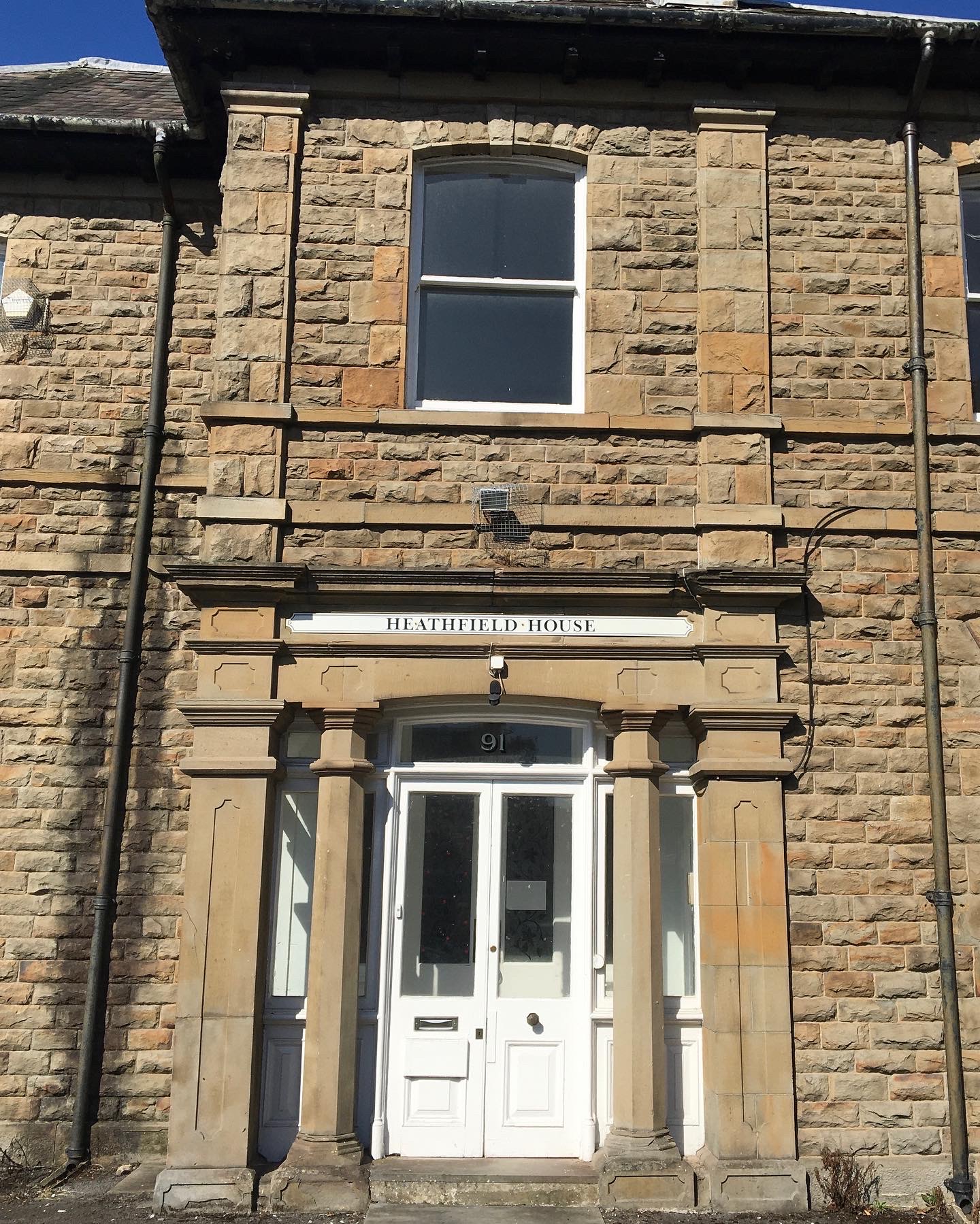
     Half way up Mount Pleasant is a narrow road - Heathfield. There is, momentarily, as you turn off and begin your ascent,  the sense of leaving the city, that Infernal City, behind, a fleeting evocation of the rural. Perhaps it is the abandoned and now overgrown site of the 'Cambrian Institution for the Deaf and Dumb', and further along the crag of bare, blackened rock. Heathfield is essentially a mews, a service road for the big houses on the south side of the street that overlook the wide expanse of Swansea Bay. They are now mostly in multiple occupancy. It is all now rather down-at-heal - Ichabod, frankly - but when build this must have been a grand address for the newly emergent Swansea middle class to inhabit.  When you think about it the construction of Heathfield must have been quite the thing - a great terrace was cut into the rocky hillside and, I presume, the spoil used to widen that terrace on the town side on which those once grand houses stand. Quite something.
     Heathfield House (HH) and its close neighbour (what is now the Heathfield Social Club) stand out from their neighbours being masonry structures while their neighbours are rendered. HH is constructed of 'polestone' - that is hammer, or quarry dressed ashlar, here laid in regular courses.  It also is more classical; HSC is a rather wilful designed with the use 'structural polychromy' in the form of dark snecked semi-boasted rubble and contrasting Bath stone ashlar dressings, but both are good examples, emblematic if you will, of the power and wealth of Victorian Swansea. In addition the wide terrace in front of both houses is contained by a massive stone revetment.
   According to one estate agent's website HH was built as an Anglican vicarage c. 1882.  Alas, it has been downhill for both houses ever since.  There is even an electricity substation in the entrance forecourt of HH. As far as I know neither house has ever been subdivided for multiple occupancy, which is something, but both interiors have been damaged by their last use - I had presumed that HH had been  used by the NHS, but it seems I was wrong.  It was used, instead, by 'The Glamorgan-Gwent Archaeological Trust, and perhaps recently as a solicitors.

   It would be a marvel if they both bought as family homes, but this is alas unlikely. Subdivision is sadly their fate.


    Heathfield Social Club (L) and Heathfield House (R). Don't be fooled into thinking Heathfield House is a pair of semidetached villas.


     Entrance façade of the social club. The door has suffered mutilation and a lot of work will be required to restore it properly. The lintel over the former entrance is cracked and probably requires replacement. 


Tuesday, 9 August 2022

Philip Larking Centenary

     On the centenary of the birth of the poet Philip Larkin, just a short post to share this wonderful clip of Sir John Betjeman talking to Larkin for the BBC arts programme Monitor in 1964. Betjeman's reading of 'Here' is just superb. Larkin (1922-1985) is a poet I have warmed to more over the years. Anyway, enjoy before he's cancelled.

https://www.youtube.com/watch?v=Coe11pgoj8E

Monday, 8 August 2022

'A Passion for Churches'

     'I was eight or nine years old when I used to come here, to the Norfolk Broads on the river Bure, sailing and rowing with my father and I think it was the outline of that church tower, of Bylaugh against the sky, which gave me a passion for churches so that every church I've been past since I've wanted to stop and look in.'


     Back in 2015, you may remember, the bf and I went on holiday to Horsey in flattest N E Norfolk. On our last full day of holiday we went out into the Broads, walking along the Fleet Dyke until we stood opposite the scanty remains of St Benet's Abbey. A small homage to Sir John Betjeman, the Poet Laureate, and the documentary film maker Edward Mirzoeff and their collaboration of 1974 the BBC documentary film: 'A Passion for Churches' (subtitled 'A celebration of the C of E with John Betjeman'). Previously they had worked together on three episodes of 'A Bird's Eye View' between 1969 & 1971, and most famously 'Metro-land' of 1973. Their final work together was, I believe, 'The Queens Realm - A Prospect of England', 'an aerial anthology with verse chosen by Sir John Betjeman'. It consisted of clips garnered from 'A Bird's Eye View' series accompanied by music and poetry read by the likes of Janet Suzman and Michael Horden; the whole thing tied together Betjeman's narration. It formed part of the BBC's cultural offerings for the Silver Jubilee Year of 1977, along with Huw Wheldon's 10 part series 'Royal Heritage' which Wheldon co-wrote with the historian J H Plumb. They certainly knew how to celebrate a jubilee back in the day. In 1979 Mirzoeff collaborated with Betjeman's daughter Candida Lycett Green on documentary film 'The Front Garden'.

     Anyway, my first encounter with 'A Passion for Churches' was in 1984, when, following the death of Sir John, I caught a glimpse of this wonderful film on the BBC tribute to the late Poet Laureate. There were, I think, three sequences shown and two have remained with me: there was the visit to the 'Golden Church' of Lound (in Suffolk, but part of the Diocese of Norwich) where between 1912 & 1914 the church architect Sir J N Comper worked his magic, and, more importantly to our family, the Mother's Union garden party in the cloisters of Norwich cathedral, where we believed we could espy my paternal grandmother amongst the crowd. 

     Judging by Eddie Mirzoeff's account in The Oldie the filming process seems to have been a picaresque affair, with an ever shifting cast of characters, such as Penelope Betjeman and the novelist Elizabeth Jane Howard, popping up and needing to be dealt with.  However the result of the collaboration of poet and film maker is something quite sophisticated and complex. The nearest equivalent would be a novel by Barbara Pym where the profound is both hidden and revealed to us through the medium of the domestic and mundane. The churches seem to be mainly chosen from N and NE Norfolk. The churches to the W and SW are largely omitted, though this partly because the churches of the Norfolk fenland are in the Diocese of Ely. 

     The title itself is a pun of a gentle sort, referring to both Betjeman's love of church architecture and the passion of Christ - that his death and burial; the implication being that the churches themselves were undergoing a death, or martyrdom (the Latin passio is used to describe the martyr's death), as faith was beginning in earnest 

     'its melancholy, long, withdrawing roar, retreating, to the breath of the night-wind'.

     Perhaps the best way of understanding this film is to think of it as cable or yarn made of a number of individual threads entwining together: the celebration of the church architecture of the diocese  and a plea for conservation; the celebration of the parish life of the diocese - PCC meetings, church fetes and the like, in which we see the preparations for Easter. Connected with that there is a linear exploration of the spiritual journey of the individual parishioner through the 'Passage Rites' such as Baptism and Marriage, the sacraments by which we participate in the death and resurrection of Christ, through the portal of death to the resurrection - of which the joy of Easter Day, with which the film ends, is a foretaste.

*  *  *  *  *

     I think a lot about Norfolk these days - that land of lost content - from this Infernal City that is a place of of exile and a place of eclipse. The very gutter. 
     I love the county. My paternal grandparents were from Foulsham, my maternal grandmother from Melton Constable. (My maternal grandfather was the odd-one-out here being a Yellow Belly.) Growing up I used to visit so many times. Hopefully I will return soon.

Into my heart an air that kills
From yon far country blows:
What are those blue remembered hills,
What spires, what farms are those?
That is the land of lost content,
I see it shining plain,
The happy highways where I went
And cannot come again.


Sunday, 7 August 2022

Dune II The Context: Empire and Jihad


    'A beginning is a time for taking the most delicate care that the balances are correct. [] To begin your study of the life of Muad'dib, then, take care that you first place him in his time; born in the 57th year of the reign of the Padishah Emperor Shaddam IV.'


II The Context: Empire and Jihad

   Dune is a book that has to come to us from the future, possibly from a time hundreds, if not thousands, of years later than the events it describes. It is a history of sorts, an attempt, as it were, to fill in the gaps left in the religious texts and official histories, fragments of which introduce each chapter. An intimate history and perhaps a corrective, with very few grand scenes; most events occur in small private spaces such as a bedroom or a cave, or even inside a tent. In addition any number of these scenes occur at night or in the dark. Each scene usually contains a limited number of characters, to whose thought processes the reader has access.  The sort of scenes where the only witnesses are the protagonists themselves. (We witness no battles in space, or indeed experience space travel.) It all adds up to a world of secrecy, but more of that later. This constricted viewpoint makes for a paradox in a novel that is so concerned with such vast existential and metaphysical concerns and some critics have likened to an opera. It carries echoes of 'The Secret History' of Procopius.
    It might be interesting, then, to investigate which events are given a full literary treatment, which are given a passing mention and which are omitted, and why that is.  At times, reading this novel is like a journey through a darkened landscape with only flashes of illumination. We see through a glass darkly. 
     Although a 'campus novel' of the late 1960s - like, indeed, the Lord of the Rings - the work of Herbert does not, it seems from my limited vantage point, have that same sort of fan-base as Tolkein. It does not inspire that same devotion. And is there any wonder? Dune is not an easy book. As I have outlined above it is violent and harsh, depicting a society where all too often human life is cheap. And although the narrative can be said to follow an archetypal arc in the manner of Jung and Campbell there are, with one notable exception, no heroes.

The Empire

     To set the scene. It is some 20,000 years into the future. Mankind, (there are no alien species), has spread across the universe and is given a resemblance of unity in a vast Universal Empire - the 'Padishah Empire', a finely balanced construction of sometimes opposing forces. Although seemingly stable - after all it has lasted some 10,000 years - the Empire is a place of distrust, of simmering resentments, feuds. Motivation is often clouded, confused and cynical. Secrecy often prevails with plot weaving with plot. It feels as though even close personal relationships are marred by this general dis-ease.
    There are any number of technological devices in advance of our own: 'glowglobes', 'suspensors', 'cones of silence', 'stoneburners'. Some, in the later books, are quite extraordinary. However progress, beyond that narrow technological sense, is lacking: democracy is apparently universally absent; feudalism rules; there is a rigid social hierarchy (there may even be sumptuary laws) and there is slavery; and those planets that somehow have retained their highly advanced technical and computational base during the Butlerian Jihad, such as Ix and Richesse, are highly stratified technocratic societies resembling the 'World State' depicted in Huxley's 'Brave New World'. In many ways humanity as returned to a pre-modern state: there is, for instance, no mass media.
     What is more, the Known Universe is a domain of exiles, a people without a home; for the Earth, previously itself the subject of a cataclysmic event (it was hit by an asteroid), has been lost in the depths of time. It has become a mythological place. Humanity has been permanently cast out of Eden. Everyone is a colonist.

The Jihad

     Mid point between then and now, in the years preceding the foundation of the Empire, there occurred a seismic cultural and technological event the effects of which are still being felt at the time of the novel: The Butlerian Jihad. That is the destruction of all thinking machines across the entire Known Universe; 'Thou shall not make a machine in the image of man,' pronounces the Orange Catholic Bible. Subsequently all political, scientific and cultural spheres have had to adjust to the new reality, forging new technologies and organisations such as the Spacing Guild and the Bene Gesserit in order to cope. Humans are trained, and perhaps genetically manipulated, to replace computers. They are also subject to a covert breeding programme by one of these new organisations, or 'schools', the quasi-messianic Bene Gesserit. This shadowy, secretive sisterhood, which manages to infiltrate every corner of Imperial society, has spent millennia carefully pursuing the goal of the 'Kwisazt Haderach' (from the Hebrew 'Kefitzat Haderach'), a man who is capable of working with higher order dimensions, who has access to all the memories of both his male and female ancestors and most importantly has prescience - that is almost divine attributes. Think the next evolutionary stage for the humanity, but one which would give inordinate power to the Bene Gesserit enabling them through the semi-divine person of the Kwisatz to control all the pillars of the post-Jihad Imperial settlement.* This breeding plan has almost come to fruition. Only for, at this late stage, for all of it to go sideways, for the Bene Gesserit Jessica Atreides under instruction to bear the Duke, Leto I, a daughter gave birth, some fifteen years previous to opening of the novel a son, Paul. (Paul: from the Latin for 'small, 'humble'. Paul after all is described as short for his years.) Dune is the story of Paul's rise to ultimate secular and spiritual power in the Known Universe, Herbert drawing on the lives of both the Islamic prophet Muhammad and the British WWI Army officer Lawrence of Arabia amongst others. Echoes, for instance, of Alexander the Great (both the historical Macedonian king and the Alexander of the 'Alexander Romance', particularly as described in the 'Shahnameh' of Ferdowsi) and the Patriarch Moses. I've noticed several internet commentators picking up on the influence of a now little-known book 'The Sabres of Paradise', by the British author and traveller Lesley Branch (1904-2007). It is a fictionalized account of Imam Shamil, third Imam of the 'Caucasian Imamate' and his doomed attempt to resist Russian expansion into the Caucasus. Important thing, the title 'Imam' in this context and one I want to return to its implications in a later post. Anyway, Branch's book is the source of all sorts stuff in Dune. One final source, in an already heady mix, before I finish this post: in one interview Herbert said he had been influenced by the Arthurian legends - not an influence I readily picked up upon on first reading.  
     I would add, 14.02.2025, 'Lord Jim' by the incomparable Joseph Conrad; the relationship of the natives and Lord Jim in Patusan and Lord Jim bears comparison to the relationship between the Fremen and Paul. One of them even carries a Kris knife.

* 10.8.23 This morning I watched a video on Youtube made by Esoterica on the little known British artist and occultist Austin Osman Spare and his theory of magic. I really can't go into it here but there seemed a real parallel between what Spare was trying to do and the Bene Gesserit, particularly in regards to the accessing of ancestral memories. I think it's likely to be just coincidental, unless Spare's writings were available to Herbert through various New Age groups on the West Coast. 

Sunday, 24 July 2022

An afternoon of 'Folk Horror'

     Well, the warm, rosy glow of the exhibition has faded over the intervening weeks and I'm back to unhappy. Work is hardly progressing. Thursday afternoon I ended up watching two BBC dramas with occult/paranormal themes: 'The Beast', 1981, and part of the 'West Country Tales' series and the remarkable 'The Stone Tape' of 1972.

    'The Beast' is a tale of haunting - of sorts. The agent is not spiritual but something quite physical and quite, quite ancient. A survival. A wildman, occupying the space between the human and the bestial. A cryptid, but also, simultaneously, a creature from out of the depths of English and European folklore. A Wodewose. Perhaps even from the dark corners of our own collective sub-conscious. The story is set on a farm deep in the Cornish countryside. The first encounter with the creature occurs within the wild wood, leading one to think that perhaps the wildman was merely the genius loci of the woods, a pan-like creature; however the second encounter takes place in the domesticity of the farm itself several years later. 

     And on to the main feature, the confrontational and quite disturbing 'The Stone Tape' written by Nigel Kneale who also, and famously, wrote the Quatermass series and the controversial, but prophetic  'The Year of the Sex Olympics'. 'The Stone Tape' is something that has come down to us therefore from the Golden Age of British broadcasting. Like 'Quatermass and the Pit' before it 'The Stone Tape' attempts to provide a rational explanation for paranormal activity. 

     The setting is a nineteenth century Gothic country house. Quite an outlandish place. (The decidedly wilful Horsley Towers in Surrey) The place has stood empty for years and has been recently bought by an electronics company. The action centres on the R & D department, which is under the gimlet eye of the demanding, maddening, driven Peter, played by the admirable Michael Bryant. A rare appearance on the small screen too for which we should be grateful. He was a great actor but worked almost exclusively on the stage. And there is Jill Greeley, played by Jane Asher, she is a sensitive - 'the type that hurts easily'. But then they are both characters on the edge. Around them is an excellent ensemble of actors including Ian Cuthbertson, Michael Bates and James Cosmo.

     Almost immediately things begin to go wrong. Cuthbertson's character, Roy Collinson who has been on site for months, it is soon apparent knows a lot and guesses the rest but is 'economical with the actualite'. Events follow events in rapid succession. There is a relentlessness, a constant intensity, to this drama that must have been exhausting work for the actors. The paranormal activity centres in a single room in the house - part cellar, abandoned. An ancient space. The builders working on the restoration of the house refuse to work there. Both Peter and Jill become obsessed with what it contains. Peter's attitude is purely utilitarian, all surface; he quickly assesses (correctly) that the room acts as some sort of recording device. He thinks it might be of some commercial value. And unhappily it is as much Peter's attitude, as it is the paranormal activity, that drives his team members to madness even death.  With possible exception of Jill, Peter and his team fail to recognize the 'recordings' represent some sort of trauma, that they are not merely chance events but are caused by another, as yet unseen, agency.

     It is perhaps unsurprising that 'The Stone Tape' shares certain themes with another of Kneale's work 'Quatermass and the Pit' of 1958/9; the abandoned property; the sensitive, slightly neurotic, female assistant; the decent into madness of individuals and groups; the intrusion of the deep past into contemporary (post-war) Britain. Both films do indeed find a logical explanation for the horrendous events, but fourteen years is a long time and the narrative of progress has collapsed; in the end 'The Stone Tape' can only offer a partial explanation. Certainly no rational explanation, because the boundary of science has been reached and beyond lies the realm of the spirit.

Monday, 20 June 2022

Exhibition

     Back to Aberglasney in Carmarthenshire for what has turned out to be my annual summer exhibition there. And I was blessed with quite a success this year, selling more pictures than at any of my previous exhibitions. Many thanks to the lovely people at Aberglasney for helping make it all happen.


Thursday, 9 June 2022

God Save the Queen! Platinum Jubilee pt 3

     Well, the Jubilee is over, but time, I hope, for one last hurrah - albeit a small but delightful one! This letterpress poster is the co-operation of the equally wonderful Tinsmiths and Talley Printers, both denizens of Ledbury in Herefordshire.