Sunday, 22 October 2023

Exhibtion

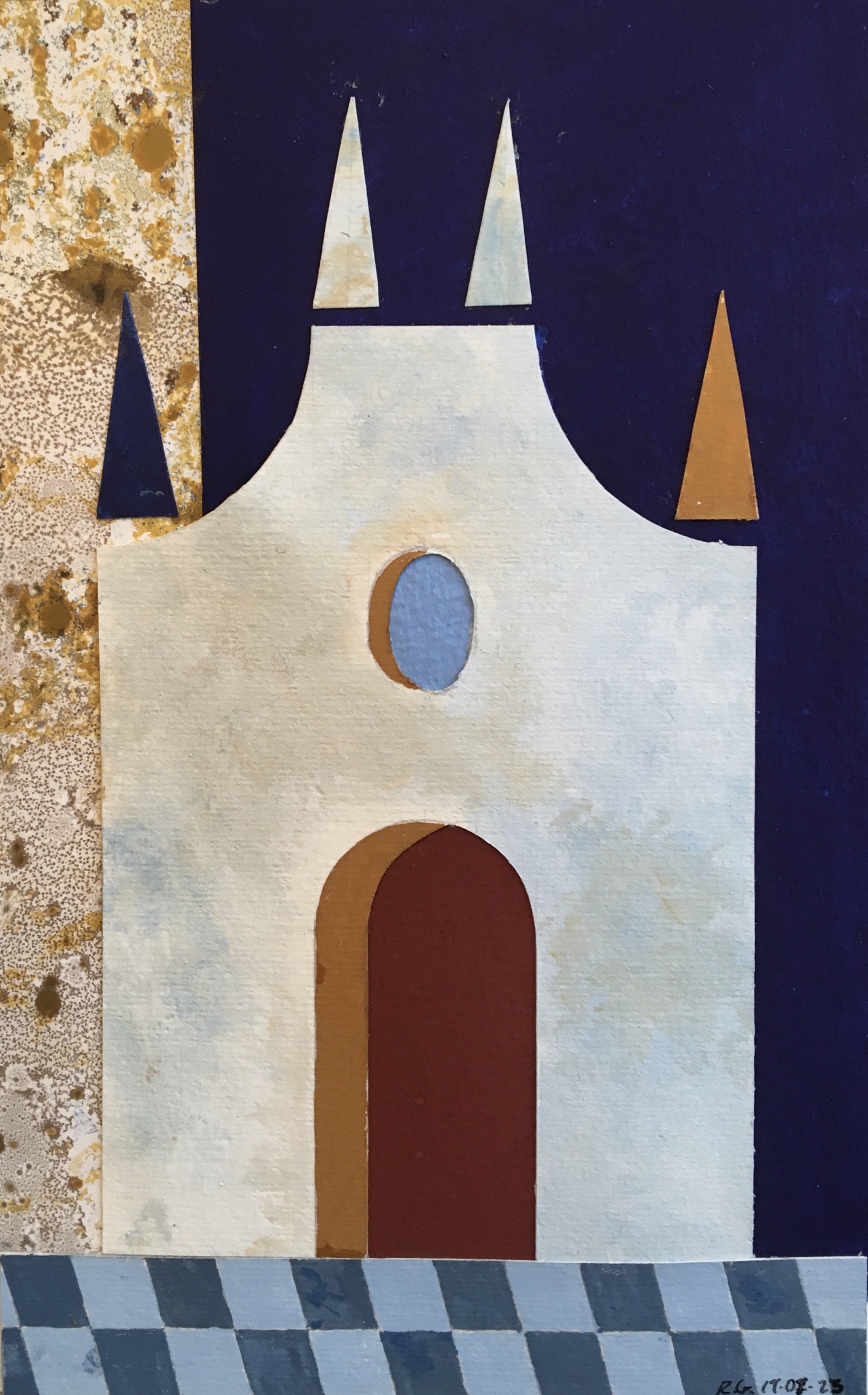
 Well, here I am sitting in the gallery at Aberglasney and tapping away at my keyboard. There is mist in the valley and the smell of woodsmoke on the air.  The sunshine is delicate and intermittent. Autumn is here in rural Wales. Here are some photos I have just taken of my current exhibition - it will last until close of play on Thursday. Enjoy.


Friday, 13 October 2023

St Mary-the -Virgin, Hay-on-Wye

     Off to Hay-on-Wye yesterday as a treat. And it was market day in that most middle class of communities. (Market towns are, unsurprisingly, always best experienced of a market day.) In the afternoon we ambled off to have a look at the parish church of St Mary-the-Virgin, which is, a little oddly, away from the medieval centre of the town, next door to what remains of Hay's other castle.

     It really is an odd mix of styles: medieval west tower, a preaching nave in the Georgian tradition (tho' technically Victorian) and a High Victorian chancel. The architect of the nave was Edward Haycock Snr and the chancel seems, according to 'Pevsner' the combined effort of Haycock (1834) and Nicholson (1866). I have no idea who either of them were. Thankfully the consistent use of local stone helps reconcile the parts and lower the temperature. The same cannot be said of the interior where nothing quite gels architecturally or when it comes to the furnishings. Sadly all a bit of a mess. 


Wednesday, 11 October 2023

Sir John Ninian Comper IV: 'Sir John Ninian Comper: An Introduction to his Life and Work'

     On our brief visit to Brecon the other month we found time to pop into that excellent second-hand bookshop 'Brecon Books'.  I rather over-spent on books that day, but I did find a copy of 'Sir Ninian Comper: An Introduction to his Life and Work' by Fr Anthony Symondson. It was published in 2006. As regular readers of this blog will know Comper is one of my favourite architects.  Apologies in advance if this post gets too arcane.


           'Philosphy helps, from Plato onwards, because it puts beauty in the right place as one of the three eternal values equal with truth and goodness so what applies to one of them is true of the others.'


     Sir John Ninian Comper, so Fr Anthony Symondson writes in this fascinating and long needed book 'sought beauty in a life-long quest'. I have chosen this quote to illustrate that Comper not only participated in the sensuous world but also that of the mind, and the spirit.  He was, for example, well-traveled and well read.  Comper's quest was a lengthy one; he was born in 1864 and died in 1960, aged 96 and with work incomplete. He was perhaps the greatest church architect working in Britain in the first half of the twentieth century, and was extraordinarily prolific; although designing a mere 18 or so churches & chapels he produced a myriad of church furnishings, stained glass and vestments. This enormous productivity means of course, that some of his work is better than others - this particularly true of the work he produced in his old age - but at his best work dazzles and entrances.  Some of it, I would argue, approaches the sublime. Of Comper's masterpiece St Mary, Wellingborough, the critic and historian John Julius Norwich wrote: 'All is confidence and conviction, the work of a man who was not afraid to take one gigantic breath of all he knew about architecture and all he felt about God, and let it all out together in one great bellow of praise.'  

    I suppose Comper isn't much thought of or about much these days - that is, after all, the fate of the overwhelming number of architects unless you're, say, Sir Christopher Wren.  He seems to be the architect most people have heard of, at least in the British Isles.  The paradox of course, is that Comper's work is very widely known indeed.  It was seen across the world at both the Lying-in-State of the late Queen, and at her State Funeral and at the Coronation of her son.  Such, I suppose is the nature of fame, or lack thereof.
     Comper is an architect, though, that has divided the critics. Betjeman was a fan (of sorts), as was the artist John Piper.  Kenneth Clarke offered an equivocal critical support.  In general the Modernists were not in approval.  Pevsner on the whole was not a fan; of St Cyprian's Clarence Gate he said, "If there must be medieval imitation in the twentieth century, it is here unquestionably done with joy and care" and "there is no reason for the excesses of praise lavished on Comper's church furnishings by those who confound aesthetic with religious emotions" (Ouch!); however of St Mary's Wellingborough, "It glistens and reveals to the heart's content."  Timothy Mowl said dismissively of Comper that 'he may or may not have been the most impressive British church architect of the twentieth century, but he was the most gloriously camp.'
     I must have been in my late teens when I first came across his work through reading the work of Sir John Betjeman in particular the Introduction to the 'Collins Guide to Parish Churches', and I was waxing in Anglo-Catholicism. My first actual encounter with his work was in the little church of St Mary in Great Ryburgh, deep in rural north Norfolk, where to my surprise there were battered copies of the English Missal in the pews.  Just why do Norfolk churches smell and feel so different from everywhere else?  My second in the Edwardian church of All Saints, Lincoln.  There was nothing particularly 'camp' in either church, or for that matter in the pristine austerity of either St Philip's, Cosham; or the All Saints Covent Chapel, at London Colney.

     Comper was born in Aberdeen of English parents. His father, the Rev'd John Comper, was a priest in the Scottish Episcopal Church - a friend of John Mason Neale and a slum priest in the Tractarian tradition. He was also a writer, and I think it one his books, 'A Handbook on the Origin, History, and Structure of Liturgies', which may help explain the intellectual outlook of his son.  This book, which strikes me as generous in its outlook, forms part of a long stream of Anglican thought that looked back to the early church for inspiration.  All newly founded Protestant churches made similar statements at the Reformation, but Anglicanism is the only one that took this claim seriously.  It was there in the work some of the Laudians, definitely there with the Nonjurors and it was there in the Scottish Episcopal Church, which in the mid-eighteenth century, had revised The Book of Common Prayer along 'primitive' lines.  And it was there too in the considerable unwritten liturgical tradition of the Episcopal church, particularly in the North-east of Scotland, that included such practices as the Dismissal of the Catechumens during the eucharist.
     Comper also took from his youth in Scotland a continuing interest in the architecture of Late Medieval Scotland. This is something that is not picked up in the book, but such details, like reticulated tracery and gabled buttresses which had remained in the Scottish architectural vocabulary long after they had been dropped south of the border, continually crop up in Comper's buildings and became more pronounced with time. To give one specific example; the west door of St Mary's Wellingborough is based directly on the Late Medieval west door of St Michael, Linlithgow.

     In 1883 Comper, aged 19, was articled to Bodley and Garner, one of the leading leading exponents of Late Gothic Revival in Britain. Along with the office of Richard Norman Shaw their office trained a whole generation of talent such as C R Ashbee and Robert Lorimer. Comper began work at one of the highpoints of architectural creativity in British history. A golden age.  Like a good number of his contemporaries Comper was in revolt against the increasing dis-enchantment of the world. Though he could not be classed as part of the Arts & Crafts movement Comper was interested in the use of local materials and styles. In addition his stained glass was made from scratch and 'in house'. This early work of his, his period of 'unity by exclusion', was solely within the Gothic tradition.  Comper took his immediate inspiration from the late Medieval architecture of these islands, but also looked elsewhere, even at that stage in his career, from places such as Belgium and Germany where he traveled to in 1879.  It goes hand in hand with a search by some High Church groups, such as the Alcuin Club, to rediscover, or define, a distinctive English ritual and liturgy.  It could also be thought of as his 'Northern' period.

     'A man should, from his youth, seek for forms which are beautiful.  at first he should love but one of them; then recognise the beauty which resides in one as the sister of that which dwells in another.'

     Comper's 'Southern' period - his period of 'Unity by Inclusion' - dates from his visits to Italy and in particular Sicily, where he encountered for the first time the world of Late Antiquity and Byzantium.  The churches on that island, such as La Martorana in Palermo, built by the ammiratus ammiratorum George of Antioch in the 11th century, with their acres of marble revetment and glass mosaic had an overwhelming affect on him and a new approach to design evolved. Although still within the framework of the Gothic, classical details and Byzantine iconography, such as the Pantocrator, began to appear in the furnishings and stained glass.  In addition, Comper adopted the planning of Late Antique churches; one can see this in two of his most important churches: St Mary Wellingborough, and St Philip Cosham.

     At the turn of the 20th century a similar same sort of process was happening in the world of British Classical music as had been happening for a number of years in the of  architecture, with the likes of Vaughan Williams and Holst searching for a specific national musical style. BBC4 recently screened a documentary on both composers , and I was particularly struck by what one of the presenters, Tom Service, said in regard to Vaughan Williams' masterpiece, 'The Fantasia on a Theme by Thomas Tallis'.  After quoting from a contemporary critic, A J Fuller Maitland of the The Times, who wrote:

 'Throughout its course one is never quite sure whether one is listening to something very old or very new. … But that is just what makes this Fantasia so delightful to listen to; it cannot be assigned to a time or a school, but it is full of the visions which have haunted the seers of all times.' 

     Service said that it was a work that compressed time. Well, that is what the liturgy and especially the eucharist does; except the eucharist compresses into to an unfolding series of moments past, present and future into a participatory whole. Comper's later work, I think, does something similar compressing Church history to a singular 'now'.  There is an element also of reconciliation going on between what might be thought of a conflicting styles.  And not just the Classical and the Gothic, but the Pre- and Post-Reformation. Gothic, Gothic Survival and Gothick. Modern and pre-Modern. It's as though he's presenting all of Anglican history in his buildings.* Sometimes he seems to be inventing an alternative future/alternative history as though the Reformation in England had taken a different trajectory. It's all rather like the work of the Inklings, particularly the Narnia sequence of C S Lewis that attempts to reconcile the Pagan and the Christian. You might even think of Comper's theory of beauty as a sort of Perennialism.  Perhaps, Comper's work is culmination of Anglican claims to be the inheritor of the Early Church.  Be that as it may Comper's work, and that of architects such as F C Eden and Temple Moore represents a culture that I find immediately appealing, but is now essentially moribund.

     All that said it pains me to say that I have some real misgivings about this book.  The index is less than thorough, though I've encountered worse. The exhaustive 'List of Works' is very welcome, but the way it is structured is far too complicated, perhaps even at times misleading. And there's the text itself. Isn't it obvious that chapel of the Chailey and the church of St Mary-in-the-Baum in Rochdale are linked? There are, for instance, similarities of plan and even have near identical nave ceilings!  But the author fails to pick up on these very obvious points.  However, I may well be missing the point of this book. It is, essentially, a lament for beauty, a lament for a certain form of Anglicanism and for the Anglican church itself.

* Comper was not alone in doing this in the 20th century. It was that sort of game that both Lutyens and Raymond Erith were both fond of.


Friday, 22 September 2023

Hill-Rhythms: David Jones and Capel-y-ffin


     It was in the Black Mountains that I made some drawings which it so happens, appear, in retrospect, to have marked a new beginning.  I began at this time to see the direction I wanted to go - or at least to see it more clearly.  My subsequent work can, I think, be truthfully said to hinge on that period. All my exhibited work dates from after that period, none, or virtually none, from before it.
     .....it was at this propitious time that circumstances occasioned my living in nant Honddu, there to feel the impact of the strong hill-rhythms and the bright counter-rhythms of the afonydd dyfroedd which makes much of Wales such a 'plurabelle' - and there was also the rhythm of the ninth wave breaking on the morlan of Penfro.'

     Very nearly a month ago, on our return journey to the Infernal City we stopped off in Brecon and 'Y Gaer' the rather architecturally vapid new 'cultural hub' (I posted about it here.) to see the current exhibition of paintings, drawings, prints and calligraphy by the twentieth century visionary artist/poet David Jones (1895-1974). Happily while the new building is sub-parr, the exhibition is most certainly not. It really is excellent, as is the catalogue written by Dr Peter Wakelin.

     I first came across the work of David Jones as a teenager on what was must have been my first visit to Kettle's Yard in Cambridge, the exquisite former home of a friend of Jones, the curator Jim Ede.  Here is my post about that extraordinary interior. If memory serves me well there are four works by Jones on display - all I think from later in his life.*  This excellent exhibition, however, focuses on the two short years when Jones lived intermittently at Capel-y-ffin in the Honddu valley deep in the Black Mountains close to the English Border.  An isolated place far removed from the world, that had attracted artists such as Turner & John Sell Cotman in the nineteenth century and Ravilious & Piper in the twentieth. Jones called it 'an enchanted place'.

     Jones moved to Capel-y-ffin in 1924 when he was 29 years of age and engaged to Petra, the daughter of the artist/craftsman Eric Gill. Jones was then a postulant in the Guild of St Joseph and St Dominic which Gill, along with Hilary Peplar had set up in 1920 for Catholic craftsmen, at Ditchling just below the South Downs, in Sussex. As a guild member Jones was also a third order, or Tertiary, Dominican, though apparently not through enthusiasm, but because it was simply what one did there. 
     A lot of words have been spilt about Gill since the publication of Fiona McCarthy's biography of the craftsman/artist in 1989.** I don't want to add too many more, but I will quote something the science fiction writer Frank Herbert said about charismatic leadership: 'I had this idea that charismatic leaders ought to come with a warning label on the forehead: 'May be dangerous to your health.'  Well, Gill, for all his talents, certainly turned out to be dangerous to the health. It is certainly tempting to view Gill, who lived a life of extreme contradiction, like a Late Sixties guru figure, surrounded by a small coterie of admirers and their families. 
     In a strange act of synchronicity Gill established his new community at Capel-f-ffin in the collection of buildings left by a failed Anglican religious community established by the so-called Fr Ignatius, a charismatic leader not unlike Gill. Both men were governed by their vanity, their ego. Both men had troubled relationships with their sexuality. And their attempts at community living eventually failed.***

     Walter David Jones was born in London of an Welsh father and English mother, and he was to remain an essentially, and paradoxically, urban artist. His early life was lived on the suburban fringes of the capital, and it was there he began to identify not with the surrounding culture with its increasing disenchantment, but with that of his father and in particular with the British Heroic Age - the world of the Mabinogion and Arthur; of Y Gododdin and Aneurin; of Taliesin and the Hen Ogledd.  He ditched his first name as too English, in favour of his second.  All, I would suggest, examples of Jones's growing estrangement from urban Modernity, and his mother's culture and, perhaps, even his mother. In researching this piece I got side-tracked by the story of another charismatic anglo-catholic monastic, Aelred Carlyle, abbot of the anglican monastery he established on the island of Caldey off the coast of Pembrokeshire; in particular I was struck by a comment made by the novelist Dame Rose Macaulay in her Forward to Peter Anson's biography of Carlyle. She said of Carlyle that 'He seemed to live from boyhood in a romantic dream.' Well, I wouldn't go that far in my description of Jones, but there is an element of truth to it. I think he came to live in a world of the imagination, in the 'imaginal realm' perhaps.
     At the age of 14 he started his formal art education at Camberwell School of Art. In 1915, at the age of 20 and in the second year of the Great War, and after at least one previous attempt to enlist, Jones enrolled in the Royal Welch Fusiliers. He never quite recovered from his experience of the Western Front; his adult life being repeatedly disrupted by prolonged periods of mental ill health. The War, I suspect, exacerbating pre-existent issues. 
     Upon his return to civilian life at the end of the War Jones returned to his education. In 1921 he converted to Roman Catholicism and the catholic faith would remain crucial to Jones and increasingly at the heart of his work. It was at the suggestion of the priest preparing him for Baptism that Jones came into contact with Eric Gill and the community he and others had created at Ditchling. He was not the only man damaged by his experience of war to find solace in the life of the community.
     In 1924 the life of the Guild was seriously disrupted by Gill's decision to leave for Capel. The situation became rancorous and resulted in Gill leaving the Guild as well as Ditchling. Gill's departure left a residue of bitterness among those who remained in Sussex and continued with the Guild. A bitterness that lingered for decades.  Yet for all the disruption, the unhappiness it caused for some, the move to Capel formed for Jones some sort of integration, or axial alignment; like his conversion to Roman Catholicism a homecoming of sorts. He had essentially entered into his own mythos.  After the horrors of war he had become re-enchanted.  The effect on his art was immediate; a new style sprang, like Minerva from the head of Jovis, fully formed.
     His reaction to this new environment is illustrated in fifteen landscape paintings - mixed media, mainly watercolour and ink - from this important period in Jones's career, and which form the core of the exhibition. A clear line of development is readily apparent as the style becomes increasingly dense and complex. The influence of Gill and Paul Nash is readily apparent. 
     A continual presence in these paintings was Twmpa, the mountain at the confluence of the Nant Bwch with the River Honddu, a breast of consolation, that reminds me of the presence of Mont St Victoire in the late works of Cezanne.
     In some paintings, most obviously in 'Melting Snow' of 1925 where a hillside looks like a woman's breast and belly, Jones anthropomorphises the landscape. 
     The opposite applies to at least one of the three large portraits at the exhibition, that of Gill's daughter Petra, 'Petra in Rosenhag', dated 1931 with her slyly erotic expression, in which the folds of her dress are metamorphosed into a landscape.  A painting, I have to say, that is an altogether different league from the other portraits that surrounds it.  Evidence, one feels, for a continued emotional link between sitter and artist long after the end of their engagement. 
     There is, I believe, the outline of Twmpa between the sitter's breasts - one might say over her heart. Peter Wakelin is surely right to describe this image as archetypal. It is iconic - in the original and correct meaning on the word; for Jones here presents Petra as the Jungian archetype of the Great Mother, here as the guardian of the 'Vegetation Mysteries', her right hand nestling sensually in the deep, cave-like folds of her dress.**** And yet for all the great sensuousness of this painting there lies threat also; the flowers are benign enough but the wisps of Petra's hair, like dry, winter twigs, suggest a wilder nature.
     Space is also given to the applied art he made at Capel such as his woodblock prints, and examples of his late work, both painting and calligraphic. The result forms an excellent introduction to Jones's life and work for those who come to him fresh. 

     Those years at Capel-y-ffin were longest period Jones was to spend in the Principality. With the collapse of his relationship with Petra Gill he returned to his parents in London and apart from the odd short visit, he was to remain in the capital for the rest of his life. Wales became, as Shropshire did for A E Housman, a 'land of lost content'. In a sense it was a life lived in exile


       In 2015 The Guardian ran an article suggesting that we were in for a revival in interest in David Jones. Well, sadly, it hasn't happened. For all the recognition he received from the likes of T S Elliot and Kenneth Clarke, I suspect it never will; at least not in our current cultural climate which is among so many other things, deeply secular.  I think this is reflected, sadly, in the lack of media attention this excellent exhibition received.  Jones and his work is, now, simply, beyond our comprehension.
    In the later works, for example, there is a deeply personal and complex symbolism that perhaps defies categorising.  It is also the work of somebody with 'issues', rather like the work of the nineteenth century English artist Richard Dadd whose late work shares certain characteristics with late Jones.  I place him, not only in the broad sweep of Romanticism and Neo-Romanticism, but more specifically in a continuum with Blake and his followers such a Samuel Palmer, though Jones's work evokes none of disquiet, or unease found the work of Blake. One feels that all four of these artists had somehow been in contact with the 'unseen' - whether that is internal or exterior to themselves, I don't know, and for the majority of people that is, perhaps, something disturbing.

     Jones will always to a lesser or greater extent remain an outsider. 


* I remember three images in particular: the painting 'Flora in Calix Light, 1950; and the calligraphy: 'Quia incarnatus est' of 1953, 'Tailpiece for the Rime of the Ancient Mariner' of 1928 
** Fiona MacCarthy, 'Eric Gill', Faber and Faber, London, 1989
*** The relationship between both Gill and 'Fr Ignatius' and Dom Aelred Carlyle is fascinating, but beyond the scope of this post. But essentially all three were to some point fantasists driven by their egos, which if they were to achieve what wanted they should have endeavoured to brake. Gill, for instance, was once described as 'A fine draughtsman, a vain poseur, a tiresome writer....he behaved like a vain willful child.'
**** See Erich Neumann's 'The Great Mother: An Analysis of the Archetype', 1963

Wednesday, 20 September 2023

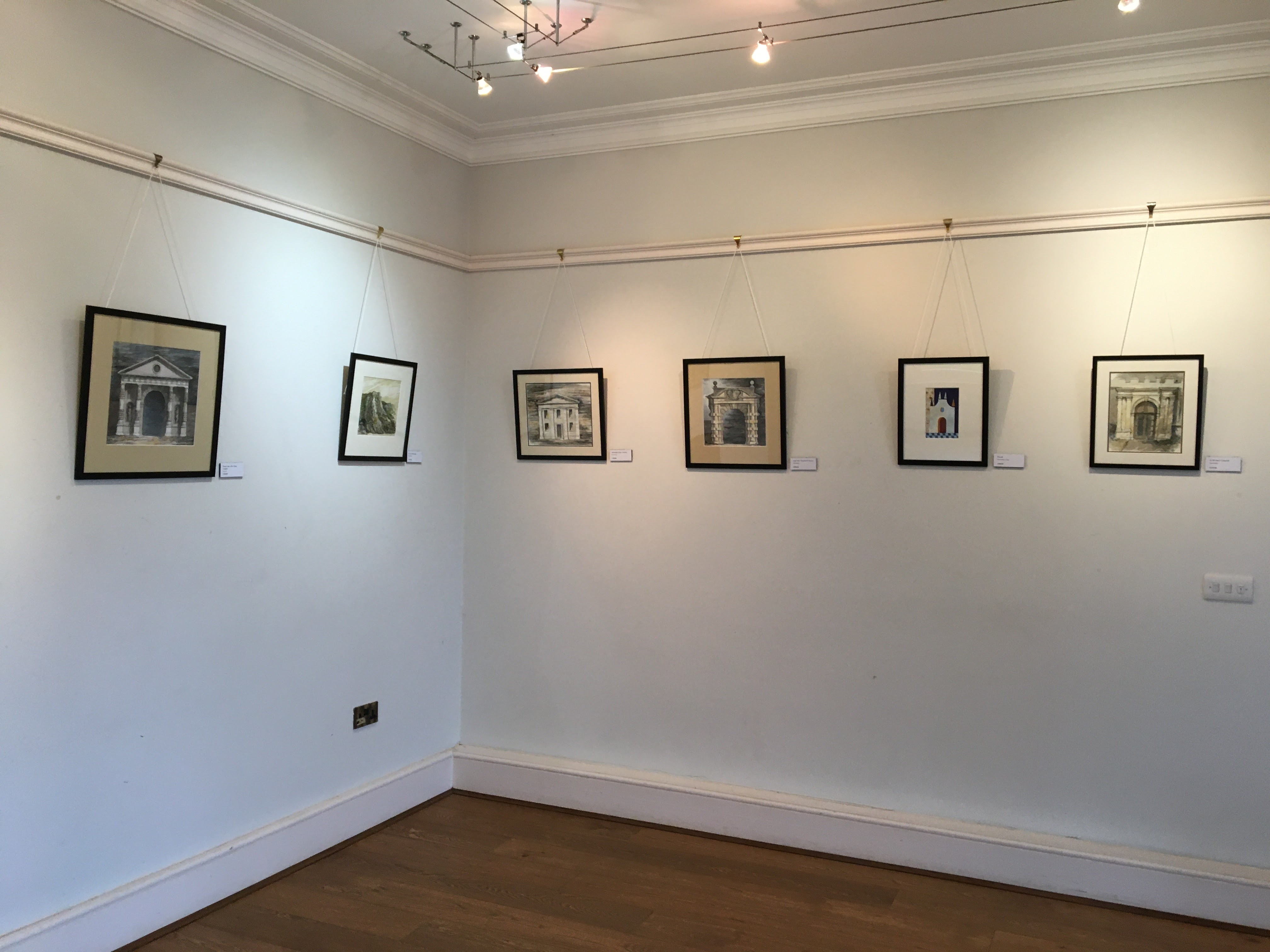
Own work: collage

     A collage!  It's been a while since I made one of these.  Not sure as to the title as yet.  Anyway 12 x 19cms, 'home-made' marbled paper and gouache on watercolour paper.


Exhibition

     It's now a month until my solo exhibition (20th-26th Oct) at Aberglasney Gardens in Carmarthenshire (just off the A40 between Carmarthen and Llandeilo).  If you're around pop-in!  Gardens open 10am and close at 6pm (last entry at 5pm).


Tuesday, 12 September 2023

Own work: West Walton

     The latest finished painting ahead of my exhibition in October: The Bell Tower, West Walton. 28 x 52.5 cms, mixed media on watercolour board.

     West Walton is one of architectural sights of Britain - a mighty detached bell tower, sophisticated Early English Gothic, except for the parapet and pinnacles. West Walton is in the extreme west of Norfolk on the silt fen, and is one of a number of excellent parish churches to be found between the rivers Nene and Great Ouse.