Sunday, 24 July 2022

An afternoon of 'Folk Horror'

     Well, the warm, rosy glow of the exhibition has faded over the intervening weeks and I'm back to unhappy. Work is hardly progressing. Thursday afternoon I ended up watching two BBC dramas with occult/paranormal themes: 'The Beast', 1981, and part of the 'West Country Tales' series and the remarkable 'The Stone Tape' of 1972.

    'The Beast' is a tale of haunting - of sorts. The agent is not spiritual but something quite physical and quite, quite ancient. A survival. A wildman, occupying the space between the human and the bestial. A cryptid, but also, simultaneously, a creature from out of the depths of English and European folklore. A Wodewose. Perhaps even from the dark corners of our own collective sub-conscious. The story is set on a farm deep in the Cornish countryside. The first encounter with the creature occurs within the wild wood, leading one to think that perhaps the wildman was merely the genius loci of the woods, a pan-like creature; however the second encounter takes place in the domesticity of the farm itself several years later. 

     And on to the main feature, the confrontational and quite disturbing 'The Stone Tape' written by Nigel Kneale who also, and famously, wrote the Quatermass series and the controversial, but prophetic  'The Year of the Sex Olympics'. 'The Stone Tape' is something that has come down to us therefore from the Golden Age of British broadcasting. Like 'Quatermass and the Pit' before it 'The Stone Tape' attempts to provide a rational explanation for paranormal activity. 

     The setting is a nineteenth century Gothic country house. Quite an outlandish place. (The decidedly wilful Horsley Towers in Surrey) The place has stood empty for years and has been recently bought by an electronics company. The action centres on the R & D department, which is under the gimlet eye of the demanding, maddening, driven Peter, played by the admirable Michael Bryant. A rare appearance on the small screen too for which we should be grateful. He was a great actor but worked almost exclusively on the stage. And there is Jill Greeley, played by Jane Asher, she is a sensitive - 'the type that hurts easily'. But then they are both characters on the edge. Around them is an excellent ensemble of actors including Ian Cuthbertson, Michael Bates and James Cosmo.

     Almost immediately things begin to go wrong. Cuthbertson's character, Roy Collinson who has been on site for months, it is soon apparent knows a lot and guesses the rest but is 'economical with the actualite'. Events follow events in rapid succession. There is a relentlessness, a constant intensity, to this drama that must have been exhausting work for the actors. The paranormal activity centres in a single room in the house - part cellar, abandoned. An ancient space. The builders working on the restoration of the house refuse to work there. Both Peter and Jill become obsessed with what it contains. Peter's attitude is purely utilitarian, all surface; he quickly assesses (correctly) that the room acts as some sort of recording device. He thinks it might be of some commercial value. And unhappily it is as much Peter's attitude, as it is the paranormal activity, that drives his team members to madness even death.  With possible exception of Jill, Peter and his team fail to recognize the 'recordings' represent some sort of trauma, that they are not merely chance events but are caused by another, as yet unseen, agency.

     It is perhaps unsurprising that 'The Stone Tape' shares certain themes with another of Kneale's work 'Quatermass and the Pit' of 1958/9; the abandoned property; the sensitive, slightly neurotic, female assistant; the decent into madness of individuals and groups; the intrusion of the deep past into contemporary (post-war) Britain. Both films do indeed find a logical explanation for the horrendous events, but fourteen years is a long time and the narrative of progress has collapsed; in the end 'The Stone Tape' can only offer a partial explanation. Certainly no rational explanation, because the boundary of science has been reached and beyond lies the realm of the spirit.

Monday, 20 June 2022

Exhibition

     Back to Aberglasney in Carmarthenshire for what has turned out to be my annual summer exhibition there. And I was blessed with quite a success this year, selling more pictures than at any of my previous exhibitions. Many thanks to the lovely people at Aberglasney for helping make it all happen.


Thursday, 9 June 2022

God Save the Queen! Platinum Jubilee pt 3

     Well, the Jubilee is over, but time, I hope, for one last hurrah - albeit a small but delightful one! This letterpress poster is the co-operation of the equally wonderful Tinsmiths and Talley Printers, both denizens of Ledbury in Herefordshire.


Monday, 30 May 2022

God Save the Queen! Platinum Jubilee pt 2

     Another Jubilee delight for you! This time a delightful, rather spiffing poster from the good folk of Cambridge Imprint. God Save the Queen!


Saturday, 28 May 2022

Bristol

     My first visit. A week ago now, and I'm not at all sure what to make of it. Perhaps a weekday would have been preferable to a Saturday, but there you go. There was family to meet. It was overwhelmingly busy and noisy, and I was, I have to admit, very tired. There was a sort of restlessness if not aggression in the air. Everything was brash, and a little scuzzy. It remined me in places of Camden Town, and that isn't a good thing. The urban layout difficult to comprehend, even in those areas of the city that hadn't been bombed or razed to the ground in Post-War redevelopment. Redcliffe was particularly wrecked through the co-operation of the Luftwaffe and urban planner. Not exactly the New Jerusalem. In common with most British cities the twentieth century was unkind to Bristol. And, I presume, that attitude to the City is only bound to continue. I think it only fair to add that I'm becoming increasingly disillusioned with urban life in general. The market town and now the village are much more preferable.  

     I should also now say that as I was there with both the bf and my brother I didn't take that many photos - there are, for instance, none of the cathedral. I know I shall have to return, for all that said above about the deleterious effect of Modernity on the city there is some very fine architecture in Bristol, too much to take in in one day, and in particular all of the buildings I'll discuss warrant a post of their own. This post then, alas, is a rather cursory view of the architecture of the city. 

      St Mary Redcliffe was our first point of call. It is a dazzlingly suave and sophisticated piece of Late Gothic architecture, almost without parallel amongst the parish churches of England. I can think of no other that is so thoroughly and consistently vaulted. Church as reliquary. Quite spectacular, and, I wonder, an influence on Robert & William Vertue's design for Bath Abbey. Just s of the church is Colston Row which gives a glimpse  - a tattered fragment, alas - of what the urban fabric was like in Redcliffe before the 20th century. 

     We walked w from St Mary Redcliffe to the cathedral via the restored Queen's Square - hard to comprehend that the planners actually sent a dual carriage way diagonally across this wonderful green space in the 1930s - and the Floating Harbour. (A quick diversion to the Arnolfini Gallery and its aggressively noisy café.) And so to the Cathedral, and somewhat muted response from us even though when built it was one of the most sophisticated buildings in Europe. Almost next door is Charles Holden's rather good 'Free Style' Bristol Central Library (under the influence of Charles Rennie Mackintosh), design that seems to presage what would be the growing froideur, if not outright anomie, of architectural design as the 20th century progressed. Across College Green is Vincent Harris's gargantuan Neo-Georgian Bristol City Hall where the rear façade is much more interesting, and inventive, than the official front, which is understated almost to the point of boredom. More froideur, but at least he attempted a monumental classical building without recourse to the cliché of a pedimented portico.

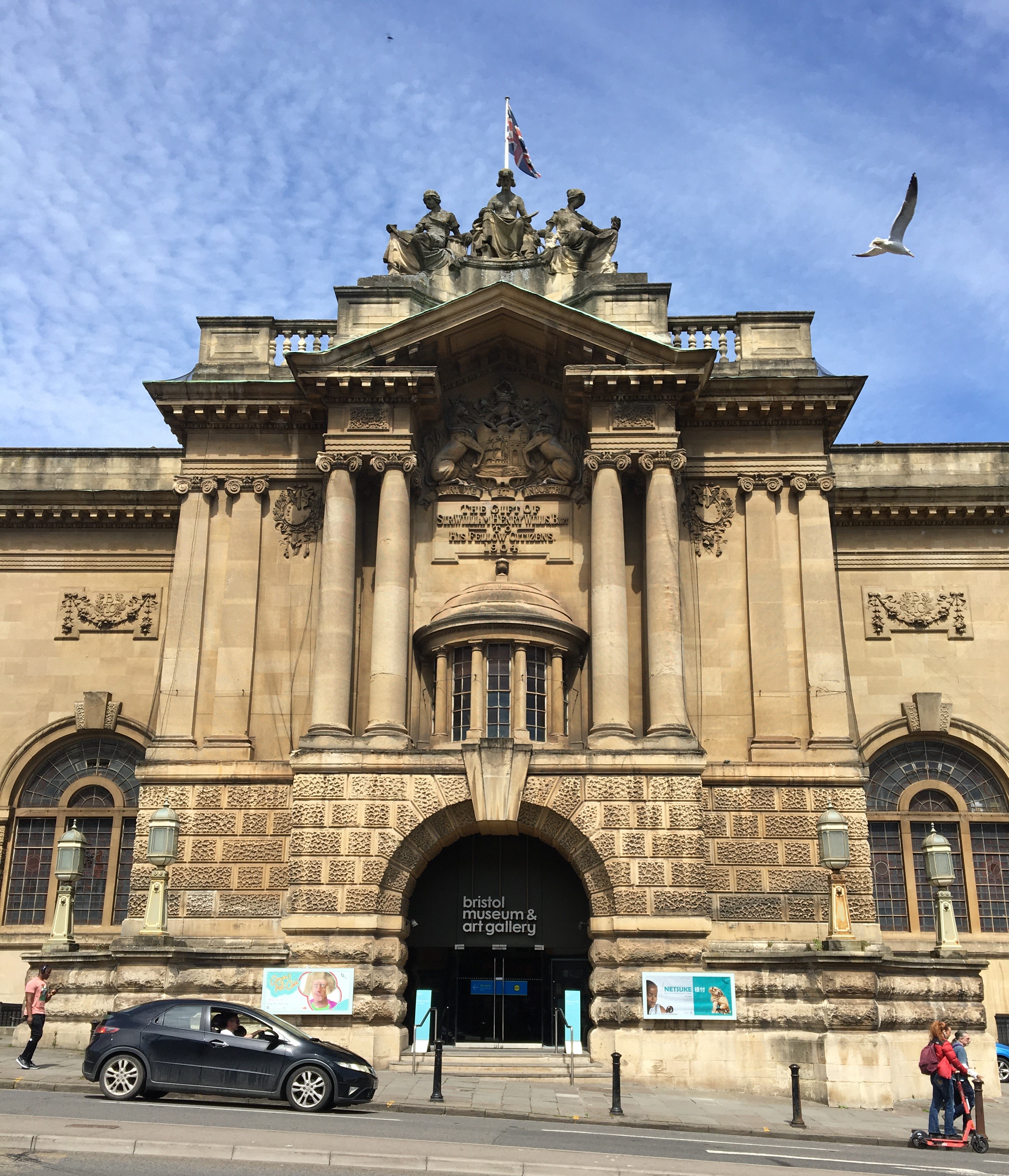
     From there up Park St, where the architecture is as fine as Bath. And there we took  lunch at Pinkmans Bakery. Crowning Park St is the colossal Wills Memorial Tower designed by Sir George Oatley as part of the University of Bristol. What can one say about this extraordinary structure? It quite dominates the other parts of this complex of buildings that Oates designed to go with it. It is a building of superlatives, beautifully massed and detailed in a free Late Gothic style with a nod to the Arts and Crafts movement. Next door is an equally massive, substantial piece of architecture the Bristol Museum and Art Gallery; Edwardian Free Style Baroque and like all the buildings discussed here built of the lovely local stone.


Tuesday, 24 May 2022

God Save the Queen! Platinum Jubilee pt1

     Just had to have this! Perhaps one of the best designed the new commemorative items issued for this remarkable Jubilee - yes, I know I am biased! And it is a snip too. God Save the Queen!


Monday, 16 May 2022

Own work: Aberglasney:

      Ahead of my forthcoming exhibition at Aberglasney I've created this mixedmedia image of the house. All rather John Piper, which - I have to be honest - was not quite what I was out to achieve, however I do seem to have regained a more confident approach than the hesitant approach I took in that painting of St Cathan's church recently uploaded here.